You find a trending design idea. You spend three hours creating it in Canva. Another hour shooting mockups with your phone. Then 30 minutes per platform writing listing copy, Etsy titles, TikTok descriptions, Instagram captions. By the time you're live across all channels, the trend has moved on.
This is the reality most POD sellers face. But here's what's changing: AI now automates the entire print on demand workflow. From trend discovery to design creation, mockup generation to multi-platform publishing, what used to take days now happens in minutes.
Learning how to use AI for print on demand isn't optional anymore. It's the difference between capturing trends early and watching competitors move faster. The POD market is projected to grow from $10.21 billion in 2024 to $102.99 billion by 2034, with 40-65% of sellers already adopting AI tools by 2026. The sellers who master AI workflows now gain advantages that compound with every product launch.
This guide shows you exactly how to use AI for your print on demand business, from choosing the right tools to building complete automated workflows that save time while scaling output.

What is AI for Print on Demand?
AI for print on demand uses artificial intelligence to automate the complete POD workflow, from design creation and mockup generation to listing optimization and fulfillment integration. Instead of spending hours on manual tasks, AI tools generate print-ready designs, professional mockups, and platform-optimized listings in minutes, letting POD sellers focus on strategy and growth rather than repetitive execution.
The technology has evolved dramatically. Early POD automation meant basic templates and bulk upload tools. Today's AI for print on demand handles creative decisions, generating unique designs from text prompts, creating lifestyle mockups with virtual models matched to your audience, and writing SEO-optimized listings tailored to each platform's algorithm.
According to Precedence Research, the global print on demand market was valued at USD 10.21 billion in 2024 and is expected to reach around USD 102.99 billion by 2034, expanding at a 26% CAGR. AI adoption is accelerating this growth; by 2026, an estimated 40-65% of POD sellers are using AI-driven design solutions.
Here's what AI handles in modern POD operations:
Design generation: Text-to-image AI creates unique designs from prompts. Describe your concept, and AI produces print-ready artwork in specific styles, colors, and compositions.
Mockup creation: AI generates professional product photography without photoshoots: lifestyle shots with virtual models, multiple angles, contextual scenes, and even video mockups.
Listing optimization: AI writes platform-specific titles, descriptions, and tags optimized for each marketplace's search algorithm (Etsy SEO, TikTok trending hashtags, Shopify product copy).
Trend discovery: AI analyzes search trends, social media signals, and competitor data to identify emerging opportunities before markets saturate.
Order automation: AI routes orders to fulfillment providers automatically, tracks production, and updates customers with less manual work.
The result? Research from Formstack shows that 60% of employees save 30% of their time with automation tools. For POD sellers, this can translate to launching products in minutes instead of hours while maintaining professional quality.
Why Use AI for Your Print on Demand Business?
The POD business model works when you can move fast and scale efficiently. AI makes both possible without proportional increases in time or cost.
Massive Time Savings
Time is your most constrained resource. Every hour spent on design work or listing creation is an hour not spent finding trends or growing your business.
The numbers are striking. According to Formstack, McKinsey estimates that 60% of employees could save 30% of their time with workflow automation. For POD sellers, the savings can be even more dramatic:
Design time: AI design generation takes ~60 seconds versus 2-3 hours for traditional design work.
Mockup creation: Professional lifestyle mockups generate in under 60 seconds with AI.
Listing creation: Writing SEO-optimized titles, descriptions, and tags for a single platform takes 15-30 minutes manually. AI can generate platform-specific copy for Etsy, TikTok Shop, and Shopify simultaneously in minutes.
Bulk operations: One POD seller documented reducing costs from $600/week using manual processes to $150/month with AI automation, while doubling output from 3,000 to 6,000 products monthly.
This time savings compounds. Launch five products instead of one. Test ten variations instead of three. Capture trends at peak demand instead of after they've cooled.
Lower Costs and Higher Margins
Professional design, photography, and marketing used to require expensive contractors or agencies. AI can eliminate many of these costs while maintaining quality.
Design expenses: Hiring designers costs $25-100+ per design. AI design generation costs pennies per iteration with effectively unlimited variations.
Photography costs: Professional product photography runs $500-2,000 per session. AI mockup generators create unlimited lifestyle shots with virtual models for a flat monthly subscription.
Marketing content: Product descriptions and SEO copy either cost your time or copywriter fees. AI copywriting generates content instantly.
Scale without proportional costs: With manual processes, doubling output means doubling expenses. With AI, costs can stay relatively flat while output scales.
Case study from GetPrintbox: Vistaprint saw a 15% improvement in design accuracy and 20% jump in customer engagement within six months of implementing AI tools.
Better Quality and Consistency
AI doesn't just work faster, it can maintain quality standards consistently across many products.
Professional mockups increase conversion rates significantly. Research shows that listings with professional mockups can see 35% higher conversion rates compared to basic flat-lay images.
Platform-specific optimization improves discoverability. Etsy's algorithm prioritizes specific title structures and tag combinations. TikTok Shop rewards trending hashtags. Shopify values detailed descriptions. AI tools can optimize differently for each platform.
According to PeaPrint, Etsy listings with videos appear in 38% more search results in 2025. Videos also drive 26% better sales performance. AI video mockup generators make this format accessible without video editing skills.\n+\n+> Note: The PeaPrint source and stats reference 2025; the overall guide framing has been updated to 2026.
Brand consistency matters for long-term success. AI can help maintain style guidelines across many products (color palettes, composition rules, brand voice in copy).
Competitive Advantage
The POD market is increasingly competitive. AI provides speed and intelligence advantages that compound over time.
Speed to market: When a trend emerges, you often have a 48-72 hour window before market saturation. AI workflows can take you from trend identification to live product in under an hour.
Multi-platform presence: Selling on multiple platforms multiplies reach but also workload, unless AI handles platform-specific optimization.
Data-driven decisions: AI can analyze what's working based on performance data, not guesswork.
First-mover advantage: Being early to emerging niches means less competition and higher margins.
The 5 Ways AI Transforms Print on Demand
AI doesn't just speed up existing processes, it changes what's possible.
1. AI Design Generation
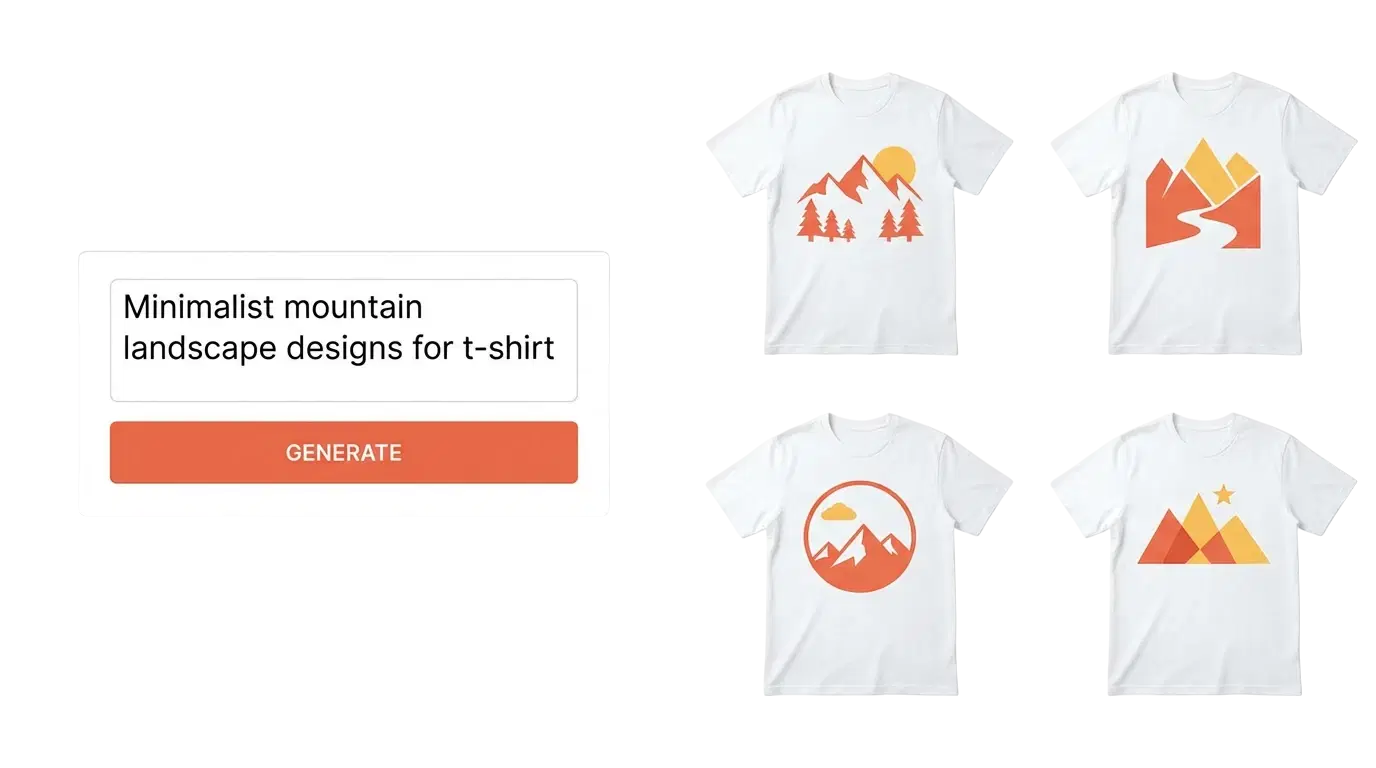
AI design generation takes text descriptions and creates unique, print-ready artwork in seconds.
Tools like Midjourney, DALL-E, Leonardo.ai, and Printify's AI Image Generator turn prompts into designs. POD-specific platforms like Vaybel's AI Design Generator go further by handling placement optimization, variants, and print-ready export.
Prompt tips for better results:
- Be specific: “Minimalist mountain landscape, line art style, black and white, clean background” is better than “mountain design.”
- Include style references: “vintage travel poster” or “Bauhaus-inspired” helps the model hit the target aesthetic.
- Use negative prompts: “no text, no watermarks, no complex details.”
- Iterate systematically: change one variable at a time (style, composition, colors).
Commercial rights are critical. Always verify licensing terms before selling AI-generated designs.
2. AI Mockup Generation
AI mockup generation creates studio-quality product images without photoshoots.
Modern tools create lifestyle shots with virtual models, contextual scenes, and multiple angles. Advanced tools can generate virtual models matched to your target demographic.
According to Mockey, Etsy listings with video mockups sell 26% better than static-only listings.
POD-specific tools like Vaybel's AI Mockup Generator can generate complete mockup sets (lifestyle, flat lay, detail shots, and video) quickly.
3. AI Listing Optimization
Your product needs to be discovered before it can be purchased. AI listing optimization handles SEO, copywriting, and platform-specific requirements.
Each platform ranks differently:
- Etsy: keyword-rich titles + tags
- TikTok Shop: trend alignment + hashtags + video
- Shopify: detailed descriptions for Google Shopping/SEO
A tool like Channel Merchandiser can generate platform-optimized listings so one design becomes multiple tailored listings.
4. AI Trend Discovery
AI trend discovery surfaces opportunities before competition saturates markets.
Tools monitor signals like search trends, social momentum, competitor performance, and seasonal patterns. Platforms like Vaybel's Trend Finder connect trend discovery to product creation.
5. Workflow Automation and Integration
The biggest gains come from connecting everything:
- Design → Mockups
- Mockups → Listings
- Listings → Publishing
- Orders → Fulfillment
End-to-end workflows reduce tool switching and manual repetition. This is where integrated systems outperform “stacking” disconnected tools.
How to Use AI for Print on Demand: Step-by-Step Tutorial
Here’s a complete tutorial to create your first AI POD product from trend to live listing.
Step 1: Set Up Your AI Design Workflow
- Choose a design tool (Midjourney, DALL-E 3, Leonardo.ai, or a POD-specific platform).
- Connect a fulfillment provider (Printful, Printify, Gelato).
- Select a product catalog and configure export specs (typically 300 DPI).
Step 2: Research Trending Niches with AI
- Use trend discovery tools.
- Analyze competitor listings.
- Validate niche potential (demand, competition, fit).
Step 3: Generate AI Designs
- Write specific prompts.
- Generate 5-10 variations.
- Refine outputs (remove artifacts, adjust colors, ensure print quality).
- Export print-ready files.
Step 4: Create AI Mockups
- Generate lifestyle shots, flat lays, and (ideally) video mockups.
- Export in platform-friendly sizes (Etsy often benefits from large images; social platforms prefer square/vertical).
Step 5: Optimize Listings with AI
- Create platform-specific titles, descriptions, and tags.
- Tailor to each platform’s discovery mechanics.
Step 6: Publish Across Multiple Platforms
- Publish to Etsy, TikTok Shop, Shopify (and optionally Instagram Shopping).
- Keep formatting aligned to each platform.
Step 7: Monitor Performance and Iterate
Track:
- CTR (mockup + title effectiveness)
- Conversion rate
- Returns/refunds
- Platform margin differences
Scale winners; retire losers.
Best AI Tools for Print on Demand in 2026
AI Design Tools
- Midjourney: strong aesthetic outputs; commercial use on paid plans.
- DALL-E 3: beginner-friendly via ChatGPT.
- Leonardo.ai: free tier and style consistency.
- Canva AI: templates + AI; can feel generic.
- Vaybel AI Design Generator: POD-specific design + export + workflow.
AI Mockup Tools
- Placeit: huge template library.
- Mockey: free tier.
- Printful mockups: free for Printful catalog.
- Vaybel AI Mockup Generator: virtual models + lifestyle shots + sets.
Workflow & Publishing
- Printify AI tools: useful if you’re staying inside Printify.
- Flying Upload: bulk listing workflows.
- Vaybel Channel Merchandiser: multi-platform optimized publishing.
Trend Discovery
- EverBee: Etsy-focused research.
- Vaybel Trend Finder: multi-signal trend discovery tied to product creation.
Platform-Specific AI Strategies
Using AI for Etsy Print on Demand
Etsy prioritizes titles/tags and listing quality. See the Etsy Seller Handbook for fundamentals.
2026 considerations include stronger natural-language query matching and growing emphasis on video.
Using AI for TikTok Shop POD
TikTok Shop is content-first: trending hashtags, creator-friendly visuals, and video matter most.
Using AI for Shopify POD
Shopify is “owned media”: optimize for Google SEO, conversion rate, and marketing automation.
AI POD Best Practices
Don’t Use Raw AI Outputs
Always refine outputs:
- Remove artifacts
- Adjust colors for printing
- Add unique elements
- Test on product templates
Ensure Commercial Rights and Copyright Compliance
See the U.S. Copyright Office guidance on AI and Congressional Research Service overview.
Optimize for Each Platform
Avoid copy/paste listings across channels. Tailor titles, tags, images, and video formats per platform.
Test and Iterate
A/B test mockups, pricing, and angles. Use unified analytics when possible.
Common Mistakes to Avoid with AI POD
- Using copyrighted style prompts (“Disney-style,” “Marvel-style”)
- Publishing raw outputs without editing
- Ignoring platform requirements
- Low-quality mockups
- No legal diligence
- Duplicate listings across platforms
The Future of AI in Print on Demand
AI adoption will continue rising; the advantage shifts from “using AI” to “using AI well.” Buyers and platforms will expect higher quality, and the differentiator becomes judgment: curation, brand consistency, and fast execution on the right opportunities.
Conclusion
AI removes friction between your ideas and execution.
The full workflow from trend insight to live listing can shrink from 10-20+ hours to 30-60 minutes with AI. That speed compounds across every product and every trend window.
Ready to build an end-to-end AI POD workflow? Start with:
Frequently Asked Questions
Can you use AI-generated images for print on demand?
Yes, provided you have proper commercial licensing and add human editing. See U.S. Copyright Office guidance for how human authorship impacts protection.
What is the best AI tool for print on demand?
It depends on your needs (design vs mockups vs publishing). Many sellers get the best ROI from an integrated workflow rather than juggling multiple tools.
How much time does AI save in print on demand?
Studies like Formstack’s automation roundup cite meaningful time savings from automation; in POD, the biggest wins come from compressing multi-step workflows end-to-end.
Is AI print on demand legal and ethical?
It can be, when you follow licensing terms and avoid copyrighted prompts. See the CRS overview.
Do AI-generated designs sell well on Etsy?
They can, especially when refined and paired with professional mockups and strong Etsy SEO.
How do I start using AI for print on demand?
Pick a niche, generate 5-10 designs, create mockups, publish 3-5 listings, then iterate based on real performance.
What AI prompt should I use for print on demand designs?
Use prompts that specify subject + style + palette + composition + print constraints (e.g., “vector-style,” “clean background,” “no text artifacts”). For more: /resources/pod-prompts.