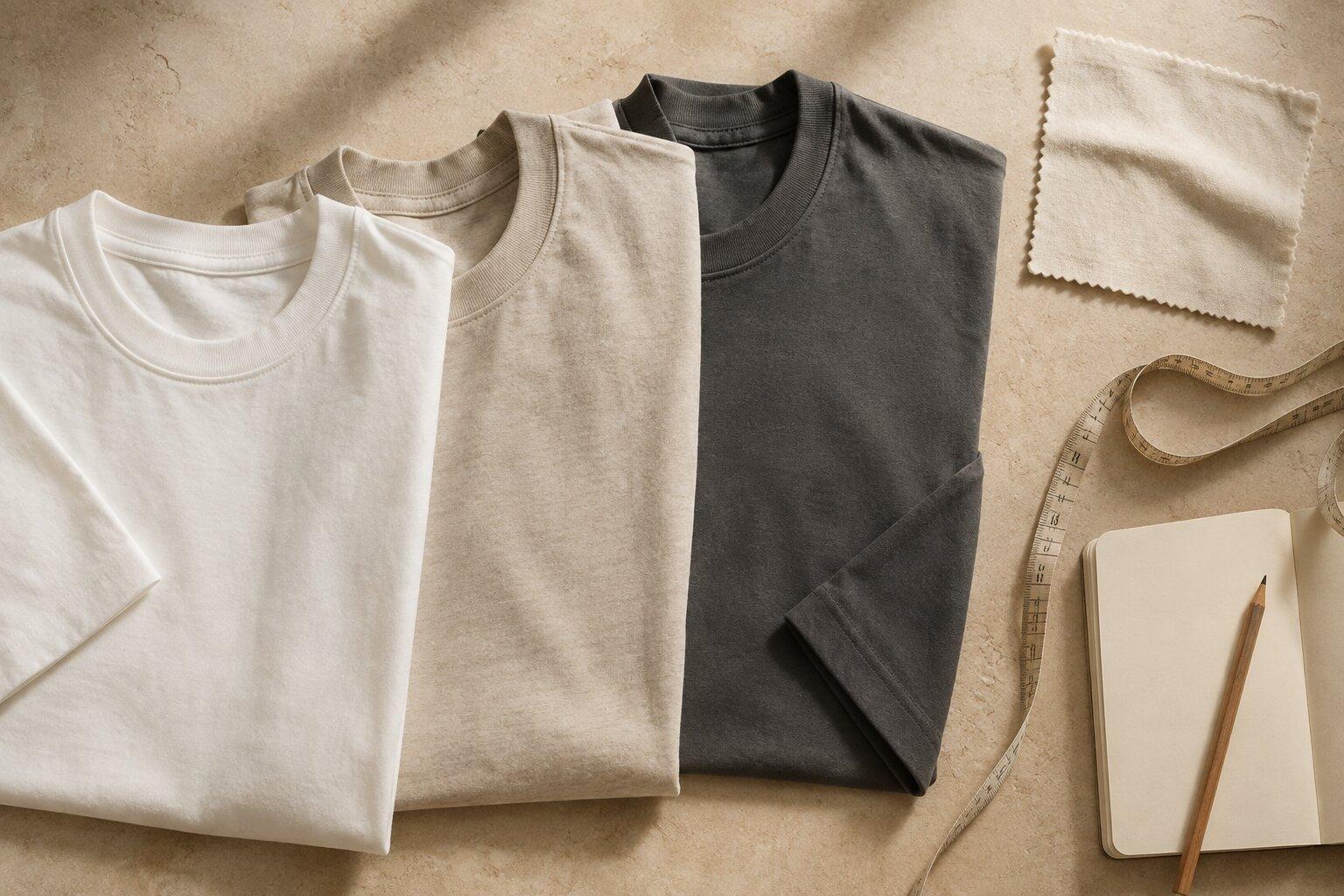
AI-created sample-planning illustration. Compare the actual supplier samples before choosing a named blank.
Choosing between Gildan and Bella+Canvas starts with the exact shirt, the buyer, and the finished cost. The Bella+Canvas 3001, Gildan 64000 Softstyle, and Gildan 5000 Heavy Cotton are three different products. A brand-wide softness ranking will not tell you which one fits your collection.
Use the specifications below to make a shortlist, put your own supplier quotes into the comparison tool, then order the same artwork on the finalists. A mockup helps with composition; a physical sample tells you about fit, fabric, and the finished print.
Go straight to: the cost comparison · the sample checklist · choosing a blank
Quick Verdict: Gildan vs Bella Canvas at a Glance
| What to compare | Bella+Canvas 3001 | Gildan 64000 Softstyle | Gildan 5000 Heavy Cotton |
|---|---|---|---|
| Fabric starting point | Airlume combed and ring-spun cotton | Ring-spun cotton | Cotton jersey |
| Construction / fit description | Side seams; manufacturer describes a tailored fit | Modern classic fit | Classic fit |
| Useful reason to sample | Evaluate a lighter jersey and side-seamed shape | Compare a ring-spun option with the 3001 | Evaluate a heavier everyday tee |
| Colors and sizes | Check the exact provider offering | Check the exact provider offering | Check the exact provider offering |
| Printed product cost | Enter your quote below | Enter your quote below | Enter your quote below |
Specification sources, checked 7 September 2026: Bella+Canvas 3001, Gildan Softstyle G64000, and Gildan Heavy Cotton G5000. Fabric blends vary by color. Match the exact SKU, region, and supplier specification before ordering.
Bella+Canvas lists the 3001 at 4.2 oz. Gildan’s current US retail Softstyle page lists 4.3 oz; confirm your provider’s version rather than assuming every 64000 listing is identical. Heavy Cotton is listed at 5.3 oz. These are fabric weights, not finished garment weights or print-quality scores.
Fabric & Feel: Compare the Shirt You Will Actually Sell
The 3001 and 64000 are useful candidates when you want to compare ring-spun cotton tees. The heavier 5000 is another option when fabric weight and a classic shape are part of the brief. Touch and wear all three if you have not sold them before; customer preference is not established by a manufacturer’s fabric description.
Start with the actual garment color you intend to offer. A heather, solid, or blended version may behave differently in printing. Record the fabric composition from the provider listing beside your sample so that your decision applies to the product you can reorder.
Avoid choosing from a brand-wide color count. Your provider may carry only a subset of a style, and a popular color may not cover every size you need.
Fit & Construction: Check Measurements, Then Wear the Sample
A side seam describes construction. It does not prove that a shirt will fit your audience better or shrink less. Compare chest width and body length in the size charts, then measure the samples before and after washing according to their care labels.
For a family event, check whether every participant can find an appropriate size. For a clothing collection, ask sample wearers about shoulder position, body length, sleeve shape, and how they would prefer the tee to fit. Record the size they tried and their feedback instead of reducing the result to “premium” or “budget.”
Print Compatibility: Test Your Artwork and Provider Together
There is no universal DTG score for a blank. Fabric composition, garment color, pretreatment, ink, curing, artwork, and your provider’s process all affect the finished result. A blank recommendation is a starting point for a print test.
For DTG, include your design’s finest line, darkest region, and any gradient in the sample review. For screen printing, ask the printer to quote the actual color count, placements, and quantity. Do not compare a bulk unprinted shirt price with a one-off printed product price.
A Vaybel mockup can help you compare artwork placement and a visual direction. It cannot establish fabric feel, wash durability, or the exact printed color. Keep the sample order in your launch plan.
Pricing & Margin Math for Clothing Brands
Compare all three at the same selling price first. This reveals the effect of the supplier cost without assuming that changing a blank automatically lets you charge more. If your audience supports another price, change it and compare again.
Your numbers · your decision
Compare what each sale leaves you
These starting values are illustrative, not supplier quotes. Enter the same currency and print placement for all three blanks. Use the printed product cost, not the unprinted wholesale price.
Bella+Canvas 3001
$9.38
33.5% of selling price remains
Gildan 64000
$11.38
40.6% of selling price remains
Gildan 5000
$12.38
44.2% of selling price remains
Calculation: selling price − printed product − shipping − percentage fee − fixed fee. Excludes tax, advertising, discounts, returns, subscriptions, and overhead. Add those costs before treating the remainder as profit. If your marketplace charges fees on shipping or tax, include the extra fee in the fixed amount.
The illustrative $28 sale with a $12 printed cost, $4.50 shipping, a 6.5% fee, and a $0.30 fixed fee leaves $9.38 before other costs. That is not net profit. Advertising, tax, returns, discounts, and your operating costs still need to be accounted for.
Get quotes for the exact color, size range, placements, and destination. Include any subscription discount only if you will actually pay for that subscription. A lower base price can lose its advantage once shipping or a second placement is added.
Sample Checklist
Copy this checklist into your launch notes and use the same review for each blank:
- Record the order: provider, SKU, color, size, fabric composition, print method, placement, cost, and order date.
- Use the same artwork: keep the design and intended print dimensions consistent between samples.
- Inspect the fit: chest width, body length, shoulder position, sleeves, and collar. Note which size was tried.
- Inspect the print: thin lines, lettering, gradients, solid areas, placement, and feel of the printed area.
- Wash and compare: follow the care label. Record wash conditions, measurement changes, twisting, collar shape, and print appearance.
- Ask the intended buyer: what feels right, what would stop them buying, and which product they prefer. Keep feedback separate from actual purchases.
- Check repeatability: confirm the provider can supply the colors and sizes your collection needs; record a sampled fallback.
- Make a dated decision: choose the blank, explain the tradeoff, and keep the sample as your reference.
Color Range & Seasonal Drops
Plan a small palette around the intersection of colors and sizes your provider carries. Check stock before publishing a promotion, and avoid promising that a color will remain available indefinitely.
If two product lines use different blanks, tell customers which garment each uses and provide its own size chart. The same size label does not establish identical measurements across styles.
Sustainability: Use Claims You Can Trace
Both companies publish sourcing and responsibility information. Start with Bella+Canvas’s sustainability information and Gildan’s certifications and partnerships, then check which statements apply to the product you purchase.
A company-level policy, facility certification, and product-specific material claim are different things. Ask your supplier for documentation when a sourcing claim is part of the offer. Avoid turning a general brand statement into an unsupported claim on your listing.
Which Blank Should You Test First?
Start with the Bella+Canvas 3001 if the side-seamed construction and lighter fabric match your brief. Compare the sample and cost against a ring-spun alternative before choosing.
Start with the Gildan 64000 if you want to evaluate a Softstyle tee alongside the 3001. Use your actual provider quote and sample; the brand name alone does not settle the price or feel comparison.
Start with the Gildan 5000 if a heavier, classic tee is part of the product idea. Ask your printer about the artwork and quantity you intend to produce.
You can use more than one blank across a collection. For example, an event tee and an everyday graphic tee may have different requirements. Treat that as a product decision to test, not evidence that either line will sell at a particular price.
If the audience and offer still need definition, complete the clothing niche worksheet. Then use the apparel prompt library to prepare an original design brief, compare mockups, and order your samples.