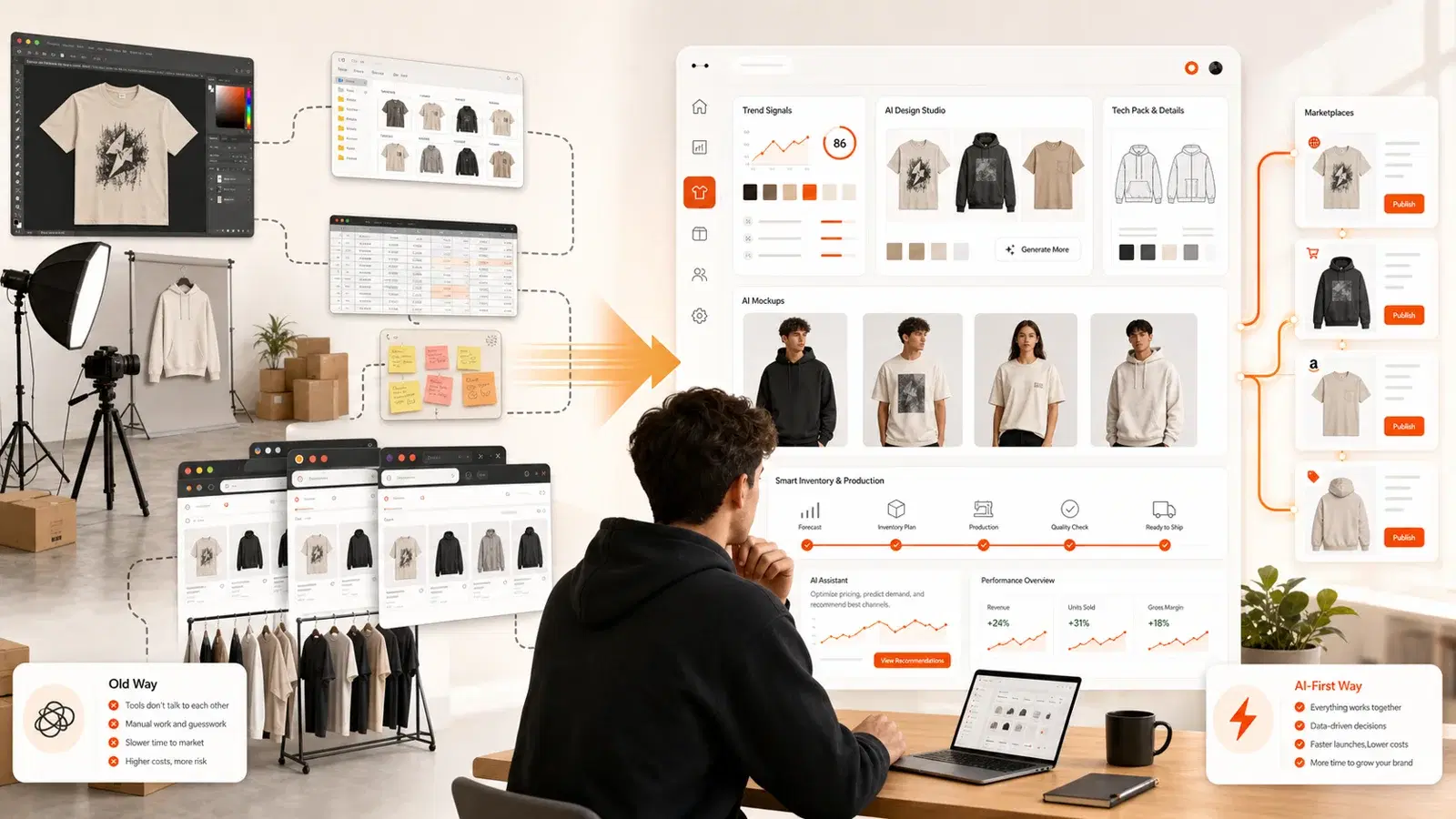
Starting a clothing brand used to cost between $2,000 and $50,000 before you made a single sale. Design agency fees, product photography, inventory minimums, and weeks of manual setup meant most ideas never left a notes app.
Here's what changed: knowing how to start a clothing brand with AI means every step of that workflow is handled for you -- from validating your niche to generating designs, creating professional product photos, and publishing listings across every sales channel. The barriers that stopped most first-time founders no longer exist.
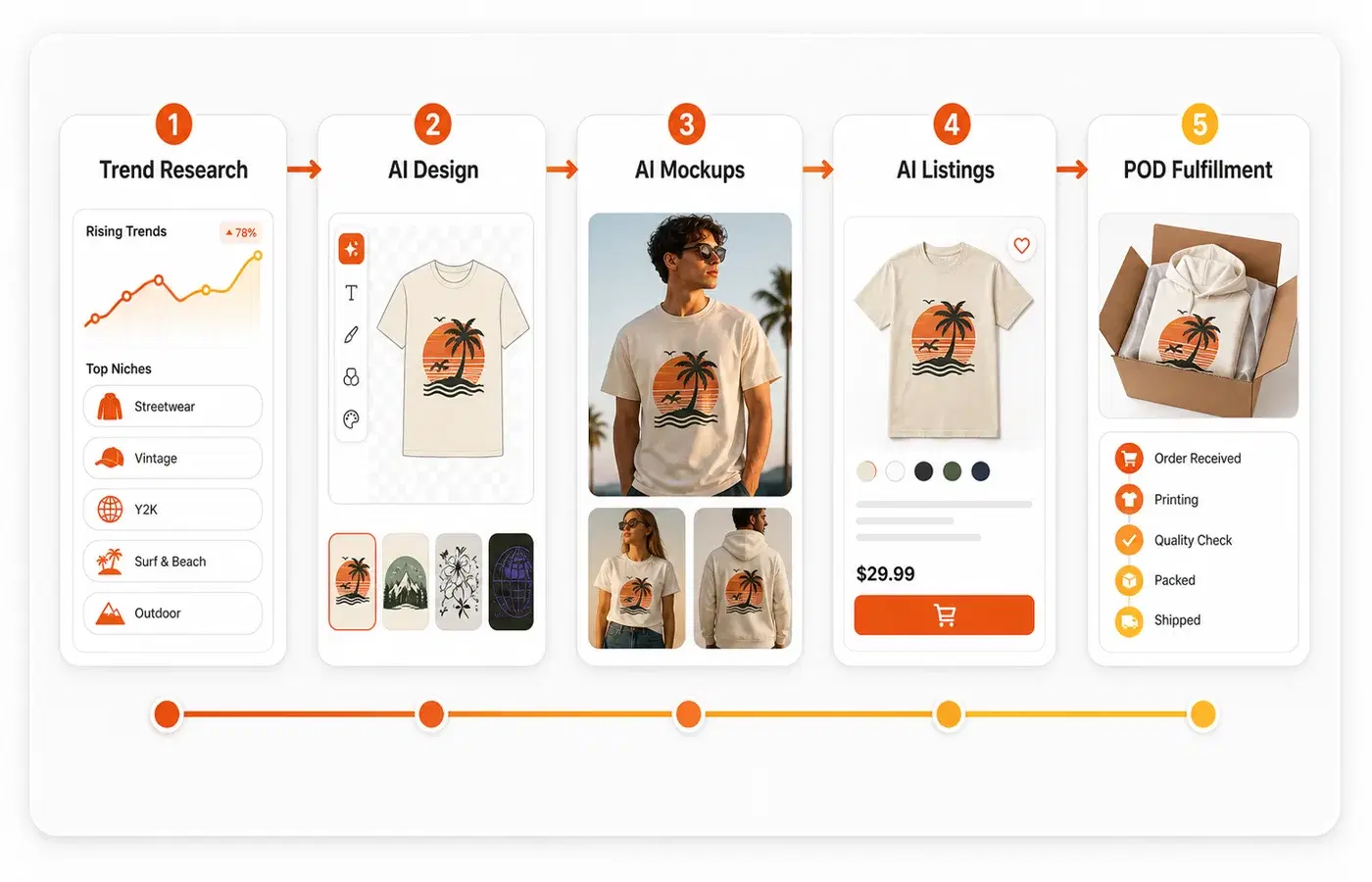
Most guides still describe the old process with AI bolted on as an afterthought. This one doesn't. This is the modern, AI-first workflow: five connected steps, zero prior experience required, from idea to first live product.
By the end, you'll know exactly how to:
- Validate a profitable niche using AI trend research before you design anything
- Generate professional clothing designs without design skills or software
- Create photoshoot-quality product images in seconds
- Publish optimized listings to Etsy, TikTok Shop, and Shopify in one workflow
- Start selling with zero inventory risk
Skip the setup and see the workflow yourself. Start your free 7-day trial on Vaybel -- the Starter plan is $19/month.
Why AI Changes Everything for New Clothing Brand Founders
The broader apparel market is projected to reach $2.54 trillion by 2033, and the print-on-demand market is projected to reach $57.49 billion by 2033, according to Grand View Research and its print-on-demand market outlook. More than 500,000 clothing brands operate on Shopify alone. The opportunity is real -- and it's growing.
The problem was always access. Building a clothing brand the traditional way required:
- A designer (or years learning design software)
- A photographer (or a $500+ per-product photoshoot budget)
- A copywriter (or hours writing platform-specific listing copy)
- $2,000 to $50,000 in upfront inventory to hit manufacturer minimums
AI tools for clothing brands like Vaybel remove all of those barriers at once -- in a single connected pipeline, not a patchwork of unrelated tools.
The shift most new founders miss: instead of stitching together ChatGPT, Midjourney, a separate mockup tool, and a manual listing process, clothing brand automation means you work in one place where each step feeds directly into the next.
Can AI Help You Start a Clothing Brand?
Yes. AI handles the four biggest barriers to launching a clothing brand: niche research, product design, mockup creation, and listing copywriting. The right platform lets you start a clothing brand with AI and go from idea to live listing in under five minutes, no design skills or photography budget required. Here's how.
Step 1: Find a Winning Niche with AI Trend Research
Most clothing brands fail before the first product is designed. The cause is almost always the same: founders skip niche research and design what they love, not what sells. It's the first mistake to avoid when you start a clothing brand with AI.
AI trend research flips that order. Before you touch a design tool, you can analyze what's gaining momentum across TikTok, Etsy, and search -- and identify niches where demand is growing faster than supply.
Why speed matters here: trend windows in apparel now average 72 hours. A viral moment that creates demand today can be oversaturated within a week. AI trend tools track these windows in real time, so you're designing for what's selling now, not what sold last month.
What to look for in a niche:
- A specific community or identity -- fitness, gaming, pet owners, local pride, a hobby subculture
- Repeat buyers who will purchase multiple pieces over time, not just once
- Low competition on your specific angle, even if the broad category is crowded
- Active presence on TikTok or Etsy, where most clothing brand discovery happens in 2026
Consider Jamie, a graphic designer who wanted to start a brand in the fitness space. Rather than launching another generic "grind mentality" hoodie brand, she spent 20 minutes with Vaybel's AI Trend Finder and spotted something specific: powerlifting humor for women was growing fast with almost no competition. Search volume was rising, conversion data on Etsy looked strong, and repeat-purchase behavior in the niche was clear. She had her niche validated before she opened a design tool -- and her first product sold out in two weeks.
The AI-powered trend research tool scans real-time signals across platforms and surfaces emerging opportunities before they peak, so you design products people are already searching for.
Step 2: Design Your Products with AI (No Skills Required)
Once you have a validated niche, you need products. This is where most first-time founders get stuck -- and where generic AI tools fall short.
General-purpose image generators produce images. What they don't understand is apparel: how a graphic wraps around a sleeve seam, the difference between direct-to-garment (DTG) and all-over print (AOP) placement, or why a design that looks sharp on a screen needs to be 300 DPI to print without blurring.
Vaybel's AI Design Generator is built specifically for clothing. It understands:
- Print method -- DTG vs. AOP vs. embroidery, with designs optimized for each method
- Garment placement -- chest, back, sleeve, and all-over layouts that print correctly
- Print-ready output -- 300 DPI files ready for fulfillment with no post-processing required
You describe what you want in plain language. The AI generates a design in under 60 seconds. You refine and iterate until it's right.
Example prompt: "Bold typography design for a powerlifting brand, women's aesthetic, heavy sans-serif font, earth tones, chest placement, DTG print."
No Photoshop, no freelancer, no $200-500 design fee per product.
Ready to create your first design? Generate your first clothing design in under 60 seconds.
Step 3: Create Professional Mockups Instantly
A product design is invisible until it's on a model. Product photography has always been one of the biggest early costs for clothing brands -- models, studios, equipment, editing time.
The flat-lay alternative (products on a white background) converts poorly. Customers expect lifestyle imagery, and platforms reward it with higher placement.
Vaybel's AI Mockup Generator replaces the photoshoot entirely. Upload your design, select a blank garment, choose a lifestyle scene or model type, and get professional product images in seconds. The output matches studio quality:
- Virtual models wearing your product in real-world environments
- Lifestyle backgrounds matched to your brand aesthetic
- Multiple angles and placements per product
- 300 DPI exports ready for any listing platform
What a traditional photoshoot cost: a single product shoot with a model ran $500 to $1,500 for most brands. For 10 products, that's $5,000 to $15,000 before the first sale -- a cost that stopped many brands before they launched.
What it costs now: included in your Vaybel plan. Generate as many mockups as you need, for every product, in every colorway.
Marcus launched a streetwear brand in March 2026 with 12 products. Traditional photography would have cost him around $8,000 and taken three weeks to schedule, shoot, and edit. Using Vaybel's mockup generator, he had all 12 products photographed in a single afternoon -- lifestyle shots, model images, and multiple angles -- and went live the same day. His brand crossed $3,000 in revenue in its first month without a single real photoshoot.
Step 4: Write and Publish Listings Across Every Channel
Most guides on how to start a clothing brand online tell you to pick one sales channel and master it. That advice made sense when writing platform-specific listings was a manual, hours-long process. It doesn't make sense anymore.
The multi-channel opportunity in 2026 is significant: Etsy buyers search differently than TikTok Shop shoppers, and Shopify customers expect a different experience than either. Staying on a single platform means leaving real traffic -- and real revenue -- on the table.
Vaybel's AI Listing Generator writes optimized copy for each platform automatically, then publishes to all three channels in one workflow. Different titles, different keyword structures, different descriptions -- all generated from a single product input.
Per-platform optimization includes:
- Etsy: long-tail keyword-rich titles, detailed materials descriptions, searchable tags (up to 13 per listing)
- TikTok Shop: short punchy descriptions optimized for discovery, product attributes for algorithm matching
- Shopify: structured descriptions, SEO metadata, variant organization
AI is already shaping product discovery: NielsenIQ reports that 42% of consumers now use AI tools to shop. The platforms are rewarding well-optimized listings more than ever -- and AI-generated listings consistently outperform manually written ones on keyword coverage and completeness.
You input the product once. Vaybel handles the rest.
Step 5: Choose Your Fulfillment Model
Your products are designed, photographed, and listed. Now you need to decide how orders get fulfilled. Two primary models exist, and the right choice depends on where you are in the journey.
Print-on-demand (POD)
- Zero inventory -- products are made only when an order is placed
- No upfront cost, no inventory risk
- Gross margins typically in the 20-40% range depending on platform and pricing
- Instant to start -- connect a POD provider and your store is live
- Best for: validation, testing new niches, first products
Custom manufacturing
- Gross margins typically in the 50-70% range
- Requires minimum order quantities (usually 50-500 units per SKU)
- Inventory risk -- you're buying stock before you know what sells
- Production lead times of four to eight weeks
- Best for: validated bestsellers, scaling established products
The smart path for new founders: start with print-on-demand. Use real sales data to identify which products and niches actually convert. Then move your bestsellers to custom manufacturing once demand is proven.
Vaybel's AI-powered print-on-demand workflow connects directly to fulfillment providers, so listings, inventory, and orders stay in sync without manual management.
How the AI-First Workflow Compares to the Traditional Approach
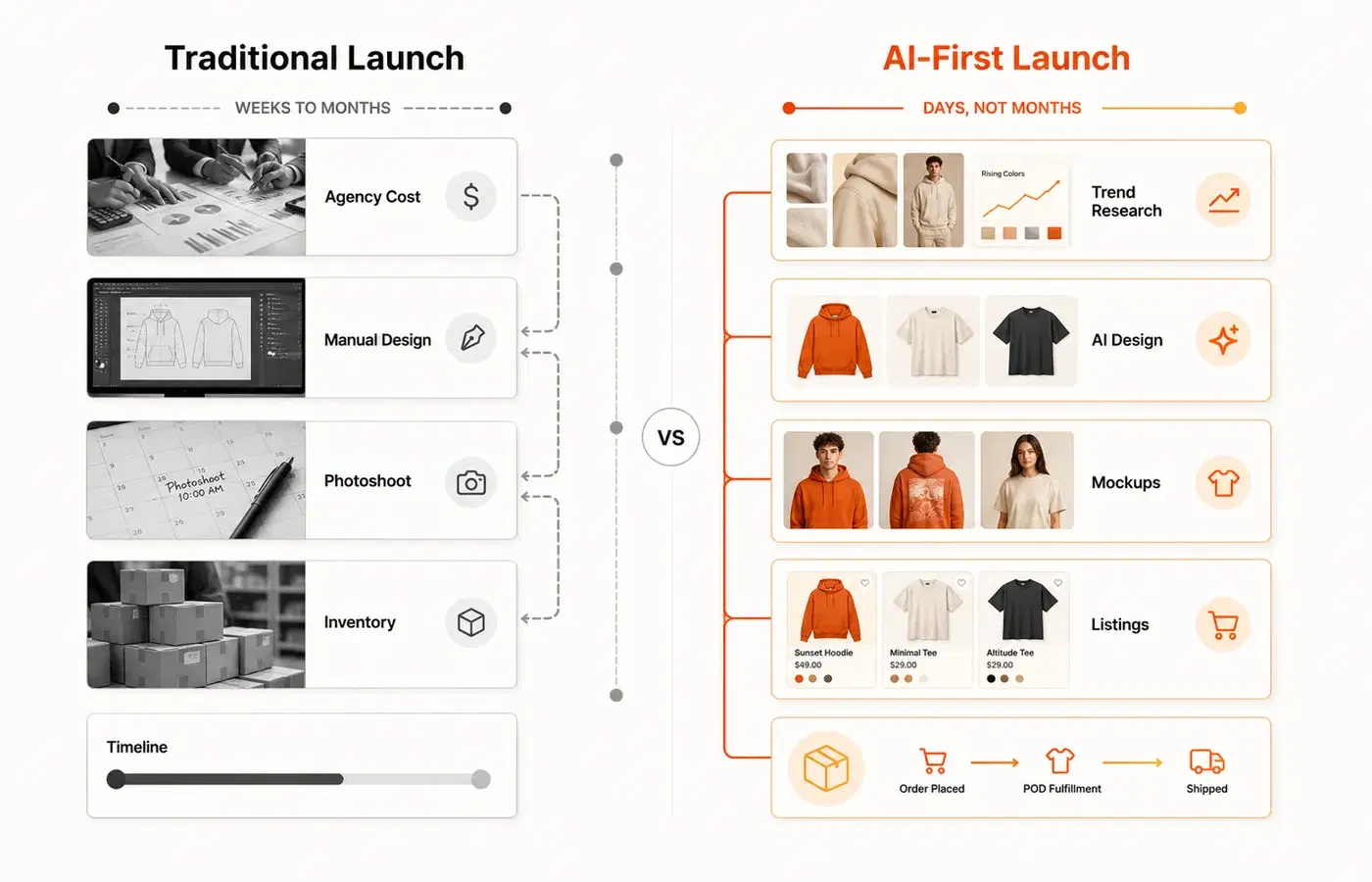
The difference between starting a clothing brand with AI versus the traditional path isn't marginal. It's structural.
| Traditional Workflow | AI-First (Vaybel) | |
|---|---|---|
| Niche research | Weeks of manual research | Hours with AI trend data |
| Design | $200-500 per product | Under 60 seconds, included |
| Photography | $500-1,500 per product | Seconds, included |
| Listing copywriting | Hours per platform | Auto-generated, all channels |
| Time to first live product | Four to eight weeks | Under five minutes |
| Upfront cost | $2,000-$50,000 | $19/month |
| Skills required | Design, photography, copywriting | None |
| Channels at launch | Usually one | Etsy + TikTok Shop + Shopify |
An AI-first workflow doesn't just save time -- it removes the skills, capital, and infrastructure barriers that prevented most people from launching in the first place.
Real Costs: Starting a Clothing Brand with AI in 2026
An AI-first approach doesn't mean zero cost. Here's an honest breakdown so you can plan accordingly.
Fixed monthly costs:
- Vaybel Starter plan: $19/month (AI Design Generator, AI Mockup Generator, AI Listing Generator included)
- Shopify: starts at $29/month if you're using it as a channel
- Etsy: $0.20 per listing plus 6.5% transaction fee (no monthly fee)
- TikTok Shop: 5-8% commission on sales (no monthly fee)
Variable costs per sale with print-on-demand:
- Quality blank garment: $8-12 per t-shirt
- Printing and fulfillment: $5-10 depending on provider and shipping zone
- Total cost of goods: $13-22 per standard t-shirt
The pricing math: if you sell a t-shirt at $35 with a $18 cost of goods, you're at roughly 48% gross margin before platform fees. After Etsy's transaction fee, you're near 40%. That's the print-on-demand reality -- lower margin than custom manufacturing, but zero inventory risk.
The comparison that matters: traditional brand founders spend $2,000 to $50,000 before they know whether anything sells. With an AI-first approach, your entire first month of testing -- multiple niches, dozens of products, across three channels -- costs less than $50 in listing fees plus your Vaybel subscription.
Priya launched her first three products in January 2026 and priced them at $22 each because that felt "affordable." Two weeks in, she ran the actual numbers: blank cost ($10) + printing ($7) + Etsy fees ($2.80 at 6.5% of $22 + $0.20 listing) left her with $1.80 per sale. She raised prices to $34, added a bundle option, and her margin jumped to 37%. The lesson cost her two weeks of data -- not two years of losses.
Want to see what your margin looks like before you launch? Use the Vaybel ROI Calculator to run the numbers for your specific niche and product mix.
Common Mistakes to Avoid When Starting a Clothing Brand with AI
Designing without niche validation first. Creating products before confirming demand is the most reliable way to fail. Spend time with AI trend research before you open a design tool.
Using generic AI tools not built for clothing. General-purpose image generators produce images, not print-ready apparel designs. The difference shows up the moment you try to print -- resolution issues, incorrect placement, and unsupported file formats are expensive problems to fix after the fact.
Underpricing. New founders often price based on what feels affordable to them rather than what covers actual costs. Run the math before launch: blank cost + printing + fulfillment + platform fees + Vaybel plan, then add your margin target.
Skipping multi-channel from day one. Publishing to three channels with AI takes almost no additional effort. The incremental revenue opportunity is significant. There's no reason to start on one platform when you can start on all three simultaneously.
Waiting for the product to be perfect before launching. Go live with five products. See what sells. Use real data to decide what to build next. AI makes iteration fast -- use that advantage.
Conclusion: Your AI-Powered Clothing Brand Starts Today
Knowing how to start a clothing brand with AI in 2026 gives you a genuine structural advantage over every founder who came before. The five-step workflow above -- niche research, design generation, mockup creation, multi-channel listing, and fulfillment -- compresses what used to take months and tens of thousands of dollars into a single afternoon.
The key shift: this isn't AI added onto a traditional process. It's a different process, built around speed, validation, and connected automation from the first step to the last.
Your next steps:
- Pick a niche direction you're curious about
- Validate demand with AI trend research before designing anything
- Generate your first three designs
- Create mockups and go live across Etsy, TikTok Shop, and Shopify
The fastest way to start is to start. Everything else -- stronger designs, more products, higher margins -- comes from real sales data. AI gives you the tools to move fast. The market gives you feedback in real time.
Try Vaybel Free for 7 Days -- the Starter plan is $19/month and includes the full AI pipeline: design, mockups, listings, and multi-channel publishing. A card is required. Cancel before the trial ends to avoid billing.