In mid-2023, there were 4,450 TikTok shops in the United States. Today there are 475,000 — more than a 100× jump in less than three years, and womenswear is now the platform's top category by store count. If you run a clothing brand and you're not on TikTok Shop yet, you're not watching a trend from the sideline. You're watching a channel shift that's already well underway.
You already know the upside. Every week, someone's brand goes viral overnight, 300 orders pile up from a creator video, and a small clothing brand makes more in 48 hours than it did in the previous three months combined. That part is real.
What most guides leave out is the other side: stack the 6% referral fee with creator commissions, fulfillment, ads, and returns, and your total cost of selling runs between 35 and 55% of revenue. That math surprises a lot of founders on their first monthly P&L.
This guide covers both sides. You'll learn how to set up your TikTok Shop step by step, what the fees actually look like for clothing brands, what content drives real conversions, how to build an affiliate program that doesn't kill your margins, and how to handle the challenges specific to selling apparel, sizing, returns, and seasonal windows, that most TikTok Shop guides skip entirely.
This is the complete guide to TikTok Shop for clothing brands in 2026. Start here.
Why TikTok Shop Is a Real Revenue Channel for Clothing Brands
TikTok Shop for clothing brands has moved well past "promising" and into significant revenue territory.
TikTok Shop's global GMV hit $64.3 billion in 2025 and is projected to reach $112.2 billion in 2026, according to data compiled by Ringly.io. The US market grew 68% year-over-year in 2025 to reach $15.1 billion (up from $9 billion in 2024), per Momentum Works, and is projected to surpass $20 billion this year. For clothing brands specifically, womenswear and underwear is TikTok Shop's top category by store count. Nine clothing brands pulled in $3.95 billion in just the first half of 2024. Brands with $30 million or more in revenue saw their TikTok Shop sales jump 97% in 2025.
Independent sellers are also winning. More than 215,000 small US businesses now sell on TikTok Shop, up 25% year-over-year, and small business sales grew 66% in 2025. TikTok's own data shows that more than a third of monthly purchases went to small businesses.
The Discovery Advantage
What makes TikTok Shop different from Etsy or Shopify isn't the product catalog, it's the algorithm. Eighty-three percent of TikTok shoppers say they discovered new products on the platform. TikTok sends buyers to your products before they've heard of your brand. That kind of organic discovery is essentially free advertising, but only if you understand how to work with it.
The algorithm rewards shoppable content. Listings tagged to videos get more distribution than passive brand posts. Storefronts that generate content consistently get more reach than ones that list products and go quiet. It's a completely different dynamic from search-based marketplaces, and it changes how you think about everything from product selection to pricing to your content calendar.
Portland Leather Goods is a documented example of TikTok Shop working the way it's designed to: the brand generated $1 million in sales in just 20 days on TikTok Shop, driven primarily by an affiliate creator blitz rather than its own brand account. And the discovery channel reaches even bigger players — nine clothing brands, led by SHEIN, collectively pulled in $3.95 billion in TikTok Shop sales in the first half of 2024 alone, with TJ Maxx ($787.1M) and Ross Dress for Less ($772.9M) each clearing $750 million.
That's TikTok Shop working the way it's designed to. The key is positioning your brand to catch those moments, which requires the right setup, the right pricing, and an affiliate program running before you need it.
Want to build a TikTok Shop workflow built for that kind of volume? Explore TikTok Shop Automation →
How TikTok Shop Works for Clothing Sellers
Before setting up your shop, understand where sales actually come from.
TikTok Shop isn't a search marketplace like Etsy, where buyers type "vintage band tees" and scroll through results. It's a discovery channel where products surface through content. Here's how GMV breaks down across the platform:
- In-feed shoppable videos: ~70% of GMV
- Live shopping sessions: ~17% of GMV
- Direct shop page purchases: ~13% of GMV
Seventy percent of revenue comes from short videos. That single number explains why TikTok Shop rewards content volume and penalizes brands that list products but don't post. The algorithm needs content to understand what your brand sells and who to show it to.
TikTok Shop vs. Etsy vs. Shopify for Clothing Brands
These three platforms serve different purposes. The most successful apparel sellers use all three.
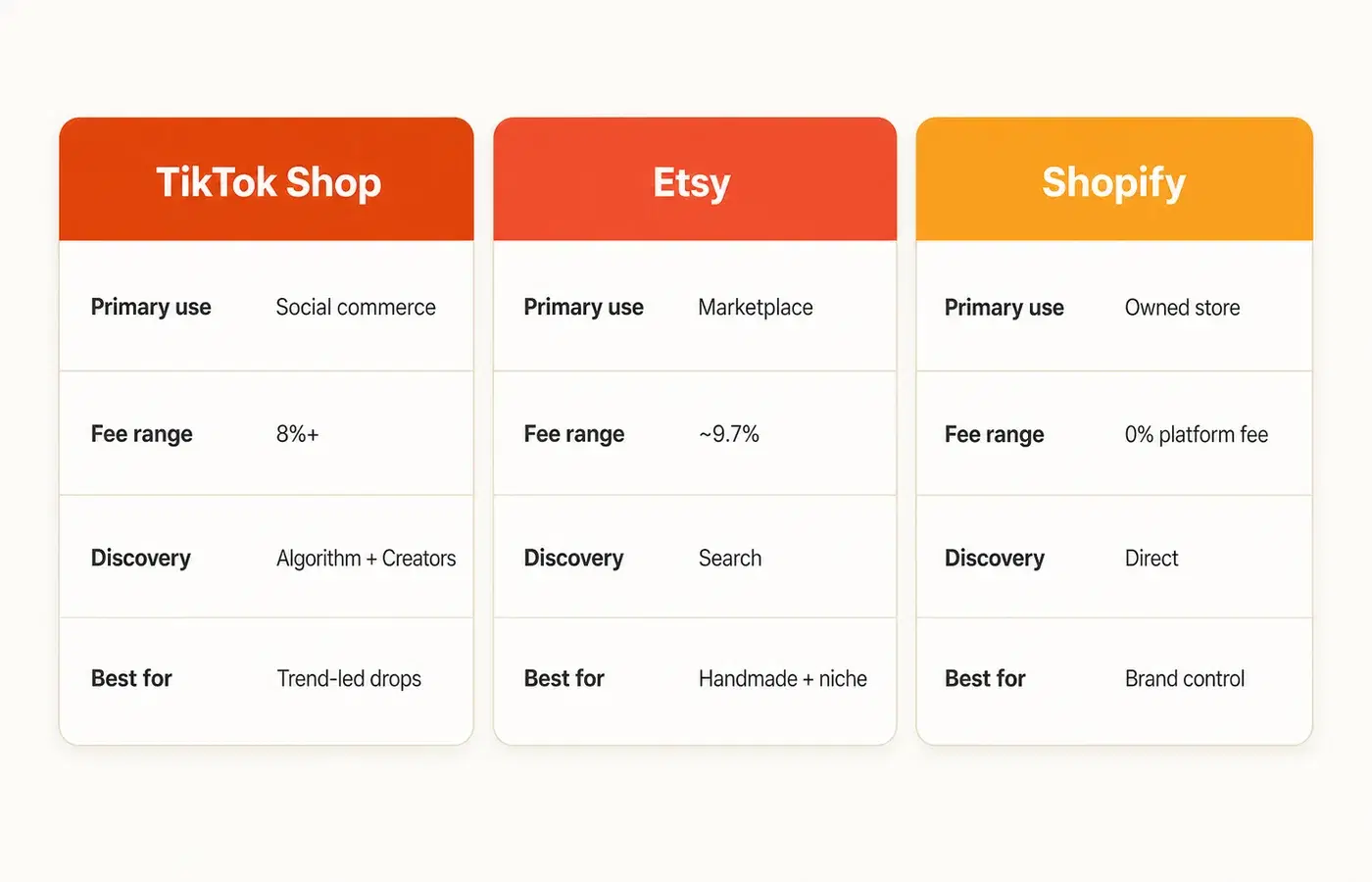
| Platform | Best For | Fee Range | Discovery Model |
|---|---|---|---|
| TikTok Shop | Trending, visual, impulse-buy products | 6% referral + processing | Algorithm + creator content |
| Etsy | Handmade, custom, vintage clothing | ~9.7% combined fees | Search + recommendations |
| Shopify | Brand HQ, full customer ownership | 0% on sales + payment processing | Direct/paid traffic |
TikTok Shop works best for clothing that demos well on video: anything with visible movement, interesting texture, strong before/after styling potential, or trend-responsive designs. If your product sells better with a story than a search query, TikTok Shop belongs in your mix.
Setting Up Your TikTok Shop: Step-by-Step for Clothing Brands
Starting completely from zero — no brand, no products yet? Our launch playbook, how to start a clothing brand on TikTok Shop, walks from first design to first sale. The steps below cover the shop setup itself.
Here's how to sell clothing on TikTok Shop, step by step. Setup is straightforward once you know what to prepare — here's what you need before you start:
Requirements:
- A US-based business (EIN or SSN)
- Valid government-issued ID
- Business registration documents
- A TikTok Business Account
- A bank account for payouts
TikTok typically reviews applications within 1–7 business days, longer (10–14 days) for regulated categories like jewelry or supplements.
Step 1: Register at Seller Center
Go to seller-us.tiktok.com and start your application. If you already have a personal TikTok account, you'll need to either switch it to a Business Account or create a separate one. The Seller Center account and the TikTok Business Account need to be linked, that connection is what allows product tags to appear in your videos.
Step 2: Set Your Warehouse and Return Addresses
You'll need a physical pickup/warehouse address and a separate return address. For print-on-demand (POD) clothing brands, your return address is typically your own location, even if products ship from a fulfillment partner like Printful or Printify.
Step 3: Link Your Bank Account
Done from the Seller Center home page after approval. Payouts are deposited here on a rolling schedule.
Step 4: Set Up Your Shop Profile
Your shop name, logo, and bio are the first things buyers see when they visit your storefront directly. Write your bio in plain language: what you sell, who it's for. "Independent streetwear for women who like clean lines and bold color" is more effective than "Welcome to our store!"
Step 5: List Your Products
Clothing listings require extra attention. A few rules specific to apparel:
- Titles: Keep them under 80 characters. Lead with what the product is, not your brand name. "Women's Oversized Vintage-Wash Hoodie, Dusty Mauve" outperforms "The Comfort Cloud Hoodie by [Your Brand]" every time in TikTok Shop search.
- Images: Your first image is your scroll-stopper. Use lifestyle shots that show the garment on a model, movement shots outperform flat lays. The thumbnail is what drives click-through in the feed, not the title.
- Size guides: Include a clear size chart with actual measurements, not just S/M/L/XL. A note like "Model is 5'7" wearing a size M, fits true to size, slightly relaxed through the shoulders" reduces return friction significantly.
- Pricing: Match or beat your website price. TikTok's algorithm favors competitive pricing, and buyers will check.
Step 6: Set Up Your Affiliate Program
Start with Open Collaboration, this lets any creator on TikTok pick up your products and promote them for commission, without you needing to reach out first. Set your initial commission at 15-18% to stand out. You can build Targeted Collaboration plans for specific creators you want to recruit with custom rates, samples, or bonus structures.
With Vaybel's AI Listing Generator, you can write keyword-optimized TikTok Shop titles, descriptions, and bullet points and publish directly to your storefront, Etsy, and Shopify simultaneously, instead of rewriting listings for each platform manually.
TikTok Shop Fees for Clothing Brands: The Real Cost Breakdown
This is the section most guides skip, or get wrong. The fee math for TikTok Shop for clothing brands is different from what you'll see in general seller overviews, and the difference matters.
The referral fee for clothing is 6% — the standard US rate on all qualified transactions, charged on the customer payment excluding tax, per TikTok Seller Center's published fee schedule. New sellers pay a promotional 3% for their first 30 days after their first sale. Rates do shift — select fine-jewelry categories were cut to 5% in late 2024, and some third-party breakdowns still cite up to 8% for apparel — so verify your category's current rate in Seller Center before you build your pricing.
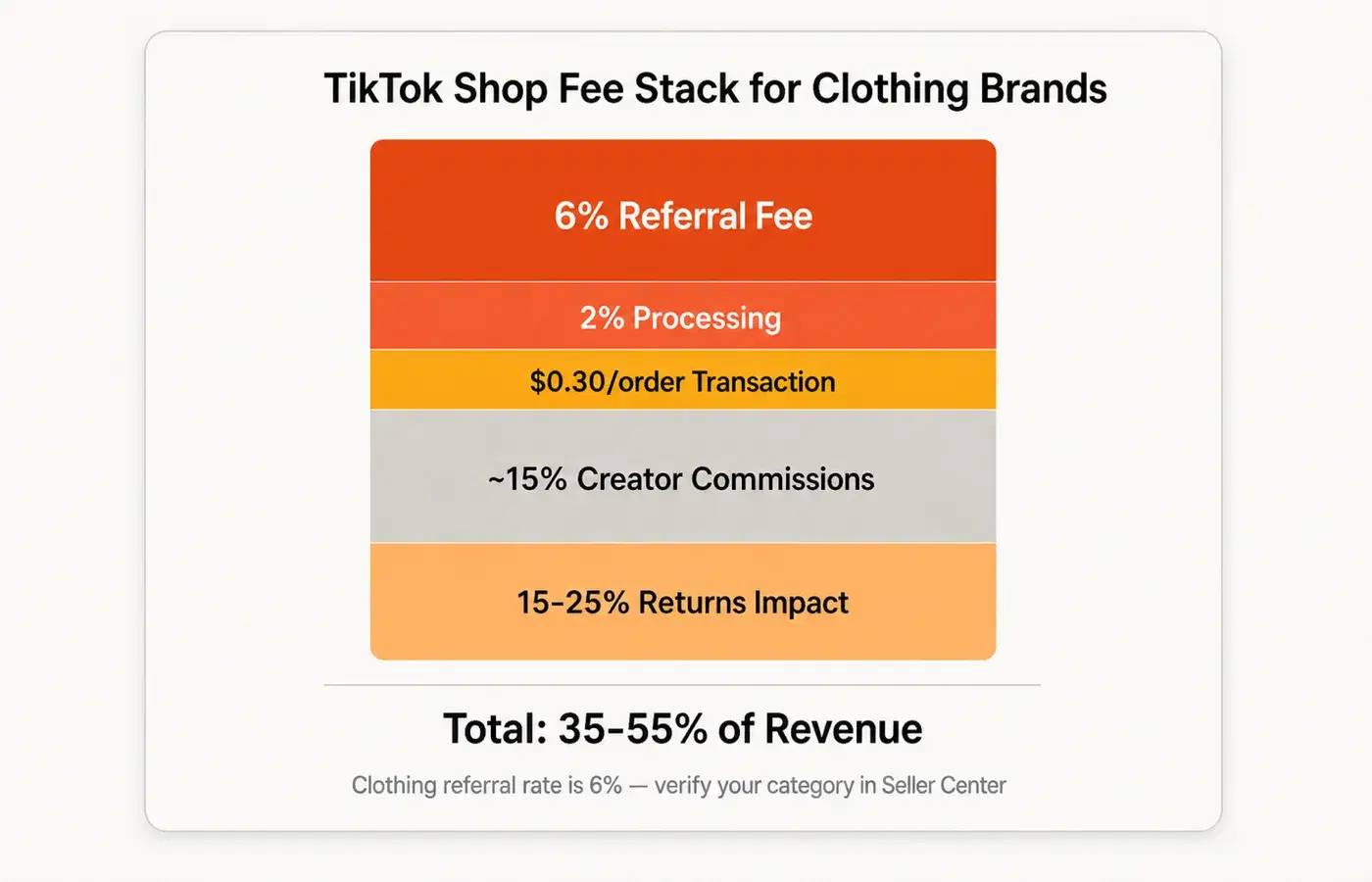
Here's the full picture (cost-stack model adapted from Darkroom Agency's seller cost breakdown; referral rate per TikTok's current schedule):
| Fee Type | Rate | Notes |
|---|---|---|
| Referral fee (incl. fashion/apparel) | 6% | Standard US rate; verify your category in Seller Center |
| New seller promo rate | 3% | First 30 days after first sale (since April 2025) |
| Transaction fee | $0.30/order | Hurts low-AOV items most |
| Payment processing | ~2.9% + $0.30 | Standard US card-processing rate |
| Fulfilled by TikTok (FBT) | $2.50-$4.50/order | Pick + pack only; excludes shipping |
| Creator commissions | 10-22% | Open collab vs. targeted; see affiliate section |
| Total cost of selling | 35-55% of revenue | When all costs stack |
The 35–55% range is what trips up most new clothing sellers. The expected line items — referral fee, payment processing, creator commissions, fulfillment — are easy to model in isolation. Stacked together against a 15–25% apparel return rate, they compound faster than founders expect.
The math has a sneaky multiplier: returns inflate every commission you pay out. If you offer a 20% commission and your return rate is 20%, your effective commission rate is closer to 26.6%, because you pay commissions on gross orders but absorb the return cost net. A model built on the headline numbers will quietly overstate margin by 5–10 percentage points.
The fix is mechanical: tighten the return policy, raise the AOV floor, and stop optimizing for top-line GMV before the cost stack is fully accounted for.
The New-Seller Window You Don't Want to Miss
New sellers who make their first sale within 60 days of onboarding unlock a promotional referral rate of 3% for 30 days (the rate stepped up from the prior 2% promo in April 2025, per TikTok Shop's seller policy). That window is the most favorable cost structure you'll ever have on TikTok Shop. Use it to build volume, test which products move, and establish your affiliate pipeline before the standard 6% kicks in.
Use Vaybel's ROI Calculator to model your actual margin at different AOV, commission, and return rate inputs before you set prices. Or see our pricing plans to find the tier that fits your current volume.
Three Levers That Protect Margin
Average order value (AOV): The $0.30 flat transaction fee hurts most on orders under $20. Bundle-and-save offers, "complete the look" suggestions, and multi-piece packs all push AOV up. Above $40, the math gets significantly easier.
Return rate: Every 5% reduction in returns adds roughly 2-3% to net margin. Detailed size guides, model diversity (show the garment on different body types), and accurate fabric descriptions are the cheapest margin-protection tools you have.
Commission tiers: You don't need to offer 25% to everyone. Micro-creators with 10,000-100,000 followers in fashion often outperform mega-influencers on ROAS for independent clothing brands. Pay the right rate for the right creator, not the maximum rate across the board.
Content That Actually Sells Clothing on TikTok Shop
Seventy percent of TikTok Shop GMV comes from in-feed shoppable videos for clothing brands and every other category. Without consistent content, the algorithm deprioritizes your storefront. Sellers who stop posting after their initial launch momentum see traffic fade fast — the algorithm needs a steady stream of fresh content to keep routing impressions to your products.
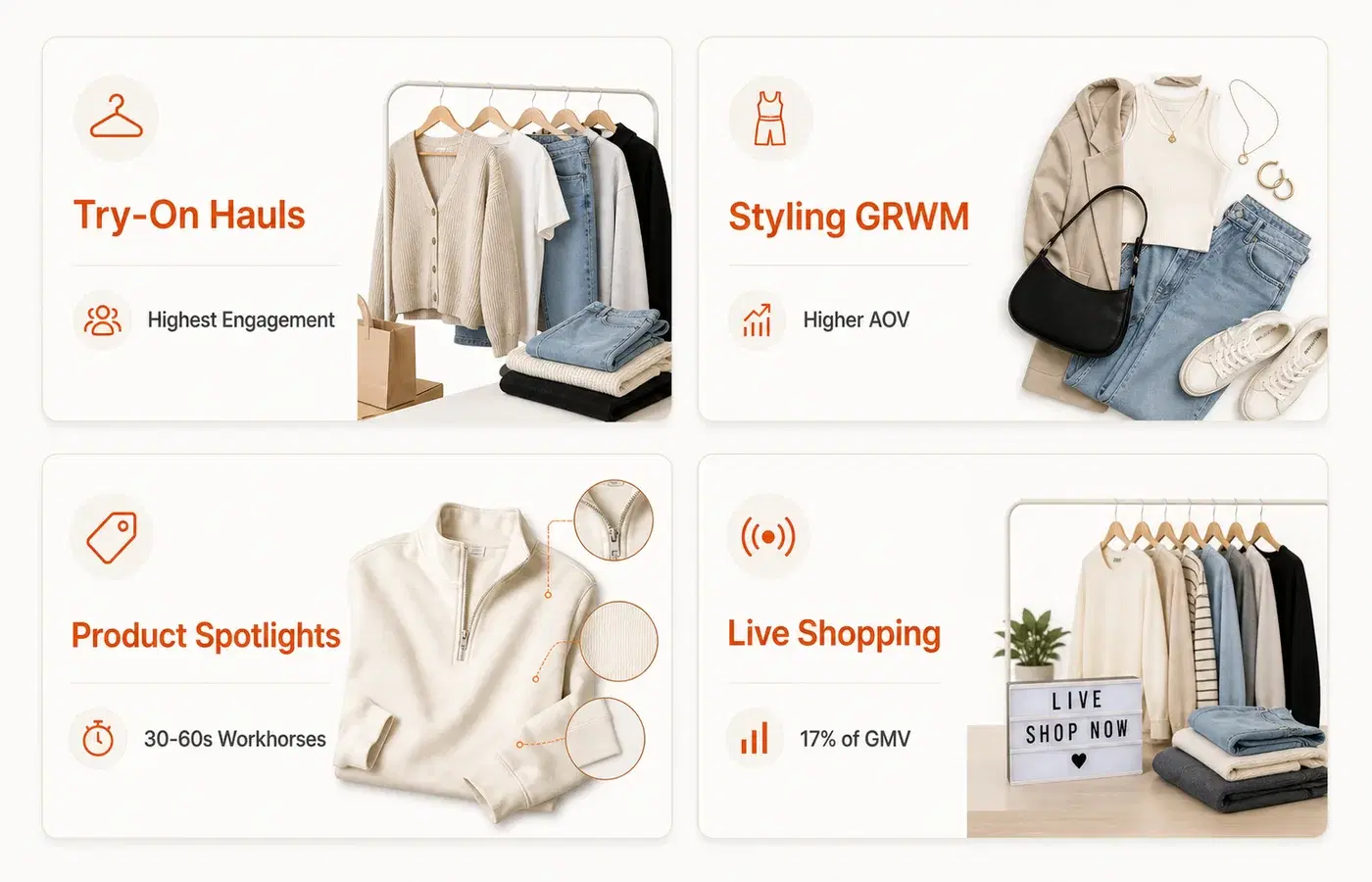
The Four Content Formats That Work for Clothing Brands
Try-on hauls are TikTok's highest-engagement apparel format. Show real fit, real movement, real proportions on a real person, not a ghost mannequin. The comment sections ("Is that true to size?" "What height are you?") signal to the algorithm that this video is driving genuine interest and deserve more reach.
Styling videos (GRWM) build outfit context around your products. A single hoodie becomes part of a complete look. Complete looks drive higher AOV because viewers buy multiple pieces to recreate the outfit they just watched. Brands that show multiple pieces together consistently see higher average order values.
Product spotlights (30-60 seconds) are your workhorses. One product. Lead with the most visually striking element, color, texture, print. Close-up of fabric and print quality. Show it in motion on a body. End with a product tag and price. Fast to produce, fast to watch, and they scale well when you're building a content library.
Live shopping sessions account for about 17% of TikTok Shop GMV. Seventy-six percent of platform shoppers have bought from a livestream. For clothing brands, lives work well for new drops, seasonal launches, and flash deals. Plan a real script: what you'll show, in what order, with timed reveals and audience interaction built in.
Content Volume: Not a Suggestion
Post 1-3 times per day. The algorithm needs multiple data points to understand what your content is about and who to route it to. Brands posting once a week starve the algorithm of signals. Brands posting daily start seeing compounding reach within the first 30 days.
Content consistency compounds. The brands hitting daily-posting cadence inside their first month tend to be the ones that simplified production to the point where it's no longer the bottleneck — built from existing product images, repurposed across formats, batched in a single sitting rather than filmed one at a time.
Tools that compress creation time translate directly into posting frequency, which translates directly into algorithmic reach. It's one of the few areas in e-commerce where the leverage is that clear. Vaybel's AI Product Video Generator is built for exactly this — generating lifestyle product videos from your existing product images so you can move from one post a week to multiple posts a day. Once you're posting at volume, track what's actually converting with Shop Insights so you can double down on the formats and products driving real GMV.
Building Your TikTok Shop Affiliate Program for Clothing Brands
Here's the number most founders running TikTok Shop for clothing brands are surprised by: for top-performing brands, the majority of TikTok Shop sales come from affiliate creators, not the brand's own videos. Pure Daily Care's CMO has publicly stated that ~80% of their TikTok Shop sales come from affiliates; Tarte Cosmetics reports ~88% of $40M+ in TikTok Shop revenue from affiliate creators.
Your own TikTok channel matters for brand credibility and some organic reach. But the growth engine is creator content. More than 800,000 US creators are now actively monetizing through TikTok Shop's affiliate program — looking for clothing and apparel products to promote. Your job is to make your products easy and attractive for them to pick up.
Open Collaboration vs. Targeted Collaboration
Open Collaboration allows any creator to find your product in the affiliate marketplace and promote it at your listed commission rate. Start here. Set your opening rate at 15-18%, above the fashion average of 10-13%, which is enough to stand out without overcommitting.
Targeted Collaboration is where you reach out to specific creators with custom arrangements: higher commission rates, product samples, exclusive discount codes, or bonuses for hitting revenue milestones.
Just launching your program? The creator sampling playbook in our TikTok Shop launch guide covers your first 20–50 sample sends and what to put in the creator brief.
Build a pool of 50 or more active affiliates. TikTok Shop rewards content volume across many creators. A post from a creator with 30,000 followers can outperform a mega-influencer if the content is authentic and the audience fit is tight. Volume diversifies your risk and gives the algorithm more signals to work with.
The Return Rate Math You Need to Run
Fashion return rates on TikTok Shop run 15-25%. If your stated commission is 20% but you're seeing 20% returns, your effective commission rate is approximately 26.6%, because you're paying commission on gross orders but absorbing returns net. According to ShortFormNation's 2026 affiliate data, the maximum sustainable commission for apparel brands targeting 15% profit margins typically falls between 14 and 19%, depending on your cost of goods.
Build your rates with that math in mind. And be transparent with creators about your policies, they'll respect it, and it filters for creators who are actually invested in your brand's long-term success, not just a quick commission.
Use Vaybel's AI Trend Finder to identify which clothing niches and styles are gaining traction right now, then recruit creators who already post in those categories. A fitness creator reviewing your athletic wear will almost always outperform a general lifestyle creator posting about fashion.
TikTok Shop Seasonal Strategy for Clothing Brands
Clothing is the most seasonal product category in e-commerce, and TikTok's algorithm amplifies this. Trends move fast. A style that's gaining traction in September can peak and fade by October. Timing matters more here than on Etsy or Shopify.
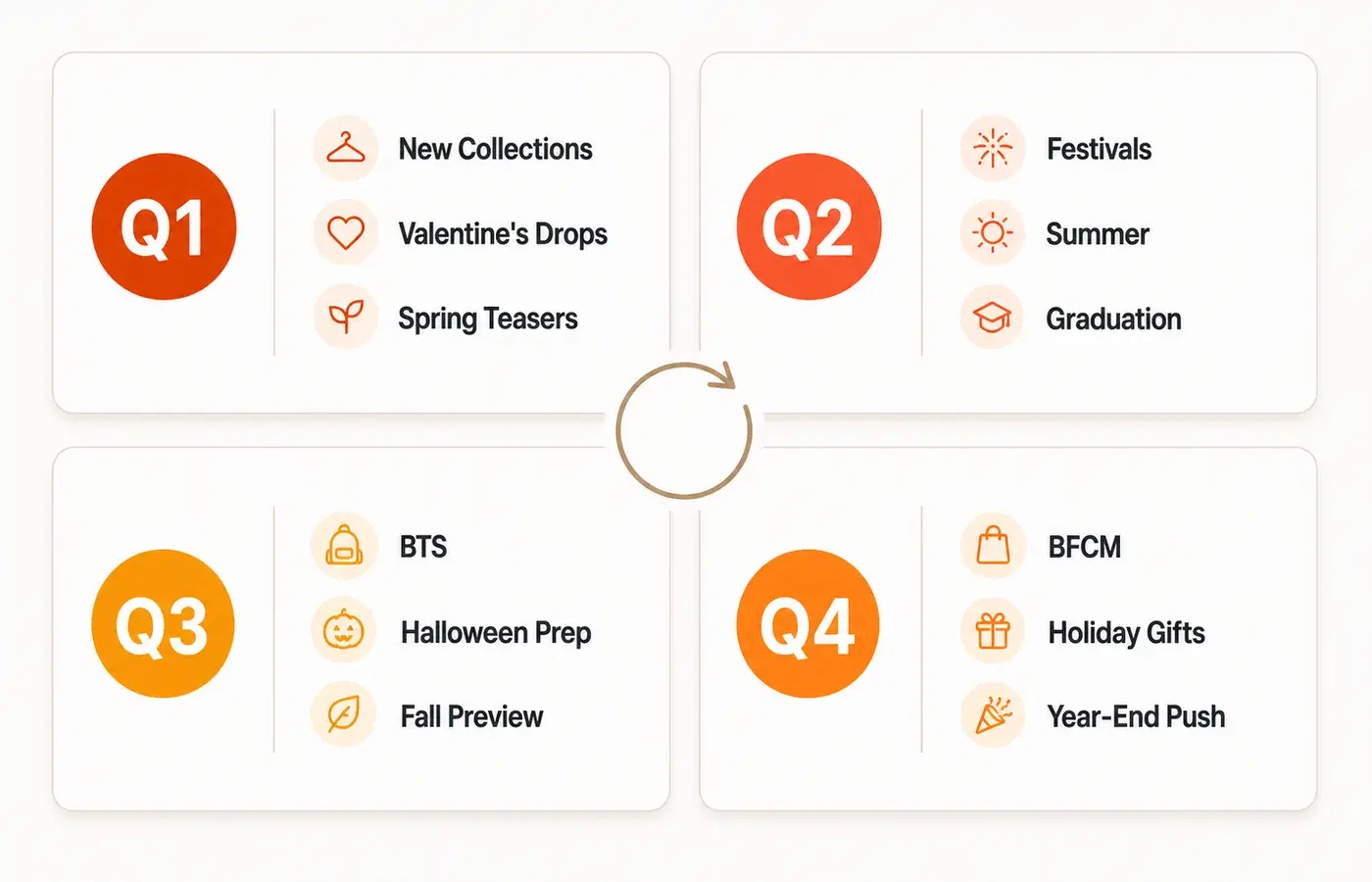
Here's a basic seasonal planning calendar for clothing brands on TikTok Shop:
Q1 (January-March) Start the year with fresh collections, not clearance. "New year, new aesthetic" content performs well in January. Valentine's Day clothing drops work well — but a timed affiliate push means recruiting creators three to four weeks ahead of the holiday, not the week before. Spring color palette teases in March warm up your audience for Q2 launches.
Q2 (April-June) Festival and summer collections are the anchor. Memorial Day sale content drives high-intent buyers. Graduation-themed drops (May-June) are underexploited in apparel, graphic tees, statement pieces, gifts. Mother's Day gift guide content is an easy affiliate play.
Q3 (July-September) Summer clearance with fall preview is a two-in-one content moment. Back-to-school styling content in late July and August. Halloween niche drops, particularly for streetwear and graphic tee brands, start gaining traction earlier than most brands expect, often in late August. Spend September building your affiliate pool before the Q4 rush, when creator inboxes fill up.
Q4 (October-December) This is where TikTok Shop separates the brands that planned from the ones that didn't. Black Friday: build content and creator relationships in October. Holiday gift guide videos for November, with emphasis on easy gifting and fast shipping. Christmas drops with express shipping callouts in early December. New year teasers in late December to prime the Q1 reset.
Start building creator relationships four to six weeks before each peak. Early outreach and marginally higher commission rates during peak periods win creator placements over brands that wait until two weeks out.
Vaybel's AI Trend Finder shows which clothing trends are gaining momentum by niche and season, so you can plan drops based on data instead of gut feel.
Clothing-Specific Challenges on TikTok Shop (and How to Handle Them)
Every product category has challenges on TikTok Shop. Clothing has more than most, and most guides don't address them.
Sizing and Fit
This is the primary driver of returns in apparel. Your size guide needs specific measurements, not just S/M/L/XL, but chest, waist, hip, and length. Include notes about the model's height and size in your product photos. A single line in your description ("Model is 5'7" wearing a size M, fits true to size, slightly relaxed through the shoulders") reduces return friction significantly without requiring expensive infrastructure.
Photography Requirements
TikTok Shop has stricter image requirements than most marketplaces. Your main product image must show the product clearly, with no text overlays, logos, or promotional banners on the first image. Lifestyle shots with real models outperform studio flat lays almost universally. Natural lighting, clear backgrounds, and garment-in-motion shots all outperform standard e-commerce photography in the TikTok feed.
Returns (15-25% for Apparel)
Returns are the biggest structural margin threat in fashion on TikTok Shop. You need a clear policy before you go live, not after your first viral moment creates 400 orders in 48 hours.
Key decisions to make in advance:
- Return window (7-14 days is the standard; shorter protects margin, longer can improve conversion)
- Who pays return shipping (buyer or brand)
- Condition requirements (unworn, with tags)
A tighter return policy reduces volume but protects margin. A generous policy can improve conversion rate. Find your balance based on your price point and cost of goods.
Inventory Management for POD Clothing Brands
If you're using print-on-demand through a provider like Printful or Printify, you technically have unlimited inventory, but TikTok's algorithm penalizes out-of-stock listings and limits their distribution. Make sure your POD integration keeps listings marked as available. If a design hits viral traction and fulfillment partners face delays, communicate clearly with buyers and have a backup plan ready.
Platform Prohibitions
Clothing is generally unrestricted on TikTok Shop, but watch your language around performance claims. Anything that sounds like a health benefit, "reduces inflammation," "improves posture," "aids circulation", can get your listing pulled, even on performance-wear that's legitimately functional. Stick to material claims ("moisture-wicking," "four-way stretch," "UPF 50+") and steer clear of anything that sounds medical.
TikTok Shop as Part of Your Multi-Channel Clothing Strategy
TikTok Shop works best when it's not your only channel. It works best when it's your discovery engine, the place new customers find you, feeding into a broader ecosystem you control.
Here's the multi-channel structure that works for independent clothing brands in 2026:
TikTok Shop, discovery and impulse purchase. Where new customers find you through creator content, shoppable videos, and the algorithm. Your customer acquisition channel.
Shopify, brand HQ. Where returning customers buy. Where you own the customer relationship, build your email list, and run your own promotions without a platform taking a cut.
Etsy, handmade, custom, or vintage-adjacent pieces. Search-driven buyers who are already looking for what you sell. Lower viral upside, but higher purchase intent.
The challenge is managing listings across three platforms without tripling your workload. That's what Vaybel's AI Listing Generator and TikTok Shop Automation are built for, write one product brief, and the platform generates optimized listings for TikTok Shop, Etsy, and Shopify simultaneously, each one formatted and keyword-optimized for where it's being published.
Multi-channel isn't more work if the workflow is right. It's more chances to catch customers at different stages of intent, the impulse buyer on TikTok, the research-driven buyer on Etsy, the loyal customer coming back to your Shopify store directly.
What It Takes to Win on TikTok Shop for Clothing Brands in 2026
TikTok Shop is the fastest-growing retail window for clothing brands right now. The numbers are real: $20 billion in projected US GMV this year, womenswear as the top category, 475,000 shops and growing.
So is the cost structure. Fashion brands pay a 6% referral fee plus creator commissions. Returns run 15-25%. The total cost of selling sits between 35 and 55% of revenue. The brands winning in 2026 built their strategy around that reality, not against it.
Start with the new-seller window. Register your shop, make your first sale within 60 days, and use the 3% promotional referral rate (the current 30-day promo) to build volume and test your affiliate program before standard fees kick in. Post daily, build your creator pool to 50 or more, and price your products with your full cost model in mind.
If you want to compress the whole workflow, from first design to live TikTok Shop listing, optimized and ready for creators to pick up, that's exactly what Vaybel is built for.
Design. Mockup. List. Sell. All from one place.