Last updated: 2026-09-16
Here's how to sell on TikTok Shop in short: register at Seller Center, verify your ID or business documents, add your tax, bank, and warehouse details, link your TikTok account, list your products, and start posting shoppable video. Approval usually lands within 24 to 48 hours, and sellers face no follower minimum. That part is straightforward. What decides whether a clothing brand actually makes money is the margin math underneath, and for apparel that math is governed by returns.
In November 2023, a creator with roughly 5,000 followers posted a video about PacSun's Casey low-rise baggy jeans. The style sold 11,000 pairs in 48 hours, and PacSun went on to do more than $20 million in TikTok sales off the back of its creator program.
You have probably read a version of that story already. It is the reason TikTok Shop sits on your list. What those stories leave out is the arithmetic: what you keep per order after fees, after affiliate commission, and after a fifth of your shipments come back because the fit was wrong.
This guide covers the complete setup sequence, how to find your real category fee instead of trusting a number from a blog, and a worked margin model on a mid-priced tee that carries the return rate all the way through. Every figure here is sourced or clearly labeled as a worked example.
Key Takeaways
- Setup is fast and free. Approval typically runs 24 to 48 hours, and sellers need no followers at all, though affiliate creators need 1,000.
- TikTok's published category table, dated May 14, 2026, lists Menswear and Underwear, including Men's Tops, at 6%. Several popular blogs claim apparel rose to 8% in August 2026, but none cite an official source. Check your own rate in Seller Center before you price anything.
- Returns, not fees, are what break apparel margins. Fashion runs 20% to 40% returns, the highest of any ecommerce category.
- In the worked example below, a $35 tee shows a 43.9% margin before returns and 24.1% after a 25% return rate. Roughly half the profit vanishes in a line item most guides never include.
- Creator-led content outperforms brand-account content. TikTok's H1 2026 GMV grew 92% year over year, and the sellers capturing it are running repeatable affiliate systems, not chasing single viral moments.
What You Need Before You Start
Gather these before you open the registration page. Missing documents are the most common reason approval stalls.
- Age and residency. You must be 18 or older with a valid US address.
- Government ID or business registration. Individual sellers use a driver's license or passport. Registered businesses use their formation documents.
- An EIN or SSN for tax reporting.
- A US bank account in the name on the account, for payouts.
- A warehouse or pickup address and a return address. These can be the same, and for print-on-demand brands they will be your provider's.
- A phone number and email not already tied to another TikTok Shop.
- No followers. This surprises people. The seller side has no follower threshold. Affiliate creators need 1,000 followers, and marketing creators need 5,000, but you don't need an audience to sell.
That last point matters more than it sounds. You can open a shop, list 20 products, and recruit creators who already have the audience you lack. The follower requirement lives on their side of the transaction, not yours.
Building your first catalog before you apply? See how Vaybel turns a product idea into a listing-ready design and mockup set. Explore the platform →
How to Set Up a TikTok Shop: Step by Step
Register at Seller Center and Pick Your Seller Type
Go to Seller Center and choose your country of residence, which also sets the market you sell into. You can sign up with a new email or your existing TikTok account.
You will then pick a seller type: individual, business, dropshipper, or affiliate. Pick carefully. Switching later means resubmitting documents, and the business type unlocks catalog imports that individuals don't get.
Submit Documents and Wait
Upload the ID or registration documents you gathered. Approval normally takes 24 to 48 hours, though verification can stretch it.
The usual cause of a stall is a mismatch. The name on your ID, the name on your bank account, and the name on your business registration need to agree. A middle initial on one and not the others is enough to trigger manual review.
Add Tax, Bank, and Address Details
Complete your tax profile, connect your payout bank account, then set your warehouse and return addresses.
Print-on-demand brands should enter their fulfillment provider's return address, not a home address. Returns routed to you personally create a handling problem you have no process for.
Link Your TikTok Account
Connect the TikTok account that will post your content. If you are a registered business, check whether you now need an Organization Account, a requirement that reportedly took effect on July 1, 2026. Confirm your own status in Seller Center rather than relying on secondhand summaries.
Set Up Your Shop Profile and Shipping
Add your brand name, logo, and shop description. Then set handling time and carrier options honestly. An unrealistic handling time produces late-shipment penalties against your shop health, and print-on-demand production adds days that retail sellers don't carry.
Listing Clothing That Actually Sells
Write Titles the Way People Search
TikTok Shop search behaves more like a marketplace than a social feed. Lead with the garment type, then the attribute a buyer would filter on: "Oversized Heavyweight Cotton Tee, Vintage Wash, Unisex" beats a brand-first title nobody is searching.
Put the material and fit in the first line of the description. These are the two fields that decide whether a buyer trusts the listing enough to skip the size-bracketing habit that drives returns.
Product Imagery Without a Photoshoot
Every guide tells you to use clear, high-quality images. None of them tell a solo founder how to get those images for 30 SKUs without a studio, a model, and a shoot day. That's the gap.
This is where AI mockups earn their place in the workflow. Vaybel generates product imagery without a photoshoot, including virtual models you can match to the audience you are actually selling to. The practical gain isn't artistic; it's that you can list a full drop in an afternoon instead of blocking on a photographer.
Pair every listing with video. TikTok Shop is a video-first surface, and a listing with no video is competing with one hand tied. Vaybel turns finished listings into TikTok-ready product videos in the vertical formats the feed expects.
Sizing and Fit: The Field That Controls Your Return Rate
Most clothing sellers treat the size chart as a compliance box. It's closer to a profit lever.
Fashion carries the highest return rate in ecommerce at 20% to 40%, and the dominant cause is fit uncertainty. Shoppers who can't judge fit order two sizes and send one back. Every one of those returns costs you the full production cost of a printed-to-order garment you can't resell.
Three things measurably reduce it. Publish garment measurements, not only S/M/L. State the model's height and the size they are wearing. Say plainly whether the piece runs oversized, true to size, or small.
Shamela Brown, a size-inclusive fashion creator, has driven nearly $5 million in GMV since November 2024 with try-on content built specifically around fit and real-world wearability. Her framing is worth borrowing: "I stopped treating TikTok Shop content as one-off viral moments and started building it like a repeatable system."
What TikTok Shop Actually Costs
How to Find Your Real Referral Fee
Don't take a fee number from a blog, including this one. Here's why.
TikTok's published category table, dated May 14, 2026, lists Menswear and Underwear, including Men's Tops, at 6%. A separate general fee policy page describes a 6% referral fee in place since April 1, 2024, and defines the fee base as the customer payment plus any platform discount, minus tax. Meanwhile a cluster of well-ranked seller blogs states that TikTok raised the standard US rate from 6% to 8% on August 4, 2026. None of them cite a TikTok announcement, a press release, or a Seller Center notice.
So the published rate is 6% and the claimed increase has no traceable source. That still doesn't mean 6% is your number. A public category table does not establish your account's specific rate, any promotional rate you are currently on, or a change made after the page was last revised.
So treat the rate as an input, not a fact. Open Seller Center, find your category's current referral rate, and build your pricing on that number. Then rebuild it whenever TikTok changes it. The same applies to new-seller promotional rates, which are quoted in at least two incompatible versions across the seller-blog ecosystem.
TikTok Shop Academy is the official reference for fee schedules and seller policy, and it is where that lookup should start:
The Full Cost Stack
Your costs fall into four layers, and only the first is fixed by TikTok:
- Referral fee, a percentage of item price, set by category.
- Affiliate commission, which you set yourself, typically in the low-to-mid teens for apparel.
- Production and shipping, paid to your print-on-demand provider.
- Returns, the layer nearly every published margin model omits.
There is no listing fee and no monthly subscription. Affiliate commission only applies when a sale happens, which makes it the safest of your variable costs.
A Worked Margin Model on a Mid-Priced Tee
The following is a worked hypothetical, not measured customer data and not actual net take-home profit. Substitute your own numbers.
Assume a $35 retail price, $12 production cost, a 6% referral fee, and 15% affiliate commission.1
| Line item | Per order | Source of the number |
|---|---|---|
| Retail price | $35.00 | Your pricing decision |
| Production cost | ($12.00) | Your POD provider's quote |
| Referral fee at 6% | ($2.10) | TikTok's published men's tops rate |
| Affiliate commission at 15% | ($5.25) | Rate you set |
| Assumed other operating overhead | ($0.30) | Your own allowance, not a TikTok fee |
| Gross margin before returns | $15.35 | 43.9%1 |
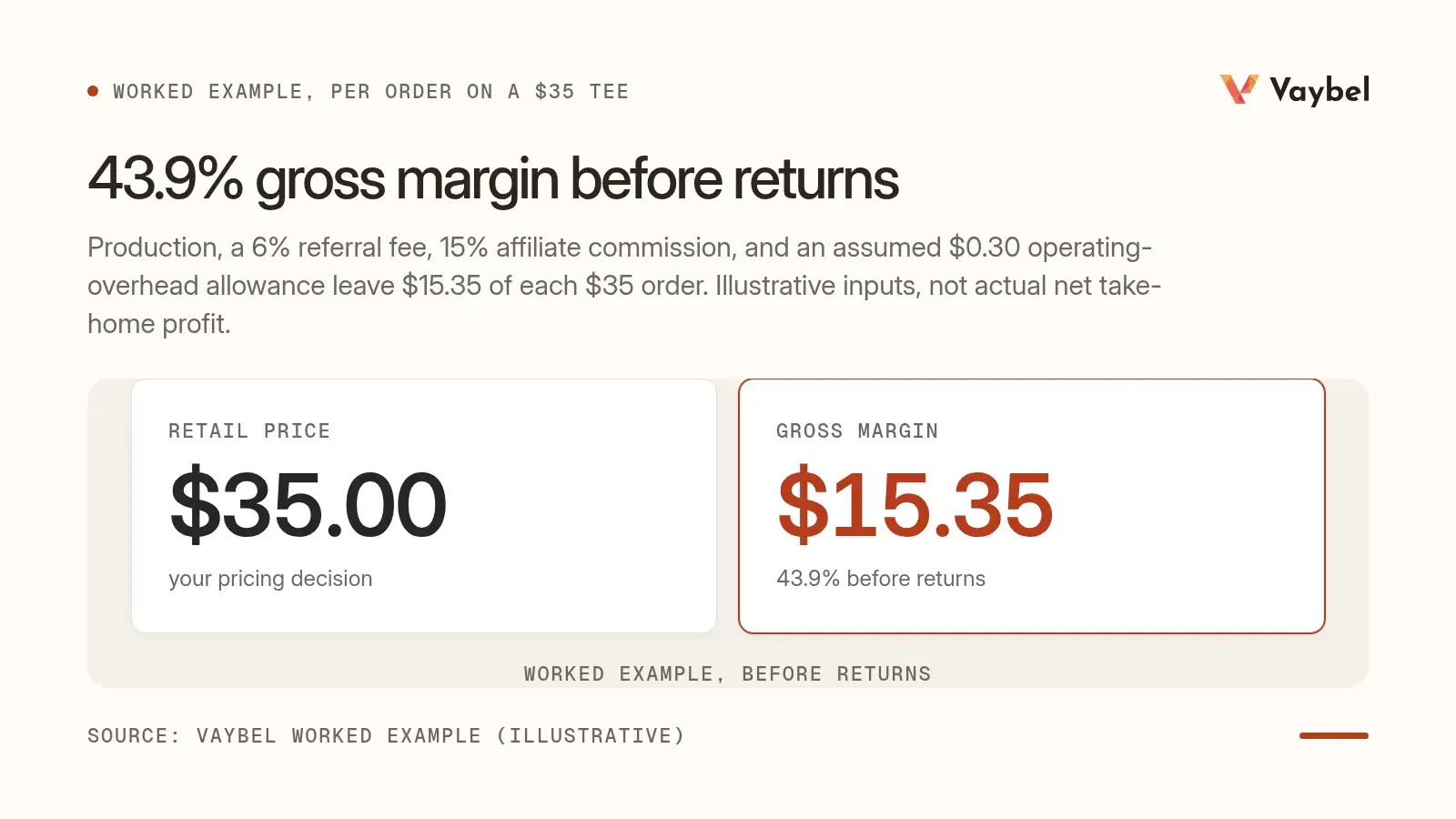
That $0.30 is an assumed allowance for other operating overhead, chosen to keep the example honest about the costs a seller carries per order.1 It is not an additional TikTok transaction fee, and TikTok does not levy it.
This model is also deliberately narrow. It excludes shipping, advertising, and refund administration charges, along with any other platform or payment charges that apply to your account. Add each of those to your own calculation as applicable, and confirm what TikTok actually charges you against the official fee policy linked above.
That 43.9% is the number most guides stop at. Now carry it through 100 orders at a 25% return rate, which sits mid-range for apparel's 20% to 40% band.
| Line item | 100 orders |
|---|---|
| Gross revenue | $3,500.00 |
| Refunds on 25 returns | ($875.00) |
| Net revenue | $2,625.00 |
| Production on all 100 garments | ($1,200.00) |
| Referral fees on 75 kept orders | ($157.50) |
| Affiliate commission on 75 kept orders | ($393.75) |
| Assumed other operating overhead, 100 orders | ($30.00) |
| Net margin | $843.751 |
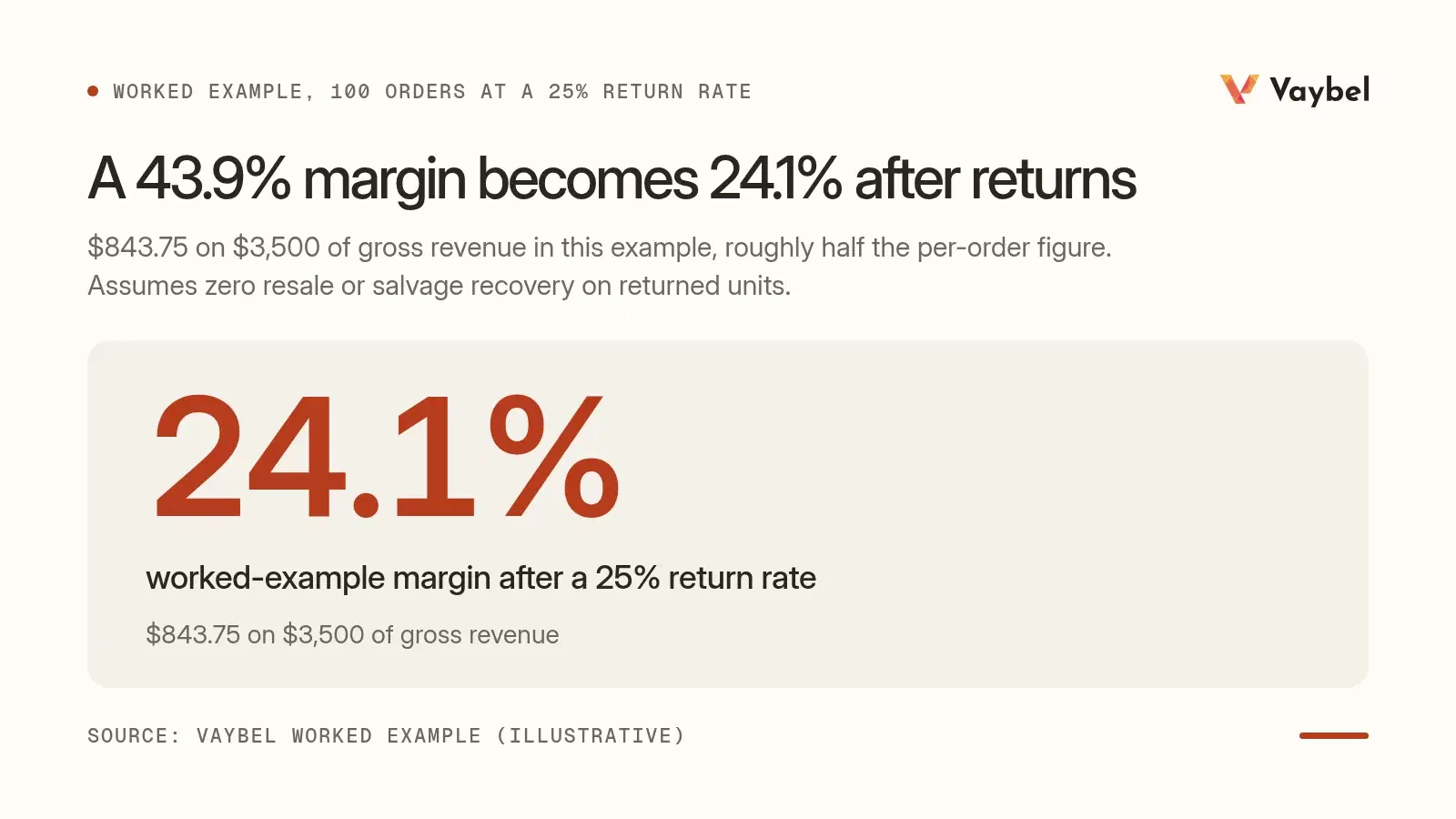
$843.75 on $3,500 of gross revenue is 24.1%.1 Against net revenue it is 32.1%. Either way, roughly half the profit implied by the per-order view is gone.
The line that does the damage is production on all 100 garments.1 This example assumes zero resale or salvage recovery on returned units, which is the harshest case: every returned garment is written off in full. Your own recovery may well be higher. If you can resell returns as seconds, run a sample sale, or route them to a liquidator, add whatever value you can realistically realize back into your own calculation. Printed-to-order apparel does tend to recover less than stocked inventory, which is why a 25% return rate can hurt a clothing brand more than it hurts a phone-case seller.
Two practical consequences. First, price with the return rate in the model from day one rather than discovering it in month three. Second, spending on better measurements, honest fit notes, and try-on video may pay for itself if it moves your return rate, though whether it does depends on your products, your audience, and what the work costs you.
Ready to price a real catalog instead of a hypothetical one? Vaybel builds designs, mockups, and listings in one workflow, so you can test pricing across a full drop before you commit. Start your free trial →
Content That Sells Clothing on TikTok Shop
The Formats That Work for Apparel
Four formats carry most clothing sales, and they are not equally weighted:
- Try-on and fit video. The highest-converting format for apparel, because it answers the objection that drives returns.
- Styling videos. One piece, three outfits. Demonstrates versatility and raises perceived value.
- Behind-the-design. How the graphic came together, why the blank was chosen. Builds the brand rather than the SKU.
- Live selling. Strong for drops and size questions answered in real time.
In H1 2026, roughly 52% of TikTok GMV moved through the Shop tab, about 40% through video, and around 8% through livestreaming. Live is real but it's not where the volume is. Build the video engine first.
Posting Volume Is Not Optional
One video per week will not move a clothing catalog. The brands that compound are posting daily or near-daily, treating content as inventory rather than as campaigns.
This is the operational wall most solo founders hit, and it's the honest argument for automating the production side. You can't personally film 30 pieces of content a week and also run a brand. Vaybel can automate your TikTok Shop listings and the content that feeds them, which shifts your time from production to selection.
Working With Affiliate Creators
Open Versus Targeted Collaboration
TikTok gives you two recruitment modes and they solve different problems.
Open collaboration publishes your commission rate to the whole creator marketplace and lets anyone promote you. High volume, low control, useful when you have no reputation yet.
Targeted collaboration means you approach specific creators with a specific offer. Lower volume, much higher fit, appropriate once you know which audience converts.
Start open to generate data on which creators self-select toward you. Then move budget toward targeted offers for the ones who actually sell.
Commission and Sampling
Commission for apparel generally sits in the low-to-mid teens. Setting it materially below what comparable brands offer means creators pick them instead, since their effort is identical either way.
Product sampling is the real activation mechanism. A creator who has worn the garment makes better content than one working from your product photos, which for clothing is the entire ballgame. Budget samples as customer acquisition cost, not as marketing collateral.
The PacSun example is instructive precisely because the creator was small. A 5,000-follower account moved 11,000 pairs of jeans in two days. Reach was not the variable; fit with the audience was.
Scaling Once the Orders Start Coming In
Once you have real order history behind you, you finally have data worth acting on. Three things change.
Read your return rate by SKU, not in aggregate. One badly sized style can carry your whole average. Fix or kill it rather than discounting across the catalog.
Expand into what sold, not into what you like. Take the winning silhouette and extend it through colorways and adjacent graphics before adding a new garment type.
Watch for counterfeits. Once a product works on TikTok Shop, copies appear quickly, and clothing is among the easiest categories to knock off. Our guide to handling counterfeit sellers on TikTok Shop covers the takedown process.
Frequently Asked Questions
How long does TikTok Shop approval take? Typically 24 to 48 hours. Delays almost always trace to a mismatch between the name on your ID, your bank account, and your business registration.
Do I need followers to sell on TikTok Shop? No. Sellers have no follower requirement. Affiliate creators need 1,000 followers and marketing creators need 5,000, but those thresholds apply to the people promoting your products, not to you.
How much does TikTok Shop charge to sell clothing? TikTok's published category table, dated May 14, 2026, lists men's tops at 6%, though some seller blogs claim a 2026 increase to 8% without citing a source. Rates vary by subcategory, so verify your own in Seller Center before pricing. There is no listing fee or monthly subscription.
What clothing sells best on TikTok Shop? Fashion is one of the largest categories on the platform, with womenswear leading. Pieces that demonstrate well on video, meaning anything with visible drape, texture, or a styling story, outperform flat graphic tees.
Can I sell print-on-demand on TikTok Shop? Yes. Set your provider's address as the return address and set handling times that account for production days, or late-shipment penalties will damage your shop health score.
Where to Start
Selling on TikTok Shop comes down to four things: get approved with clean documents, list with imagery and fit information that preempt returns, price against your verified category fee rather than a blog's number, and build a creator program instead of waiting for a viral moment.
The margin math is the part worth sitting with. A 43.9% per-order margin that becomes 24.1% after returns is still a workable business, but only if you knew about the second number before you set your prices.1
Start this week: pull your actual referral rate from Seller Center, price one product with a 25% return rate built into the model, and publish garment measurements on every listing you already have.1
Start your free trial → and build your first TikTok Shop-ready drop, from design through listing, in a single workflow.
Footnotes
-
Worked example, not actual net take-home profit. The $35 retail price, $12 production cost, 15% affiliate commission, and $0.30 per-order overhead allowance are illustrative inputs chosen to show the method, not measured customer data. The $0.30 is an assumed allowance for the seller's other operating overhead, not a TikTok transaction fee. Every downstream figure is arithmetic from those assumptions plus TikTok's published 6% men's tops referral rate. The model excludes shipping, advertising, and refund administration charges, and assumes zero resale or salvage recovery on returned units. Substitute your own numbers and add the costs and recoveries that apply to you. ↩ ↩2 ↩3 ↩4 ↩5 ↩6 ↩7 ↩8