Last updated: 2026-06-25
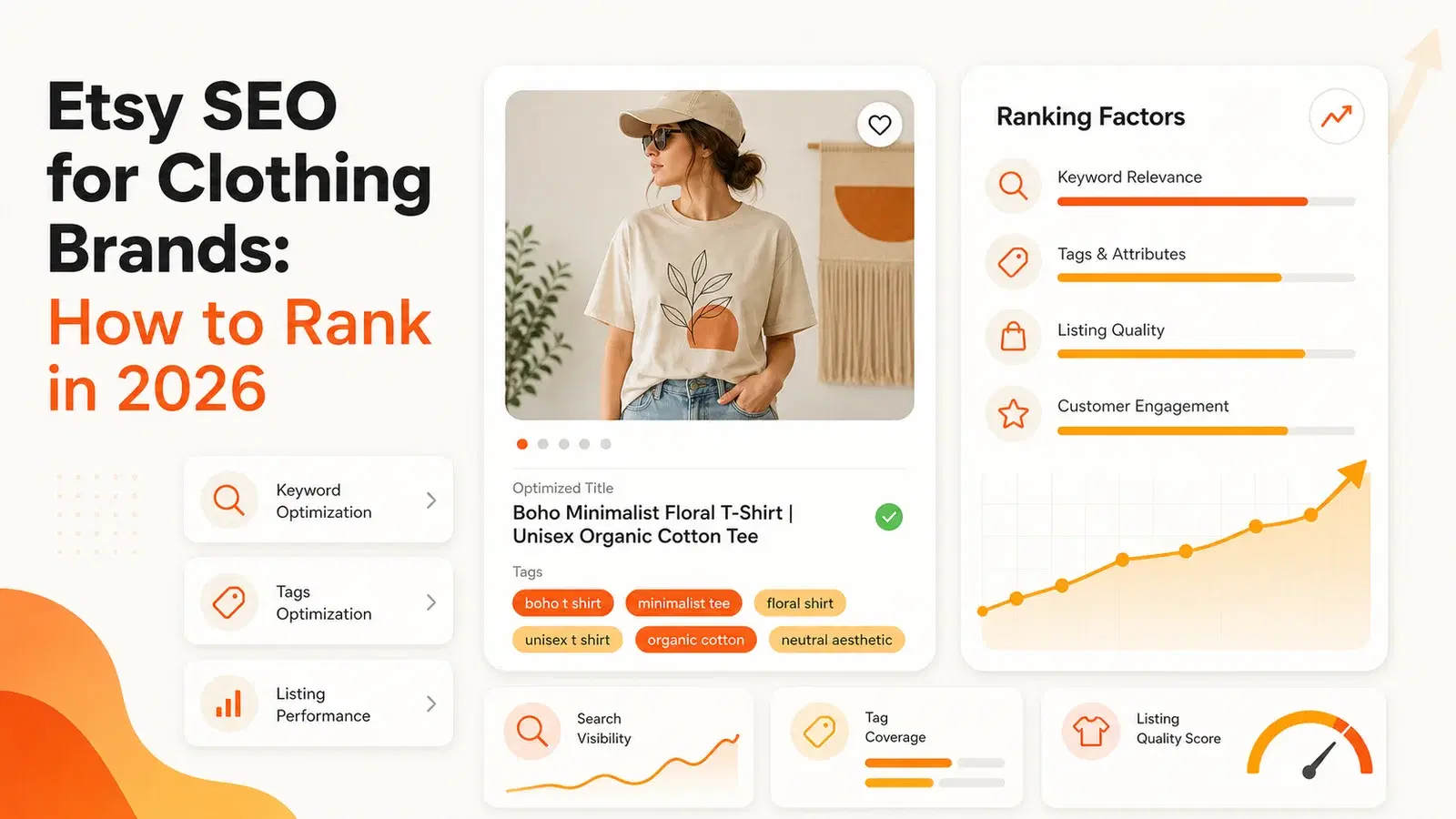
Etsy SEO for clothing brands in 2026 comes down to a single shift: Etsy now ranks the listings buyers click, stay on, and buy, not the ones stuffed with the most keywords. If your designs are live but invisible, the fix isn't more tags. It's matching the buyer's exact search and then earning the click and the sale.
Here's the uncomfortable part. Search "graphic t-shirt" on Etsy and your listing is one of millions of active listings.1 At the same time, Etsy's active buyer base actually shrank slightly last year, to roughly 86.5 million shoppers.2 More competition, fewer buyers to win, and an algorithm that just rewrote the rules in your favor if you know them.
You already know generic "Etsy SEO tips" exist by the thousand. Most are written for jewelry and digital downloads, and they leave apparel founders guessing about the things that actually decide whether a t-shirt ranks: variations, occasion keywords, image click-through, and the 2026 engagement signals.
This guide is the apparel-specific version. You'll get the exact ranking factors Etsy uses now, a title and tag formula built for clothing, the attribute and image moves most sellers skip, and the production reality nobody talks about: how to make enough optimized listings to build the sales velocity Etsy rewards.
Key Takeaways
- Etsy's 2026 algorithm weighs engagement (click-through, add-to-cart, purchase, and now dwell time) as heavily as keyword relevance, so a weak first image sinks a keyword-perfect listing.
- Titles should front-load the buyer's exact phrase, read like natural language, and stay under about 15 words, per Etsy's own seller guidance.
- Fill all 13 tags with distinct multi-word phrases, never single words, and never repeat what's already in your title or category.
- For apparel, US shipping over $6 lowers your search visibility, so price free or sub-$6 shipping into the product.3
- Standard t-shirts are the most saturated product on Etsy (millions of active listings).1 You win on niche, occasion, and long-tail, not on "t-shirt," and you win by producing enough optimized listings to build velocity.
How the Etsy Algorithm Actually Works in 2026
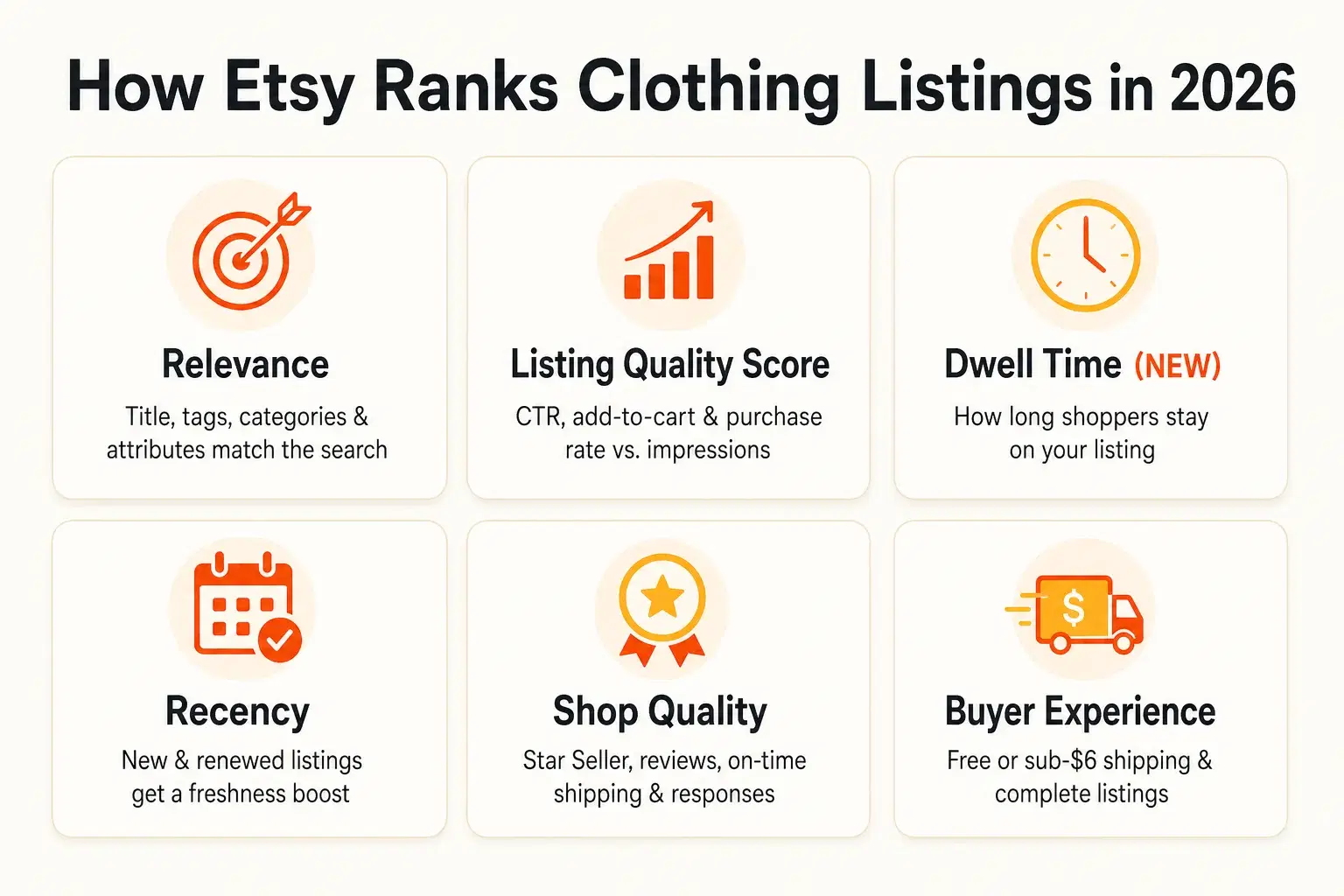
Etsy search works in two stages. First, relevance decides whether you qualify for a query at all: your title, tags, categories, and attributes have to match what the shopper typed. Then a set of quality and experience signals decides your position among everyone who qualified.
That second stage is where 2026 changed. Etsy now leans harder on how buyers behave once your listing appears: click-through rate, add-to-cart rate, and purchase completion relative to impressions.
The newest signal is dwell time, how long a shopper stays after clicking. An instant bounce tells Etsy your listing wasn't what they wanted. A shopper who reads your description or watches your video tells Etsy the opposite.
Want to see how this looks applied to a real catalog instead of one listing? See how Vaybel turns a design into an Etsy-ready listing →
Here are the factors that decide your rank, and the lever you actually control for each.
| Ranking factor | What it is | How to influence it |
|---|---|---|
| Relevance | How well your title, tags, categories, and attributes match the search | Front-load the buyer's exact phrase; fill all 13 tags and every attribute |
| Listing Quality Score | CTR, add-to-cart, and purchase rate vs. impressions, plus favorites and recent sales | Win the click with a strong first image; win the sale with clear photos and a fair price |
| Dwell time (new for 2026) | How long shoppers stay on the listing after clicking | Give them a reason to stay: multiple photos, a short video, a scannable description |
| Recency | New and renewed listings get a temporary freshness boost | Add listings steadily instead of dumping a full catalog at once |
| Shop quality | Star Seller status, review score, on-time shipping, response time | Ship fast, answer messages, protect your ratings |
| Buyer experience | Price, shipping cost, completeness of the listing | Free or sub-$6 shipping,3 competitive price, no blank fields |
The takeaway: keyword-perfect is the entry ticket, not the finish line. If nobody clicks, stays, and buys, you slide.
Why Apparel Is Different (Read This Before the Tactics)
Etsy is a real apparel marketplace. Its top six categories make up roughly 85% of all sales, and clothing sits among them.2 But standard t-shirts are the single most saturated print-on-demand product on the platform, with millions of active listings competing for the same generic searches.
The honest framing: Etsy isn't saturated, it's stratified. Broad markets like "funny t-shirt" are hopelessly overcrowded, while micro-niches stay wide open. With the overall buyer pool flat to shrinking, chasing the biggest keywords is the worst possible move. You want the specific shopper who knows exactly what they want.
So you don't rank for "t-shirt." You rank for a niche, an occasion, and a recipient stitched into one long-tail phrase. "Retro running club shirt for marathon runners" has a fraction of the competition and a buyer who is closer to checkout. Finding that underserved angle before you design is half the battle, which is exactly what tools like Vaybel's AI Trend Finder are built to surface.
This is also the difference between Etsy and a discovery channel. If you're weighing the two, our guide to selling clothing on TikTok Shop breaks down when each one wins. Etsy is your evergreen search engine; TikTok is your viral top of funnel.
Write Titles That Rank (And Read Like a Human)
The 2024 playbook of comma-stuffed keyword soup is dead. Etsy's own seller guidance now tells you to write titles in natural, conversational language and to consider keeping them under about 15 words. Search engines only show the first 50 to 60 characters anyway, so the front of your title carries the weight.
A simple apparel title formula works:
[Primary buyer phrase] + [key attribute] + [occasion or recipient]
Compare the two approaches:
- 2024 (stuffed): "Running Shirt Run Tee Marathon Gift Runner Tshirt Track Vintage Retro Jogging Top Men Women"
- 2026 (natural): "Retro Running Club Shirt, Vintage Marathon Tee, Gift for Runners"
The second reads like a human wrote it, front-loads the exact phrase a buyer types, and still covers three distinct search angles. Use one primary query per listing, and don't repeat that same phrase across your shop. Etsy typically surfaces only one or two of your listings for the same search, so ten near-identical titles just compete with each other.
Writing one strong title is easy. Writing a distinct, front-loaded, natural-language title for every SKU in a growing catalog is where most founders stall, and where an AI listing generator earns its keep by producing one unique primary query per product.
Use All 13 Tags as Distinct Long-Tail Phrases
Every empty tag is an abandoned ranking path. Etsy gives you 13 slots, and each one is a separate chance to match a different search. If you use eight, you've thrown away five.
Two rules separate tags that rank from tags that waste slots:
- Use multi-word phrases, never single words. "Coffee lover gift" ranks. "Coffee" does not. Each tag can hold up to 20 characters, so use them.
- Make every tag distinct. Don't repeat what's already in your title or your category. If your category is already "T-shirts," don't burn a tag on "t-shirt." Cover new ground: material, occasion, recipient, style, and use case.
Here's a full tag set for that retro running shirt, with no wasted overlap:
retro running shirt, vintage marathon tee, gift for runners, runner gift for him, running club apparel, track and field tee, marathon training gift, jogging shirt women, cross country gift, vintage athletics tee, retro sports shirt, running coach gift, half marathon shirt
The workflow behind that list is repeatable: seed from your niche plus an occasion plus a recipient, expand into long-tail variations with a keyword tool like eRank (free to $29.99/mo), Marmalead (around $19/mo), or Sale Samurai (around $9.99/mo),4 then assign one distinct phrase per slot. The tool surfaces the phrases. The discipline is in not repeating yourself.
Variations and Attributes: Apparel's Secret SEO Weapon
This is the section generic guides skip in one line, and it's where clothing listings live or die. Attributes (color, material, occasion, recipient) and variations (size, color) do double duty for apparel: they're invisible keywords and they're filter paths.
When a shopper narrows to "black t-shirts for women" inside a price filter, Etsy only surfaces listings whose attributes are set correctly. Leave the color or recipient attribute blank and you simply don't exist in that filtered view. Worse, you've left free ranking signal on the table, because fully completing your attributes also frees up tag slots you'd otherwise spend describing the obvious.
Variations matter just as much. Setting up size and color as variations on one listing keeps all your reviews, favorites, and sales velocity consolidated on a single strong listing instead of fragmenting them across near-duplicates. One listing with 40 reviews outranks four listings with 10 each.
The move is simple to say and tedious to do: pick the deepest, most specific subcategory Etsy offers, then fill every attribute field for apparel. Do it on every listing.
Your First Image Is Now a Ranking Factor
Because the 2026 algorithm weights click-through, conversion, and dwell time, your first listing photo stopped being a design choice and became an SEO asset. A scroll-stopping thumbnail earns the click that lifts your rank. A flat, low-contrast mockup buries you no matter how perfect your tags are.
A few apparel-specific image rules:
- Design for the thumbnail. Your image competes at the size of a postage stamp in search. High contrast and a readable design beat fine detail every time.
- Show it on a body. Shoppers need scale and fit. A mockup on a model converts better than a flat lay.
- Add lifestyle context in images two and three, and add a short video where you can. Video is one of the strongest dwell-time levers you have, because a shopper who watches stays longer.
The barrier here is obvious: photoshoots are slow and expensive, and you need fresh imagery for every color and fit. That's why generating clothing mockups without a photoshoot has become a core SEO skill, not just a design shortcut. The same AI mockups that earn the click in search become your full product gallery.
Ready to test the difference a stronger first image makes? Generate model-quality mockups across every color and fit without a shoot. Try Vaybel's AI Mockup Generator free →
Shipping, Reviews, and Shop Authority Are SEO Too
Most guides bury these as operational afterthoughts. In 2026 they're ranking signals, so treat them that way.
The big one for apparel: Etsy now factors shipping price directly into US search visibility. Listings with shipping over $6 lose visibility, because the data shows buyers abandon once shipping crosses that line. Free or sub-$6 shipping is a ranking lever, full stop.
Let's make that concrete with a quick, clearly hypothetical example.5 Imagine two identical tees. Listing A is priced at $19 with $7 shipping; Listing B is priced at $24 with free shipping. Same $26 to the buyer, but Listing B ranks higher, reads cleaner at checkout, and avoids the shipping-fee penalty. Price the shipping into the product and offer it free.
The rest compounds over time. Your Shop Quality signals (Star Seller status, review score, on-time shipping, response time) feed directly into rank, and recency gives new or renewed listings a temporary freshness boost. The practical move is to feed your catalog steadily rather than dumping everything in one weekend, so you're always banking a little freshness.
The Velocity Problem: Why One Perfect Listing Isn't Enough
Here's the part the tactics-only guides never address. Etsy rewards sales velocity across a catalog, not a single flawless listing. The quality score is relative to impressions and recent sales, which means you need many well-optimized, well-imaged, apparel-correct listings all feeding each other.
That exposes the real bottleneck. Knowing the rules isn't hard. Hand-crafting a front-loaded title, 13 distinct tags, complete attributes, and a scroll-stopping image, then repeating that across dozens or even hundreds of SKUs, is where a solo founder hits a wall. Most sellers don't have a ranking problem. They have a production problem.
The edge in 2026 is throughput. The brand that can move from trend to design to high-CTR mockup to optimized listing copy in one pass populates a catalog fast enough to build velocity, while the seller doing it by hand is still on listing number five. This is exactly the loop Vaybel is built to close: find the underserved niche, generate the design, produce the mockups, and write the Etsy-ready listing copy, so the constraint stops being your time.
If you're earlier in the journey and still picking products, our guide to choosing the right blanks and our Etsy print on demand beginner's guide cover the groundwork before you optimize for search.
The Cross-Channel Flywheel: TikTok and Pinterest Lift Etsy Rank
One more lever competitors barely mention: Etsy treats inbound traffic from social platforms as a brand-authority vote that boosts your organic visibility. External clicks from TikTok and Pinterest don't just bring direct sales, they signal to Etsy that your listings are worth surfacing.
For a clothing brand already making short-form content, that's close to free. The same design and mockup assets that drive TikTok discovery also drive the external clicks that lift Etsy rank. One asset set, two channels, compounding.
The simple way to think about it:
| Channel | Strength | Role |
|---|---|---|
| TikTok Shop | Viral discovery and affiliate reach | Top of funnel, new demand |
| Etsy | Evergreen search and return buyers | Bottom of funnel, intent capture |
Run both. The two channels feed each other, and the assets are interchangeable. For the full breakdown of how they compare, see our TikTok Shop clothing brand guide.
Frequently Asked Questions
How does the Etsy algorithm work in 2026? It runs in two stages. Relevance (your title, tags, categories, and attributes) decides whether you match a search, then quality and experience signals (click-through, add-to-cart, purchase, dwell time, shipping, recency, and shop quality) decide your position. Engagement now weighs as heavily as keywords.
How many tags should I use on an Etsy clothing listing? All 13. Each should be a distinct multi-word phrase covering a different buyer intent, and none should repeat your title or category.
Why aren't my Etsy listings showing up? Usually one of four things, in this order: you're targeting a saturated generic keyword, your first image earns too few clicks, your attributes are incomplete so you miss filtered searches, or your shop is too new to have velocity. Diagnose in that order.
What's the best Etsy keyword tool for clothing? eRank, Marmalead, and Sale Samurai all work. The tool matters less than the workflow: seed from niche plus occasion plus recipient, expand into long-tail, and assign one distinct phrase per tag.
Should I sell t-shirts on Etsy in 2026? Only with a specific niche and long-tail angle. Generic tees are the most saturated product on the platform. A "retro running club shirt" can rank where a plain "graphic tee" never will.
Can I use print on demand and still rank on Etsy? Yes. Ranking is about optimization and engagement, not fulfillment method. POD listings rank fine when the title, tags, attributes, images, and shipping are dialed in.
The Bottom Line
Etsy SEO for clothing brands in 2026 is the sum of a few things done consistently: the right niche instead of the saturated keyword, apparel-correct titles and tags and attributes, a first image that earns the click, free or sub-$6 shipping,3 and enough optimized listings to build the velocity Etsy rewards.
None of those moves are secret. The structural advantage goes to the brand that can actually produce them at scale, generating the niche, the design, the high-CTR mockup, and the optimized copy in one pass while competitors hand-craft one listing at a time. That's the difference between knowing how to rank and ranking.
Vaybel closes that loop for clothing brands across Etsy and TikTok, so your bottleneck stops being production and starts being how fast you want to grow.
Start building Etsy-ready listings with Vaybel, free →
Then keep the flywheel turning with our TikTok Shop clothing brand guide.
Footnotes
-
PrintCube, "Is Etsy Too Saturated for Print on Demand in 2026?" — notes t-shirts as the most competitive POD category with the highest listing density. https://printcube.io/blog/is-etsy-too-saturated-for-print-on-demand ↩ ↩2
-
Etsy Inc. FY2026 results and Business of Apps, "Etsy Revenue and Usage Statistics (2026)." https://www.businessofapps.com/data/etsy-statistics/ ↩ ↩2
-
Etsy Seller Handbook, "Updating How Shipping Price Is Factored Into Search for US Domestic Listings." https://www.etsy.com/seller-handbook/article/1293023712519 ↩ ↩2 ↩3
-
Pricing per eRank, Marmalead, and Sale Samurai (2026); plans change, so confirm current rates before citing. ↩
-
Illustrative example for explanation only; not figures from a specific seller. ↩