Last updated: 2026-06-18
The fastest way to sell activewear on TikTok Shop is to copy the mechanics the breakout brands already proved: launch a wide catalog fast, let one hero legging carry discovery, recruit an army of micro-creators paid on commission, and feed the algorithm hundreds of short demo videos a month. That's the whole playbook. The difference between brands that stall at a few thousand dollars and brands that scale into eight figures isn't budget or luck. It's speed, and speed is now something a single founder can buy.
Here's the proof that the playbook works. One activewear brand opened its US TikTok Shop in mid-October 2023 and sold roughly 60,000 products in its first month, generating an estimated $1.7 million in its first full month, according to TikTok analytics platform EchoTik. Within two years it crossed $101 million in lifetime TikTok Shop revenue. That brand is Halara, and almost none of what it did requires a warehouse, a film crew, or a Series A.
You've probably already seen the leggings. The split-hem ones, the "squat-proof" tests, the same five silhouettes restyled a thousand ways across your For You page. What you haven't seen is the structure underneath. This guide reverse-engineers that structure into a six-step playbook, attaches the real numbers to each step, and shows how an AI-native brand can run the same plays solo. Vaybel is an official TikTok Shop App Store partner, and the AI tools referenced below are part of that certified integration.
Disclosure: Halara is not a Vaybel customer, does not use Vaybel technology, and is not affiliated with Vaybel in any way. It is cited here solely as an independent case study to illustrate what's possible on the platform.
Want to see the catalog-and-content pipeline behind this before you read the playbook? Explore the product workflow →
Key Takeaways
- Halara opened its US TikTok Shop in October 2023, did an estimated ~$1.7M in its first full month, and reached a ~$6.9M/month run rate by August 2025 on the way to $101.86M lifetime, according to TikTok analytics tools Tramicheck and EchoTik.
- The two growth engines were catalog velocity (~1,000 SKUs, fast trend-to-listing turnaround) and content velocity (22.6K active affiliate creators, thousands of videos), both of which used to require a team.
- One legging SKU (the UltraSculpt SoCinched) drove an estimated $20.54M and 735K units on its own. Hero products seed the algorithm; you over-invest in the one creators love.
- The small-brand version: launch 8–12 SKUs, recruit 10–30 micro/nano creators with $500–$2K in sampling, post 200–300 videos a month, and run LIVE 2–4 times a week.
- Activewear's edge on TikTok Shop is that it's natively demonstrable, squat tests, fit checks, and compression side-by-sides convert in 15 seconds. Generic guides say "make videos"; the formats that actually sell activewear are specific.
In this guide:
- Why activewear is built for TikTok Shop
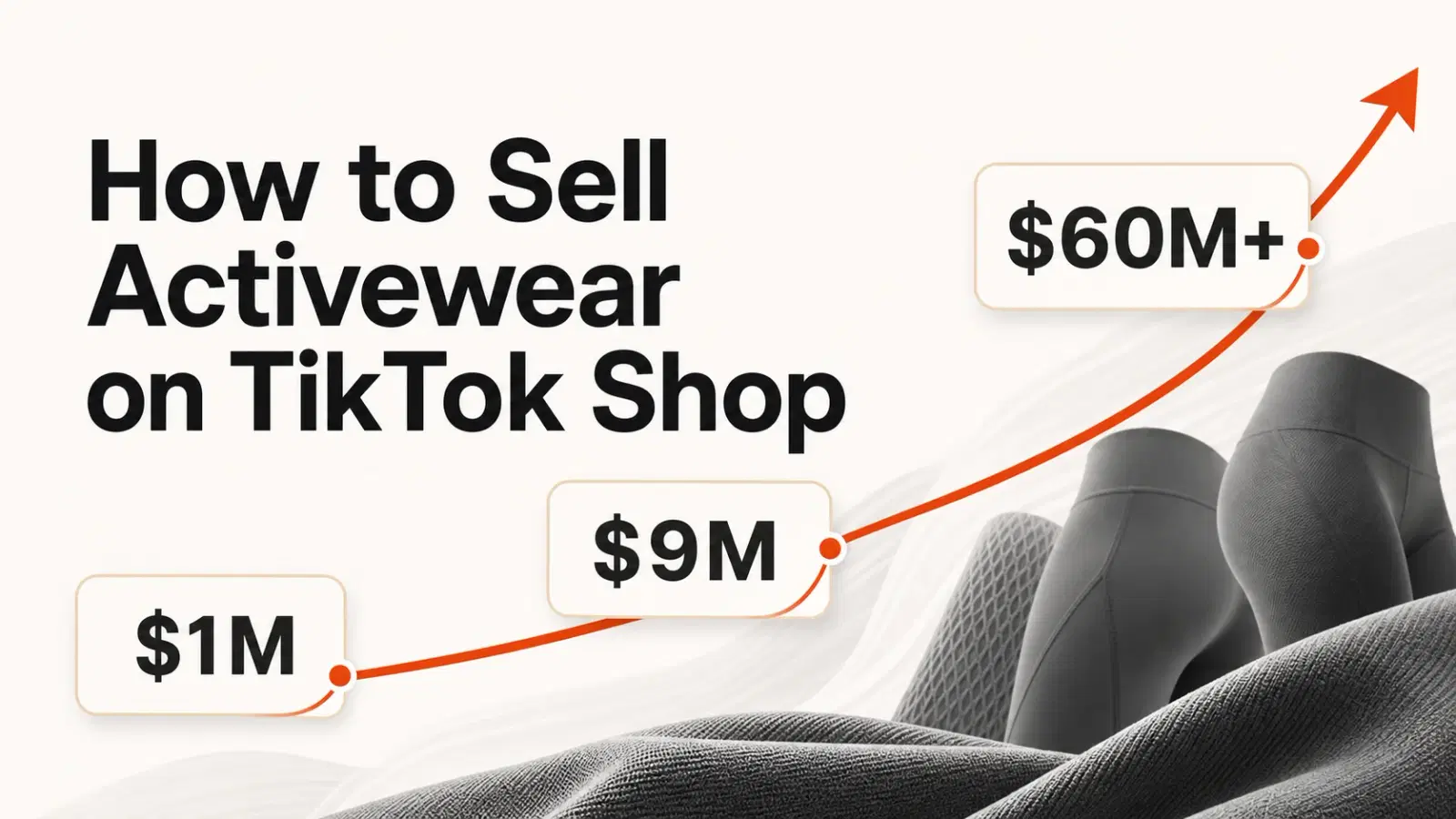
- The case study: from $1M months to a $60M+ run rate
- The 6-step playbook, reverse-engineered
- The activewear unit-economics stack
- How to run this playbook solo with AI
- What not to do in activewear
- FAQ
Why Activewear Is Built for TikTok Shop
Some product categories fight the platform. Activewear fits it like compression fabric.
Start with the buyer. Women drive an estimated 70–75% of all TikTok Shop purchases, and the core demographic skews 18–34, the exact audience buying leggings, sets, and sports bras. Fashion and apparel is the second-largest category on the platform globally, behind only beauty. You're not trying to teach a new audience to shop for your product. They're already there, already scrolling, already in the buying demographic.
Then there's the tailwind under both markets. The global activewear market sat around $430 billion in 2025 and is projected to roughly double by the mid-2030s, growing at a 7–9% clip. TikTok Shop's US GMV hit an estimated $15.1 billion in 2025, up 68% year over year. Two fast-growing curves crossing each other is where breakout brands get built.
But the real reason activewear wins is mechanical: it's natively demonstrable. A skincare serum has to tell you it works. A pair of leggings can show you in three seconds. Does it squat without going sheer? Film it. Does it have pockets deep enough for a phone? Film it. Does the compression actually hold? Side-by-side, on camera, done. TikTok is discovery commerce, which means the product finds the buyer mid-scroll instead of waiting for a search. Activewear gives the algorithm the most watchable possible thing to surface: a real body, in motion, in your product.
Halara understood this at the design level. Its viral split-hem legging design solved a specific, visual problem (an easy bathroom break) that creators could demonstrate in a 10-second clip, a feature that turned product design into built-in content. The lesson isn't "make a split-hem legging." It's design for the demo. When the product itself is the hook, every creator who films it is making your ad for free.
The Case Study: Inside Halara's Run to Eight Figures
Let's put real numbers on the trajectory, with the appropriate caveat up front: the figures below are estimates from TikTok analytics tools (Tramicheck, EchoTik, Kalodata), not audited financials. Treat them as a directionally accurate picture of scale, not a balance sheet.
Halara was founded in 2020 by Joyce Zhang and ran as a website-first DTC brand before TikTok Shop existed in the US. When the US marketplace opened, Halara launched in October 2023 and recorded its first order on October 19. Its first full month, November 2023, did an estimated $1.7 million in GMV, averaging roughly $56,000 a day and peaking at 14,300 units sold on a single day, per EchoTik's tracking.
From there the climb was relentless. By August 2025, Halara was doing an estimated $6.88 million per month (about $80M+ annualized) and had crossed $101.86 million in lifetime TikTok Shop revenue across 3.8 million units, according to Tramicheck. Across all channels, Halara is estimated to be a ~$300 million brand that has doubled roughly sales every year since 2021.
So "$1M to $60M" isn't a single audited line item. It's a fair, conservative way to describe that first 18-to-24-month arc, the climb those Tramicheck and EchoTik estimates trace: from a ~$1.7M opening month to a run rate well past $60 million annualized, still climbing. The exact figure matters less than the shape, because the shape is what you copy.
How much do activewear brands make on TikTok Shop? The ceiling is high and the floor is real. The category's breakout, Halara, has done an estimated $101.86M in lifetime TikTok Shop revenue and was running ~$6.9M/month as of August 2025, according to Tramicheck's estimates. Mid-tier activewear sellers commonly do five to six figures a month. A disciplined new brand running the playbook below can realistically target $10K–$50K/month within its first few quarters, driven by 10–30 creators and a tight catalog, not a viral fluke.
Two engines drove all of it. Catalog velocity: Halara runs roughly 1,000 SKUs on TikTok Shop and is known for turning a trend into a live listing fast. Content velocity: it activated an estimated 22.6K creators and, in one early stretch, produced 469 short videos that pulled in 62 million views, according to EchoTik. Hold those two words. The entire rest of this guide is about how a solo founder reproduces catalog velocity and content velocity without Halara's headcount.
The 6-Step Playbook, Reverse-Engineered
Each step below follows the same structure: what Halara did, the number behind it, how a small brand copies it, and where AI removes the bottleneck that used to make it impossible to do alone.
1. Win on catalog velocity, not one hero product
Halara didn't bet the brand on a single design. It flooded the zone with around a thousand SKUs and kept turning new trends into listings while competitors were still scheduling photoshoots. On a discovery platform, more shots on goal means more chances for the algorithm to find a winner.
You don't need a thousand SKUs. You need velocity. Launch 8–12 SKUs to start, then expand aggressively around whatever gets traction. The constraint for a small brand was never creativity. It was the days-per-SKU tax: design, mockup, copy, list, repeat.
That tax is what AI removes. AI Trend Finder scores rising activewear aesthetics before they peak, AI Design Generator turns a prompt into a print-ready graphic in seconds, and AI Mockup Generator puts that design on an on-model shot without a studio. Days per SKU become hours. That's catalog velocity, solo.
2. Let one hero product carry discovery
Wide catalogs win, but one product usually does the heavy lifting. For Halara, that was the UltraSculpt SoCinched legging: an estimated $20.54 million and 735,000 units from a single SKU, according to Tramicheck. One product seeded the brand's entire algorithmic presence, then the catalog caught the overflow.
The small-brand version: launch wide, watch closely, and the moment one item starts outperforming, pour everything into it. Build a mini-collection around its aesthetic. Send it to every creator. Make it the star of every LIVE. Insights surfaces your view-to-order rate and GMV per SKU early, so you spot your UltraSculpt equivalent while there's still time to ride it instead of after the trend cools.
Want to see how this works in practice before you commit? Explore the AI product pipeline →
3. Run a creator army, not an influencer deal
This is the step most new brands get backward. They chase one big influencer. Halara did the opposite. It activated an estimated 22,600 active creators at 10% commission plus performance rewards, reinforced with recurring giveaways and incentives that turned creators into repeat ambassadors. The math behind why this works is consistent across the platform: the top 10% of creators tend to drive about 90% of revenue, and revenue-per-video plateaus past roughly 50K followers. That means micro and nano creators win on cost-efficiency.
You can't afford tens of thousands of creators. You don't need them. Start with 10–30 micro and nano creators in the activewear and fitness niche. Budget $500–$2,000 for sampling, expect 40–60% of recipients to post, and target a 5–10x return on that sampling spend.
The proof that small-creator volume beats celebrity spend is well documented: footwear brand EGO Shoes generated a 156x order surge not through one famous face but through a diversified mix of micro and nano creators. Their cumulative reach and authenticity outperformed any single mega-deal. The same dynamic carries straight into activewear, where a real person doing a real fit check beats a polished studio ad every time.
4. Feed the algorithm relentlessly
Content is the engine; nothing else moves without it. The rough benchmark on the platform is that roughly a million dollars a month in GMV correlates with about a thousand videos a month flowing through your shop's ecosystem (yours plus your creators'). You won't hit that volume early, and you don't have to. Aim for a few hundred videos a month to get real algorithmic traction.
For activewear specifically, certain formats convert far better than generic "here's my product" clips. The ones that work:
- The squat-proof test, bend, stretch, prove it isn't sheer. The single most-trusted activewear format.
- The fit check, front, back, "I'm 5'6 wearing a medium." Sizing trust closes the sale.
- "Leggings with pockets", show the phone going in. Pocket reveals are reliably viral.
- Compression side-by-side, your product against a baggy competitor, on camera.
- "5 ways to style", one set, multiple looks, multiple posts from a single product.
Hitting 200–300 of those a month without a studio is the second place AI changes the math. AI Product Video Generator builds 9:16 product videos from your mockups, and Shorts Creator queues full product-reveal Shorts with footage, voiceover, and music. Pair that engine with your creators' authentic fit checks and you sustain content velocity that used to need a content team. Our guide to shoppable product videos for clothing brands breaks down each format in depth.
5. Use LIVE as a conversion multiplier
Feed content builds discovery. LIVE closes. TikTok LIVE shopping converts an estimated 3–5x better than feed content because it stacks urgency, real-time social proof, and direct Q&A. Halara leaned in hard, running dedicated live accounts and, during one six-day event, logging more than 3,500 hours of live streaming. As of August 2025 it was still pulling an estimated 14,500 units a month directly from Lives, according to Tramicheck.
The small-brand version is approachable. Start with two to four sessions a week, twenty to thirty minutes each, during evening peak hours. Show 6–10 SKUs. Use limited colorways and honest scarcity ("only 5 left in this size") rather than fake countdowns. Activewear is ideal for LIVE because you can demonstrate fit and movement in real time and answer the sizing questions that kill conversion in the comments before they become returns.
6. Engineer the spike, then protect the floor
Halara's most-cited moment was its June 2024 Super Brand Day: an estimated 115 million video views and roughly 100,000 purchases in six days, according to Tramicheck, with thousands of live hours stacked into the window. That kind of spike doesn't happen by accident. It's engineered: creators, LIVE sessions, and a product drop all coordinated into one concentrated window so the algorithm sees a surge it can't ignore.
The small-brand version: pick one window, line up your creators to post together, run extra LIVE sessions, and drop something new into the middle of it. But the spike is only half the play. The other half is protecting the floor afterward. Guard your week-one reviews. Review volume and rating gate how TikTok surfaces your product for months, and a few early sizing complaints can suppress an otherwise strong SKU. Over-deliver on fit accuracy and fulfillment in week one, because that's the foundation everything else compounds on.
The Activewear Unit-Economics Stack
Most case studies skip the math. Run it before you set a single price, because activewear has a specific cost stack that determines whether your viral moment is profitable or just busy.
Here's a realistic model for a mid-priced legging, using a forty-dollar retail price, on a print-on-demand or low-MOQ manufacturing setup:
| Cost component | Amount |
|---|---|
| Production (POD or low-MOQ manufacture) | $14.00 |
| TikTok Shop referral fee (~6%) | $2.40 |
| Affiliate commission (10%) | $4.00 |
| Fulfilled by TikTok (FBT, if used) | $2.86 |
| Gross margin before ads | $16.74 (41.9%) |
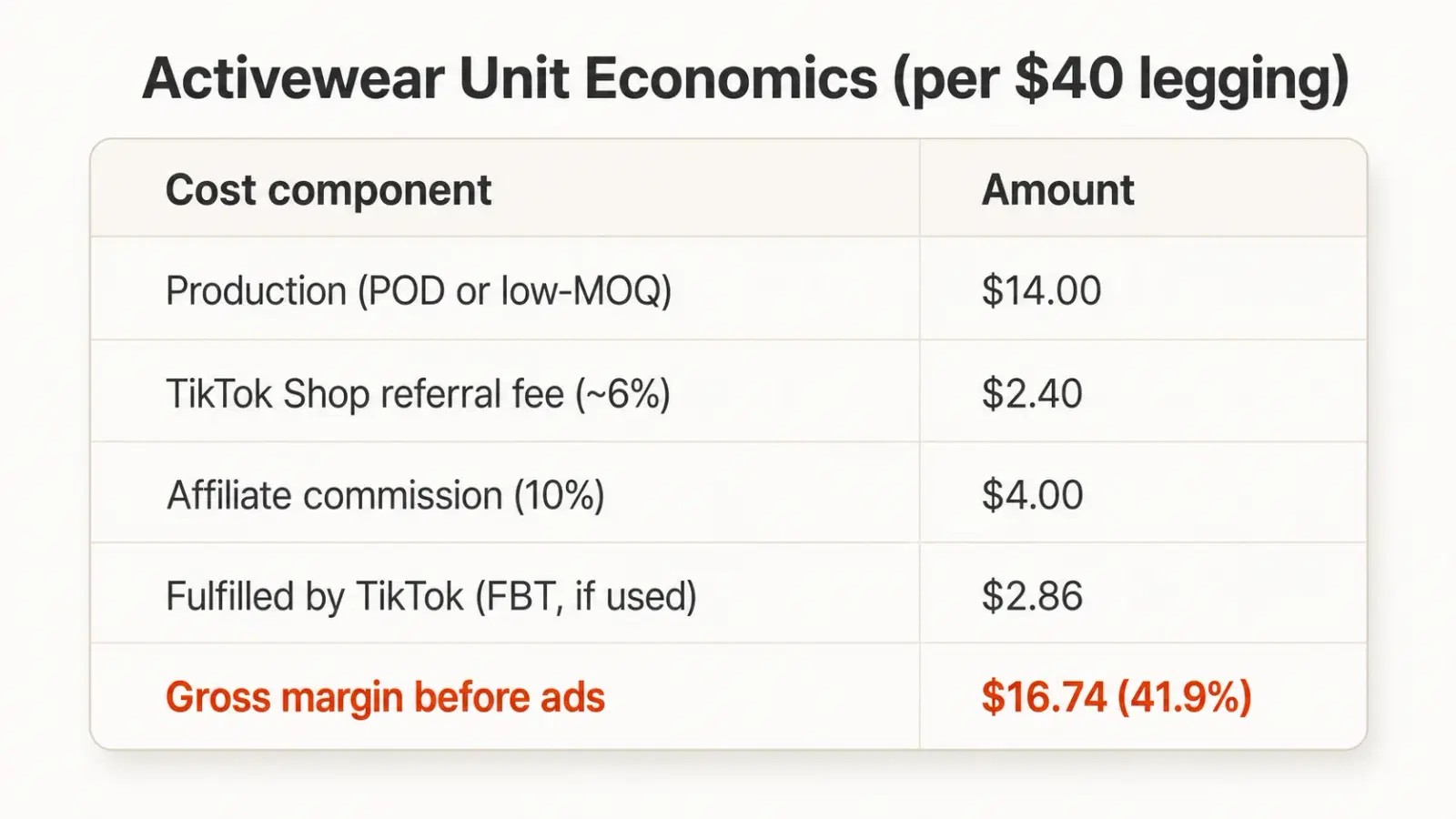
Illustrative model. The Fulfilled by TikTok rate and the full fee structure follow our TikTok Shop margin breakdown.
A gross margin in the low forties before ads is healthy for a new activewear brand, but it compresses the moment you raise affiliate rates for top performers or layer in paid amplification. The levers that protect margin are specific to this vertical.
One option to test is average order value through sets. For example, a $40 legging and a $95 coordinated set have different revenue potential, but the set also has higher production and potentially higher fulfillment costs. Compare contribution margin per order after discounts, commissions, shipping, and returns. Keep creator commission rates within that budget, and use provider quotes to check whether a larger order actually lowers production cost.
How to Run This Playbook Solo with AI
Step back and look at what actually stopped you from copying Halara. It was never the strategy. The strategy is six steps on a page. It was the two engines underneath it: catalog velocity and content velocity. Both used to require a team you don't have.
That's the entire reason Vaybel exists. It hands one founder the same two engines through a single end-to-end pipeline:
AI Trend Finder → AI Design Generator → AI Mockup Generator
 ↓
Channel Merchandiser (publish to TikTok Shop)
 ↓
AI Product Video Generator → Shorts Creator → Insights
Mapped to the playbook, it looks like this:
| Playbook step | What you need | Vaybel feature |
|---|---|---|
| Catalog velocity (Step 1) | Match Halara's SKU speed solo | AI Trend Finder + AI Design Generator |
| Listing imagery (Steps 1–2) | On-model activewear shots, no photoshoot | AI Mockup Generator |
| Publishing | Optimized, compliant TikTok Shop listings | Channel Merchandiser |
| Content velocity (Step 4) | 200–300 videos a month, no studio | AI Product Video Generator + Shorts Creator |
| Find the hero, scale it (Steps 2, 6) | Spot the winner early, double down | Insights |
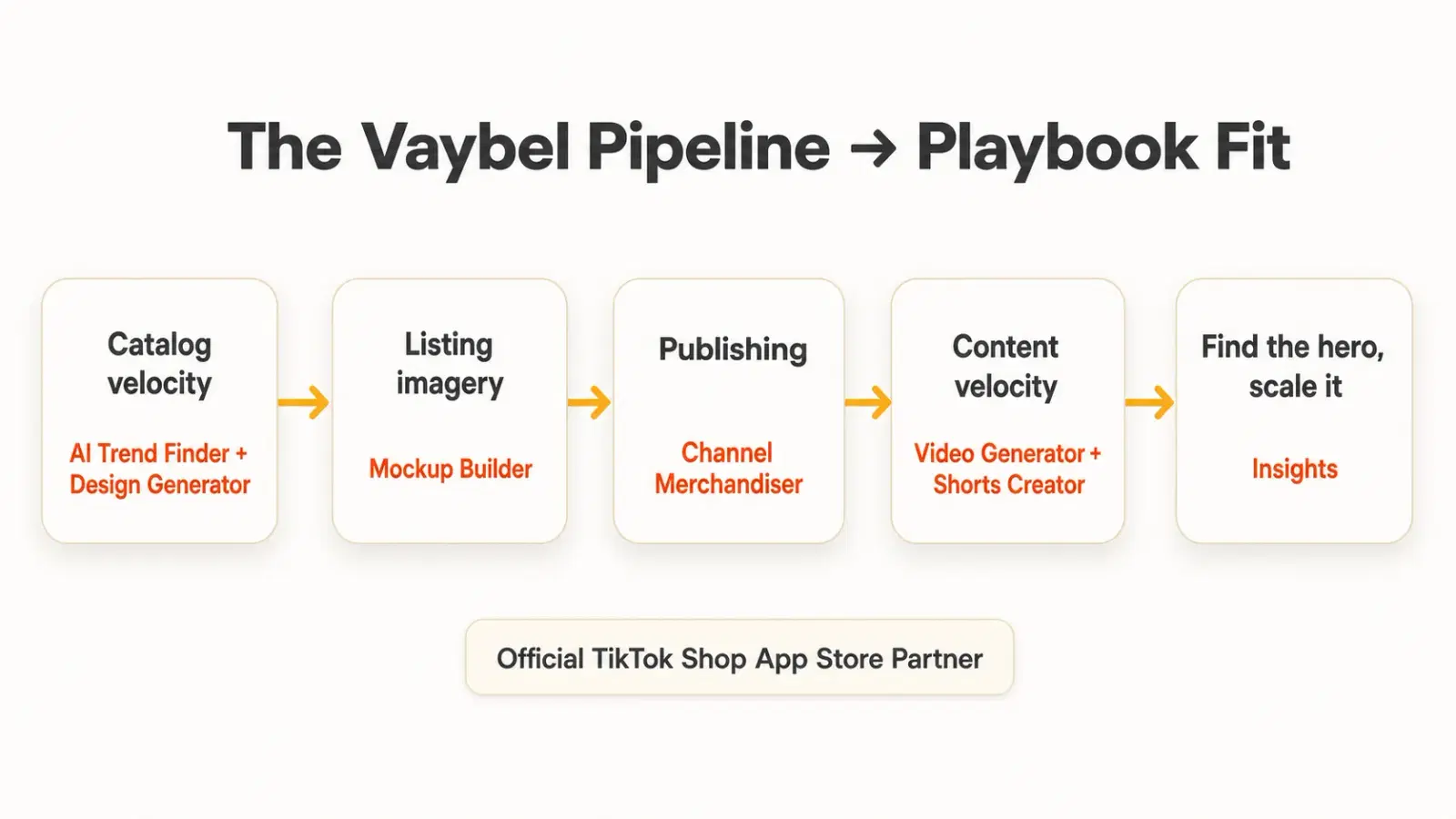
Vaybel connects to TikTok Shop to prepare and publish product listings. Review the product details, images, fulfillment settings, and marketplace requirements before publishing; an integration does not guarantee that a listing will be approved. Start with a manageable catalog and measure the time and cost of producing assets you can actually use.
If you're newer to the channel itself, start with our complete TikTok Shop guide for clothing brands for setup and account mechanics, then come back to this playbook for the activewear-specific scaling moves.
Ready to test the difference? Start your free trial → and publish your first activewear SKUs this week.
What Not to Do in Activewear
Activewear has failure modes the generic guides never mention. Avoid these and you'll outlast most of the brands that launch alongside you.
Don't ignore sizing and fit risk. Sizing disputes are the number-one driver of returns in TikTok Shop clothing, and returns tank your Shop Health Score, which suppresses your visibility across discovery. Activewear is especially exposed because fit is the whole product. Show accurate sizing, state the model's height and size on every listing, and describe compression honestly.
Don't overclaim "shaping" or "compression." Promising body-altering results you can't deliver generates returns, bad reviews, and policy risk. Demonstrate the real benefit; don't inflate it.
Don't run knockoff-adjacent designs. Copying a Gymshark or Alo silhouette too closely invites listing removal and shop penalties. Differentiate on aesthetic and niche instead.
Don't lead with one-size cuts. "One size fits most" maximizes the exact return risk that hurts you most. Offer a real size range.
Don't bet everything on one mega-influencer. As the EGO Shoes example showed, diversified micro and nano creators beat a single big deal on both cost and authenticity. One creator going quiet shouldn't be able to stall your whole shop.
Don't neglect week-one reviews. Review volume gates surfacing for months. A weak first week is hard to dig out of, so over-invest in fulfillment and fit accuracy at launch.
Frequently Asked Questions
How much do activewear brands make on TikTok Shop? The range is wide. The category's breakout, Halara, has done an estimated $101.86M in lifetime TikTok Shop revenue and was running roughly $6.9M/month as of August 2025, according to Tramicheck. Mid-tier sellers commonly do five to six figures a month. A disciplined new brand running this playbook can realistically target $10K–$50K/month within its first few quarters.
What activewear sells best on TikTok Shop? Leggings lead, especially "squat-proof" and pocket leggings. Matching sets and co-ords drive the highest order value. Bike shorts, sports bras, and seamless basics round out the top sellers. Anything you can demonstrate in motion (fit, compression, movement) has a structural advantage.
Do I need to hold inventory to start? No. A print-on-demand or low-MOQ model lets you list activewear and only produce on order. It caps your downside while you find which SKUs convert, then you can move winners to bulk production for better margins.
How many creators do I need to start an affiliate program? Ten to thirty micro and nano creators in the fitness and activewear niche is plenty to get meaningful data. Niche alignment beats follower count: a 12K-follower fitness creator will usually outperform a 200K general lifestyle account.
How many videos per month should I post? Aim for a few hundred a month across your own content and creator content combined. That's the threshold where the algorithm starts giving you consistent reach. AI video tools make that volume reachable without a studio.
Can I compete with Halara or Gymshark as a small brand? Yes, but not on their terms. You won't out-budget them. You win on speed and niche aesthetic: catch a rising activewear trend before the big brands react, own a specific community look, and move from trend to live listing in hours. Speed is the small brand's only structural advantage, and AI is what makes it usable.
Start Running the Playbook
The activewear brands that broke out on TikTok Shop didn't win on budget, brand history, or a warehouse. They won on two things: catalog velocity and content velocity. Halara turned trends into around a thousand SKUs fast, let one hero legging seed its discovery, activated thousands of micro-creators on commission, and flooded the feed with demo videos until the algorithm couldn't ignore it. Every one of those moves is copyable.
What used to make them impossible for a solo founder was the team they required. That's the part that changed. AI Trend Finder finds the opportunity, AI Design Generator and AI Mockup Generator create the product, Channel Merchandiser publishes it, Shorts Creator keeps the content flowing, and Insights tells you which SKU to double down on. The loop runs in hours, and it keeps running while your affiliates post.
Pick your niche aesthetic, launch 8–12 SKUs, sample 10–30 creators, and start filming squat tests. The breakouts proved the playbook. The only question left is how fast you run it.
Start your free trial → Vaybel is an official TikTok Shop App Store partner, and the TikTok Shop automation handles the catalog and content velocity so you can focus on building the brand.