The fastest way to make product videos for a clothing brand in 2026 is to skip the photoshoot entirely: generate an on-model image with AI, turn it into a shoppable video in minutes, then publish it straight into your TikTok Shop listing. No studio, no film crew, no sample in your hands. What used to cost thousands of dollars and take weeks per clip now costs cents and takes minutes, which is why a solo founder can now put a video on every SKU.
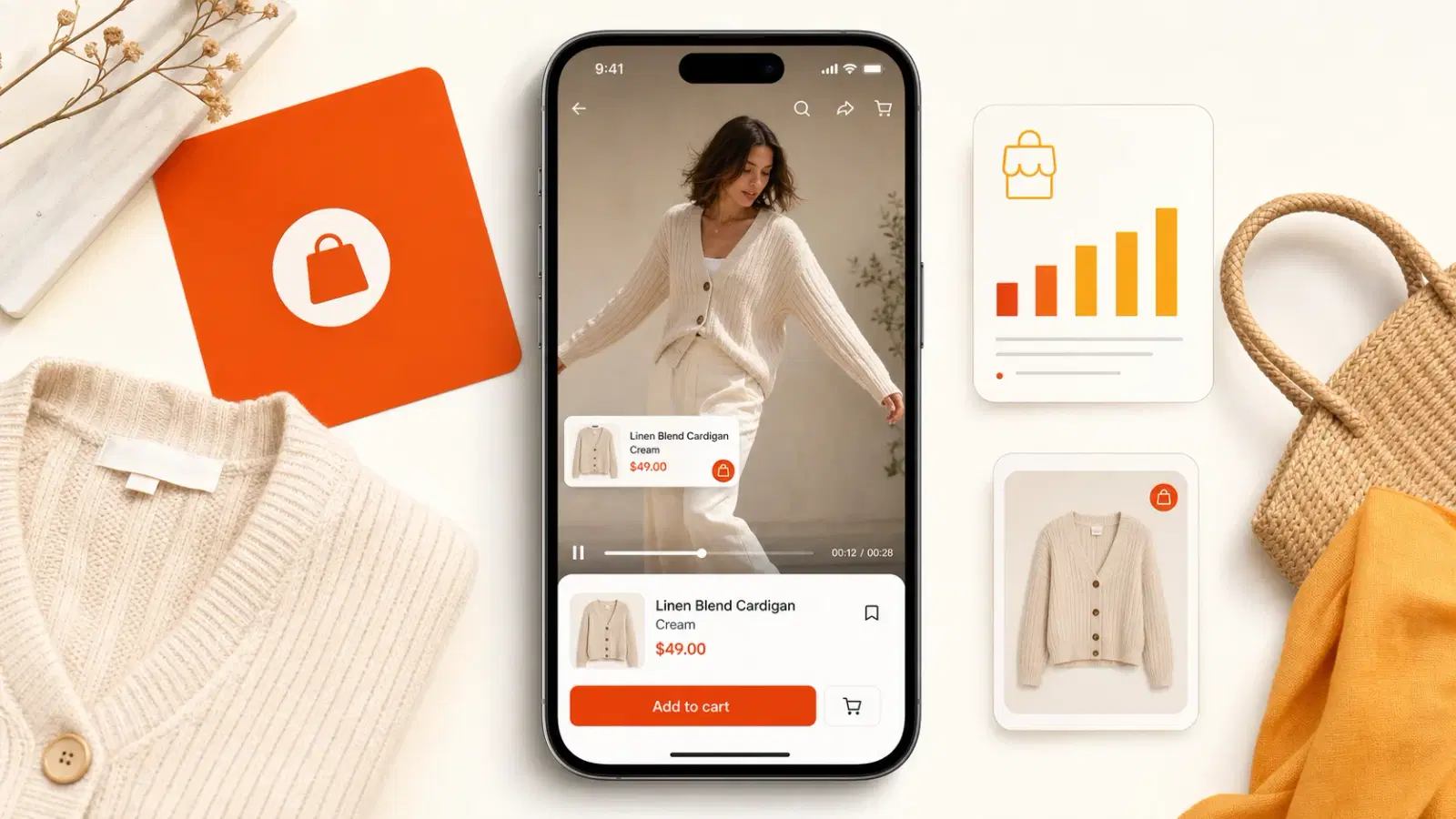
That shift matters more for clothing than almost any other category. Shoppers can't feel fabric or judge a fit from a flat photo, so they fill the gap with imagination, and imagination breeds hesitation. Video closes that gap. It shows the drape, the movement, the way a hem sits, the exact things a fitting room does. Fashion is, in fact, the highest-converting vertical for shoppable video.1
Here's how lopsided the payoff has become. Product pages with video convert up to 65% better than pages with images alone, shoppers spend twice as long on them, and multi-angle video on varied body types cuts returns by 12 to 18%.2 On TikTok Shop, video isn't a nice-to-have at all: shoppable and creator videos now drive roughly half of the platform's entire GMV.3
This guide covers the practical version of all that: the six video types every clothing brand actually needs, the correct specs for each placement (including the TikTok Shop asset rule most guides get wrong), and the exact AI pipeline that produces them without a camera. Vaybel is an official TikTok Shop App Store partner, and the tools referenced below are part of that certified integration.
Want to see the image-to-video pipeline before you read the how-to? Explore the product workflow →
Key Takeaways
- Video is a conversion engine for fashion specifically: product pages with video convert up to 65% higher, shoppers spend 2x longer on them, and multi-angle video reduces returns 12–18%.2 Shoppable video's median watcher-conversion uplift is +125%, with top performers hitting +500%.1
- You no longer need a photoshoot. A 60-second traditional product video runs $5,000–$20,000 and takes weeks; AI generation costs roughly $0.50–$5 per clip and takes minutes, a 70–90% cost cut, with per-video costs down about 97% since 2020.4
- Clothing brands need six distinct video types, and each maps to a different goal, placement, and spec, from the 3:4 primary listing asset TikTok Shop actually requires to the 9:16 hook-in-3-seconds feed clip.5
- On TikTok Shop, video is a discovery signal, not just a conversion one: shoppable and creator videos account for about half of all platform GMV, and live selling converts 3–5x higher than feed content.36
- The winning setup is a two-track system: AI produces your listing and PDP videos at scale, while creator affiliates produce the organic try-on content, so one person never has to do both by hand.
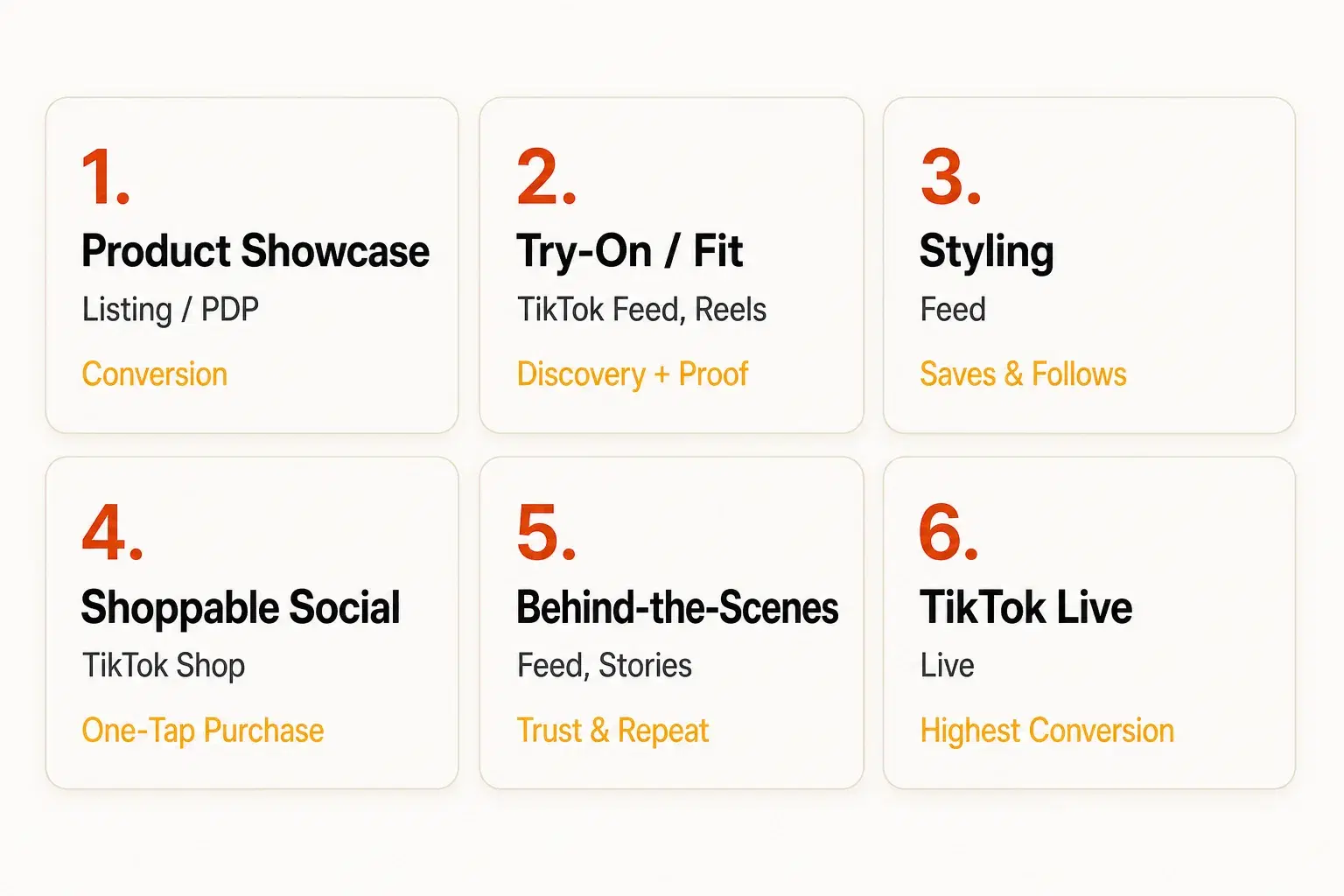
The six product-video types every clothing brand needs:
- Product showcase (listing/PDP video), converts the shopper at the point of decision.
- Try-on / fit video, creator content that drives social discovery and proof.
- Styling video ("one item, five ways"), earns saves, follows, and reach.
- Shoppable social video (affiliate-tagged), turns a scroll into a one-tap purchase.
- Behind-the-scenes / brand story, builds trust and repeat intent.
- TikTok Live session, the highest-converting touchpoint you own.
In this guide:
- Why product videos are non-negotiable for clothing brands
- The 6 product video types every clothing brand needs
- Video specs by channel (with the TikTok Shop correction)
- How to make product videos without a photoshoot
- What actually makes a product video convert
- A simple weekly video workflow
- FAQ
Why Product Videos Are Non-Negotiable for Clothing Brands
Clothing is a video-native product. A customer buying a t-shirt wants to know how it hangs, whether the fabric is thin, how the sleeve falls on a real arm. A static image answers none of that, so the shopper hesitates, and hesitation is where sales die. Video answers all of it at once, which is why fashion sees a bigger lift from video than any other retail category.
The numbers are hard to argue with. For visitors who actually engage with a shoppable video, conversion jumps between +50% and +500% versus those who don't, with a median uplift around +125%.1 Put that video inline and above the fold on a product page rather than in a floating widget, and fashion brands see a +24–29% conversion gain on its own.1 People who watch are also +225% more likely to add to cart than people who only see photos.1
There's a discovery story here too, not just a conversion one. On TikTok Shop, shoppable and creator videos have grown to drive roughly half of all GMV on the platform, and pre-recorded creator video specifically has climbed toward two-thirds of revenue.3 The platform is enormous and still compounding: global TikTok Shop GMV hit about $64.3 billion in 2025, nearly double the year before, and is projected past $112 billion in 2026, with US sales alone tracking toward $23.4 billion.3 Womenswear is already the second-largest category on the whole platform.3 Video is how you get seen in that feed, not just how you convert once someone lands.
You don't have to take the mechanic on faith, because it scales in public. Maëlys, the body-care brand that won the 2025 Glossy Pop Award for Best Use of TikTok Shop, drove $108.5 million in category sales largely on the back of before-and-after transformation videos, according to Glossy. It isn't a clothing brand, but the lesson transfers exactly: show the product doing its job on a real body, and the video does the selling for you. For clothing, "the job" is fit, drape, and movement.
Now weigh that against what video used to cost. A traditional 60-second product video runs $5,000 to $20,000 with a crew, and even a simple social clip lands between $500 and $5,000, with a two-to-six-week turnaround.4 For a brand with 50 SKUs, that's a five- or six-figure line item before a single ad runs. AI generation has collapsed that math: roughly $0.50 to $5 per clip, produced in minutes, a 70–90% cost cut, with per-video costs down about 97% since 2020.4 The barrier that kept small clothing brands out of video is simply gone.
Ready to see what that looks like for your catalog? Explore the AI product video generator →
The 6 Product Video Types Every Clothing Brand Needs
Most roundups of clothing brand product video ideas stop at inspiration. The useful version treats each type as a decision, not just an idea, so here's what each one is, where it lives, and the exact job it does.
1. Product Showcase Video (Listing / PDP)
This is the workhorse: a 10-to-30-second clip showing the garment from multiple angles, on a body, with a little movement. It lives inside your TikTok Shop listing, your Etsy listing video, and your product page. Its only job is conversion at the moment of decision. This is the type AI produces best from a single mockup image, so every SKU can have one without a shoot.
2. Try-On / Fit Video
A real person wearing the garment through a few natural movements. It lives in the TikTok feed, Reels, and Shorts, and its job is discovery plus proof, since watching how a piece fits a real body is the single biggest purchase driver on TikTok. This is creator territory, not brand-produced, which is exactly why the creator-affiliate track matters (more on that below).
3. Styling Video ("One Item, Five Ways")
One garment shown across several complete outfits or occasions. It lives in the feed and earns saves, follows, and reach, all strong algorithm signals. It's a great candidate for automation with an AI shorts pipeline, because you're remixing existing product visuals rather than shooting anything new. Text overlays are essential here since most viewers have the sound off.
4. Shoppable Social Video (Affiliate-Tagged)
Short-form content carrying a shoppable product tag, so a viewer taps and buys without ever leaving the app. It can be AI-, creator-, or brand-made; what makes it "shoppable" is the tag you attach at publish. This is where discovery collapses into purchase in a single tap, and it's the format doing the heavy GMV lifting on TikTok Shop.
5. Behind-the-Scenes / Brand Story
Your design process, your inspiration, a day in the life, why the brand exists. It lives in the feed and Stories, and its job is trust and repeat-purchase intent rather than an immediate sale. Keep it deliberately low-production, because overproduced content reads as an ad and underperforms on TikTok. One or two a week is plenty, and it never has to compete with your listing-video budget.
6. TikTok Live Session
Real-time selling: demos, styling, Q&A, limited-time offers, feeding straight into your TikTok Shop. It's the highest-converting touchpoint you have, running 3–5x higher conversion than feed content.6 This is the one type AI shouldn't touch; the whole point is live, unscripted authenticity. A smart move is to queue your pre-made listing videos as replay clips so the exposure continues after you sign off.
That's the mechanic Portland Leather Goods rode to roughly $1 million in TikTok Shop sales in just 20 days, according to Modern Retail's 2025 case study. The brand didn't grind its own account; it mobilized creators to produce try-on and shoppable video at volume and only paid when a sale landed. That's the two-track system in action: the brand supplies the listing videos, creators supply the discovery videos.
Video Specs by Channel (The Part Most Guides Get Wrong)
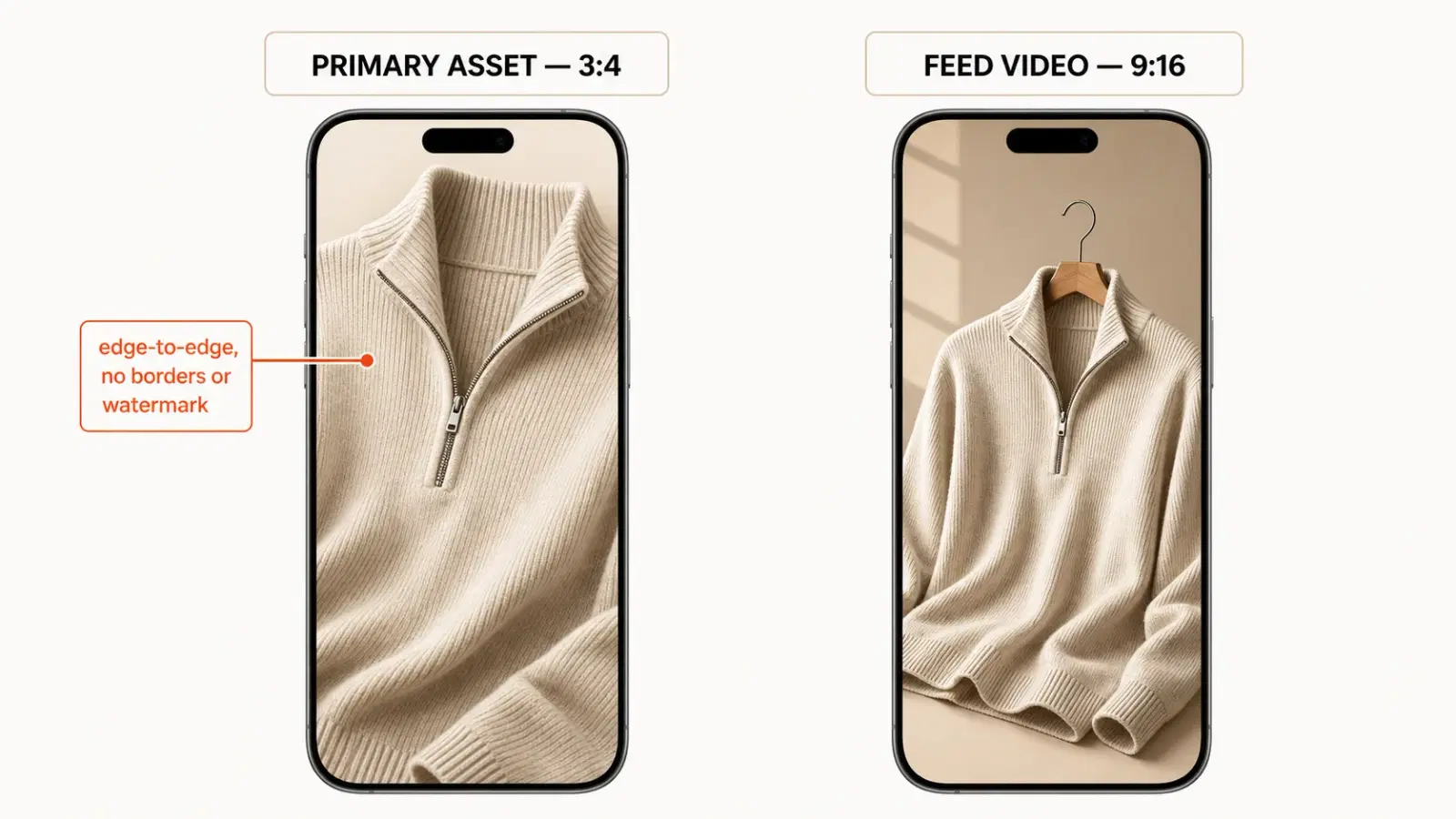
Most guides hand you one aspect ratio and call it done. That's how brands upload the wrong asset to TikTok Shop and quietly tank their listing quality. The key thing to understand: the primary listing asset and the embedded/feed video are two different specs.
TikTok Shop requires your primary product asset in a 3:4 aspect ratio, with the product filling the frame edge-to-edge, no white borders, no watermark, no promo text, at least 600×600 pixels, and at least five assets per product.5 Your embedded and feed videos are a separate 9:16 (or 1:1) job. Get the 3:4 primary asset wrong and TikTok can down-rank the listing before your video ever gets a chance to convert.
| Channel / Placement | Aspect Ratio | Length | Key Requirement |
|---|---|---|---|
| TikTok Shop primary listing asset | 3:4 | image / short | Product edge-to-edge, no borders or watermark, ≥600×600, 5+ assets5 |
| TikTok Shop embedded listing video | 9:16 or 1:1 | 10–60 sec | Product clearly visible at thumbnail size |
| TikTok feed (organic) | 9:16 | 15–60 sec | Hook in the first 3 seconds |
| TikTok LIVE | n/a | 45–90 min | Real-time, unscripted |
| Instagram Reels | 9:16 | 15–90 sec | Captions or text overlays |
| YouTube Shorts | 9:16 | ≤60 sec | Thumbnail must read at 90×160 |
| Ecommerce PDP (Shopify/Etsy) | 1:1 or 16:9 | 10–30 sec | Loop-friendly, muted autoplay |
| Instagram Stories | 9:16 | ≤60 sec | Link sticker to the product page |
One more clothing-specific rule that lives right next to these: fashion listings need a size chart and material information, both of which TikTok treats as listing-quality factors.5 They also happen to be your best defense against sizing returns, so they're worth getting right the first time.
How to Make Product Videos Without a Photoshoot
Here's the section competitors skip. Everyone tells you that you need video; almost nobody explains how a print-on-demand brand with no inventory, no model, and no studio is supposed to produce it. The traditional answer, 50 SKUs means 50 shoots and $25,000 to $100,000 at typical per-video rates, isn't realistic for a boutique or a first-season brand.4 The AI answer is a four-step pipeline that never touches a camera.
Step 1: Generate Your On-Model Image
Start with the source material. Vaybel's AI Mockup Generator places your design on a virtual model, letting you choose body type, aesthetic, and scene, and returns a high-resolution on-model photo. That single image is what everything downstream is built from. It takes minutes per SKU instead of the days a traditional shoot demands, and you never need to own a sample.
Step 2: Turn the Image Into a Video
Next, motion. Vaybel's AI Product Video Generator takes that mockup image and produces a multi-format shoppable video: a 9:16 social clip, a looping PDP embed, and the 3:4 primary asset TikTok Shop wants. Where a generic AI fashion video generator hands you a single clip, this outputs every placement you need in one pass. The garment moves, so it reads as a real product video rather than a photo with a zoom effect, and it's done in one to five minutes. No model was ever filmed.
Want to try it on your own design? Generate your first product video free →
Step 3: Build a Short-Form Pipeline
One video per SKU isn't a content strategy; the feed needs volume. Vaybel's Shorts Creator turns your existing product visuals into an ongoing stream of TikTok, Reels, and Shorts content, so you keep algorithmic momentum between manual posts. Use it for styling sequences, seasonal angles, and trend-reactive clips built from SKUs you already have.
Step 4: Publish With the Video Embedded in the Listing
Finally, get it live where it counts. Vaybel's Channel Merchandiser publishes to TikTok Shop with the listing video embedded at creation, not bolted on as an afterthought, and formats the 3:4 asset correctly. Because video is a discovery signal on the platform, embedding it at publish is what earns those extra Shop-tab impressions rather than leaving them on the table. The same flow adds video to your Etsy listings.
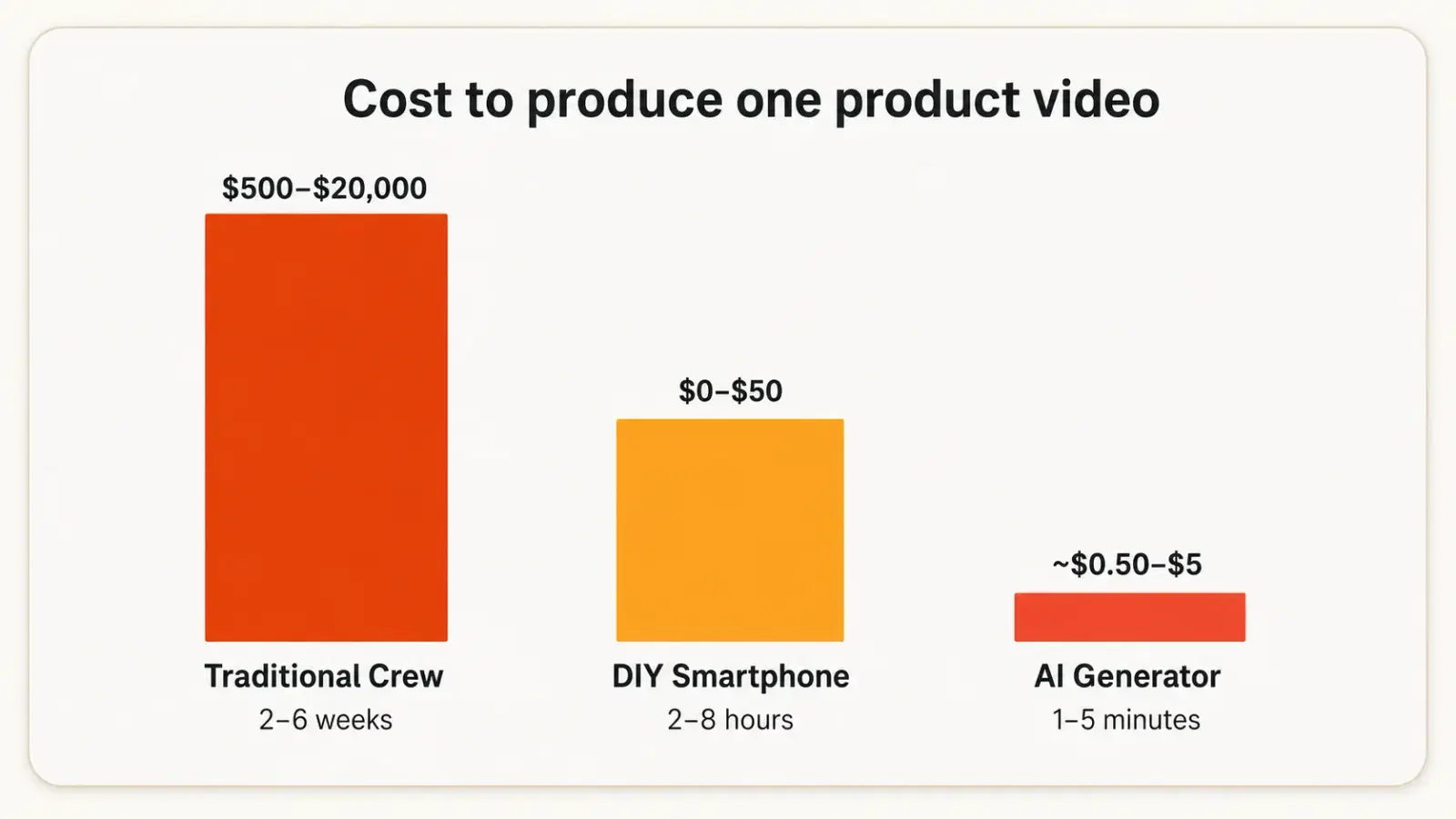
Here's the economics of the whole pipeline in one view.
| Method | Cost per video | Time per video | Quality |
|---|---|---|---|
| Traditional crew | $500–$20,000 | 2–6 weeks | High, if budget allows4 |
| DIY smartphone | $0–$50 | 2–8 hours | Variable, inconsistent |
| AI Product Video Generator | ~$0.50–$5 | 1–5 minutes | Consistently professional |
Keeping the design, mockups, listing, and video assets together can reduce the work of moving files between tools. Test the workflow on a few products first. Track production time, the cost of usable clips, and the response to published content before expanding to the rest of your catalog.
What Actually Makes a Product Video Convert
Producing a video is easy now. Producing one that sells still comes down to a handful of variables, and they're worth memorizing because they apply no matter how the clip was made.
- The first frame is the thumbnail. It has to be identifiable at 150×150 pixels, so lead with the product centered and clearly lit. AI-generated videos start product-forward for exactly this reason.
- Win the first 3 seconds. Most viewers who bail do it almost immediately. No logo bumpers, no slow fades, garment visible from frame one.
- Movement is the whole point. A static image with a zoom isn't a video. Fabric drape, a natural walk, a hem catching light, that motion is what replaces the fitting room.
- Design for sound off. Around 85% of social video is watched muted, so your text overlays and captions are the copy, not an afterthought.2
- Keep it short. Fifteen to thirty seconds for social and listings, ten to twenty seconds looping on a PDP. Longer doesn't convert better.
- One clear CTA. "Shop this look," a pinned product, a link in bio, pick one per video, never three.
Get those six right and an AI-generated clip will out-convert an expensive one that ignores them.
A Simple Weekly Video Workflow for a Solo Brand
You don't need a content team. You need a repeatable cadence that splits the work between AI and creators so neither track becomes a bottleneck.
| Content type | Volume | How it's produced | Time |
|---|---|---|---|
| TikTok Shop listing videos (new SKUs) | 1–3 / week | AI Product Video Generator | 5–15 min total |
| Organic TikTok / Reels | 5–10 posts / week | Shorts Creator + 2–3 creator try-ons | ~30 min (AI) + affiliate UGC |
| Styling / behind-the-scenes | 1–2 / week | Phone-filmed, authentic | 30–60 min |
| TikTok Live | 2–3 / week | Real-time, no pre-production6 | 45–90 min / session |
The principle underneath the table is the one to hold onto: AI owns the listing and PDP track; creators own the discovery and social track. They're genuinely different jobs. AI is unbeatable at producing consistent, on-brand product videos at volume. Creators are unbeatable at authentic try-on content that a feed rewards. Trying to force one person to do both by hand is how brands burn out before they find traction. To see which of the two tracks is actually driving your sales, Shop Insights shows you which videos and which creators convert, so you double down on what's working instead of guessing.
If you're still setting up the brand itself, start with our guide on how to start a clothing brand with no experience, then come back and layer video on top.
Frequently Asked Questions
How do I make product videos for my clothing brand without a photoshoot?
Generate an on-model image with an AI mockup tool, then feed that image into an AI product-video generator to create a shoppable clip in minutes. You never need a sample, a model, a studio, or a camera. The full Vaybel pipeline runs mockup image to video to published TikTok Shop listing in one place.
What aspect ratio does TikTok Shop require for clothing listings?
Your primary product asset must be 3:4, with the product filling the frame edge-to-edge, no borders, watermark, or promo text, at least 600×600 pixels, and at least five assets per product. Your embedded and feed videos are a separate 9:16 (or 1:1) spec. Fashion listings also need a size chart and material info.5
What's the best length for a clothing product video on TikTok?
Fifteen to thirty seconds for feed and listing videos, and ten to twenty seconds looping for a product-page embed. Hook the viewer in the first three seconds and lead with the garment, since most drop-off happens almost immediately.
Do AI-generated videos rank and convert on TikTok Shop?
Yes. TikTok's ranking signal is engagement, not how the video was produced. Shoppable and creator videos already drive roughly half of TikTok Shop's GMV, and a well-made AI clip that follows the format rules competes directly with filmed content.3
How much does it cost to make a product video for a clothing brand?
Traditional production runs $500 to $20,000 per video depending on scope, with a two-to-six-week turnaround. AI generation costs roughly $0.50 to $5 per clip and takes one to five minutes, a 70–90% cost reduction.4 For a brand with a full catalog, that's the difference between five- or six-figure video budgets and a monthly subscription.
How many videos should a new clothing brand post?
Give every new SKU a listing video, and aim for one to three organic feed posts a day to feed the algorithm. Split the load: AI for the listing videos, creator affiliates for the daily try-on and styling content.
Can I make product videos if I'm not on camera?
Yes. AI generates your listing and PDP videos with no filming at all, and creator affiliates produce the on-camera try-on content in exchange for commission. You can run the entire video engine without ever appearing yourself.
Put a Video on Every Product
Video used to be the line item that kept small clothing brands looking small. A photoshoot per SKU was a five-figure bet most founders couldn't make, so their listings sat there as flat images while shoppers scrolled past to brands that moved. That constraint is gone.
The path now is short and repeatable: generate an on-model image, turn it into a shoppable video in minutes, build a short-form pipeline from your existing visuals, and publish with the video embedded where TikTok Shop rewards it. AI handles the listing track at catalog scale; creators handle the discovery track; your data tells you which clips and creators to back. That's a real video program a single person can run, and it produces the exact thing that makes clothing convert, motion, fit, and drape a photo can never show.
That's how you make product videos for a clothing brand in 2026: Vaybel closes the loop from design to mockup to video to published listing in one place, built end to end for clothing brands as an official TikTok Shop App Store partner. The only thing left is to put a video on your first product.
Start free and generate your first product video →
Want the full channel strategy next? Read the complete TikTok Shop guide for clothing brands.
Sources
Footnotes
-
Shoppable video conversion benchmarks, including the +125% median watcher uplift (top performers +500%), +225% add-to-cart lift, +24–29% above-the-fold PDP gain, and fashion as the highest-converting vertical. WhatMore, "Shoppable Video Conversion Rate: 2026 Benchmarks & ROI Stats," https://www.whatmore.ai/blog/shoppable-video-benchmarks-2026/ ↩ ↩2 ↩3 ↩4 ↩5
-
Fashion product-page video impact: up to +65% conversion versus image-only pages, 2x time on page, 12–18% lower returns from multi-angle video, and ~85% of social video watched without sound. Kleep, "Why your fashion e-commerce product page needs video content to convert customers," https://kleep.ai/blogs/why-your-product-page-needs-video-content-to-convert-customers-in-2025 and Vimmi, "Video Commerce in Fashion," https://vimmi.net/blog/video-commerce-in-fashion/ ↩ ↩2 ↩3
-
TikTok Shop GMV and video-share data: shoppable/creator video driving roughly half of platform GMV, global GMV of ~$64.3B in 2025 and a projected ~$112.2B in 2026, US sales tracking to $23.4B, and womenswear as the second-largest category. Resourcera, "TikTok Shop Statistics (2025–2026): Global GMV & Insights," https://resourcera.com/data/social/tiktok-shop-statistics/ ↩ ↩2 ↩3 ↩4 ↩5 ↩6
-
Video production cost benchmarks: traditional 60-second product video $5,000–$20,000 (social clips $500–$5,000), AI generation ~$0.50–$5 per clip, a 70–90% reduction, with per-video costs down ~97% since 2020. MagicHour, "Video Production Costs in 2026: Traditional vs AI," https://magichour.ai/blog/video-production-costs-traditional-vs-ai ↩ ↩2 ↩3 ↩4 ↩5 ↩6
-
TikTok Shop product listing and asset requirements, including the 3:4 primary asset, edge-to-edge framing, ≥600×600 resolution, 5+ assets, and size-chart/material requirements for fashion. TikTok Seller University, "Product Detail Pages & Listing Quality Guidelines," https://seller-us.tiktok.com/university/essay?knowledge_id=481891871868714&lang=en ↩ ↩2 ↩3 ↩4 ↩5
-
Live selling on TikTok Shop converting 3–5x higher than feed content. Pepper Agency, "TikTok Shop Best Practices: What Brands Need to Know in 2026," https://www.pepperagency.com/blog/tiktok-shop-best-practices-how-to-get-started-and-what-brands-need-to-know-in-2026 ↩ ↩2 ↩3