Last updated: 2026-08-14
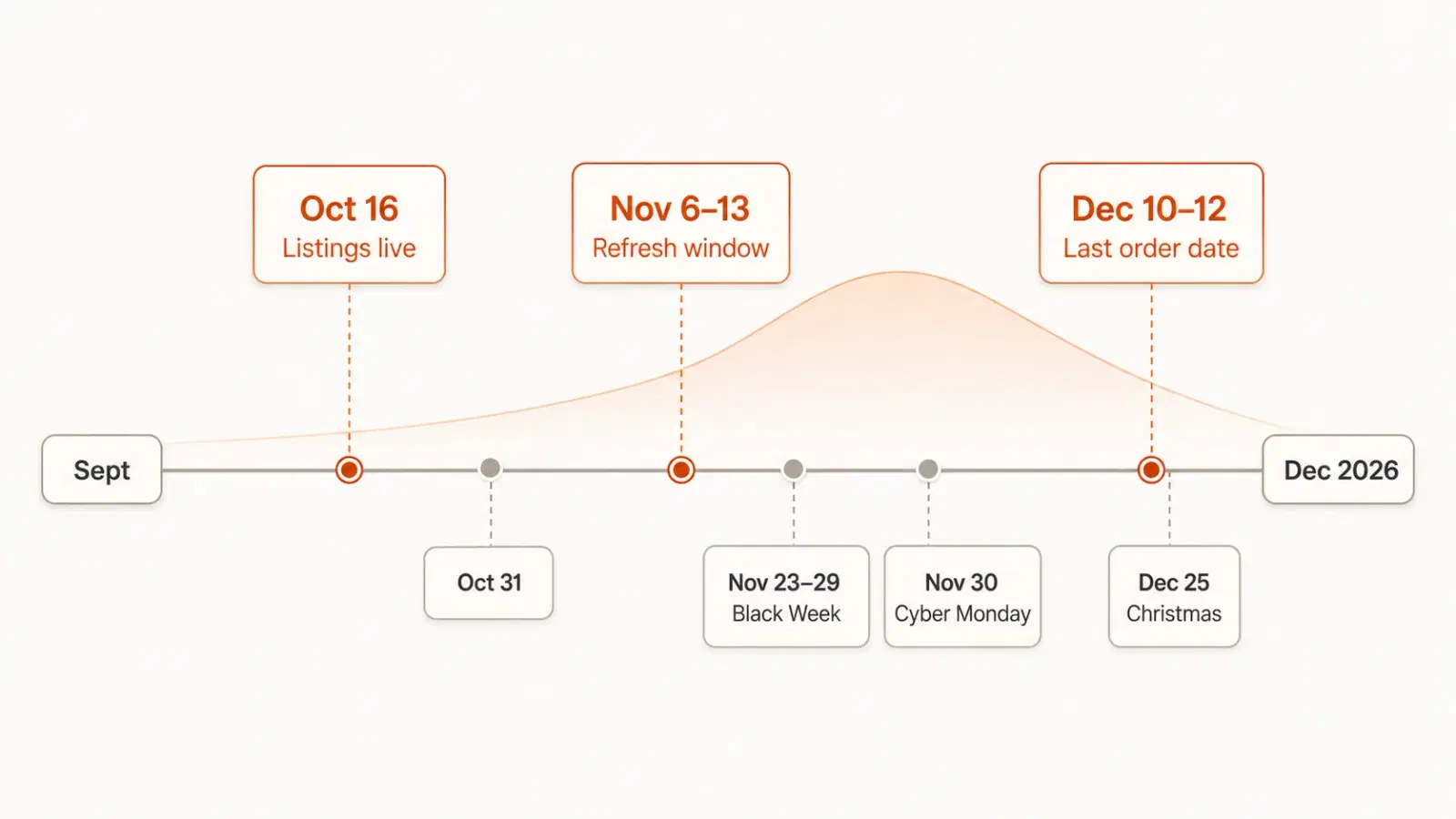
If you're planning Q4 print on demand for a clothing brand, your real deadline is mid-October, not December. New listings need roughly four to six weeks to rank, Black Friday lands on November 27 this year, and print on demand apparel needs production time before it ever touches a carrier. Work backwards and the whole quarter is decided by what you upload in October.
It's August. You probably think you have four months. You have about eight weeks.
That gap between how much time founders think they have and how much they actually have is the single most expensive mistake in seasonal selling. Most Q4 guides tell you to "plan ahead" and then hand you a list of mugs and ornaments. None of them do the subtraction.
This one does. Below you'll find the dated 2026 calendar, the margin math on which apparel actually pays in Q4, and a section for the large group of people who'll read this in November and need a completely different plan.
Key Takeaways
- Your practical deadline for holiday listings is October 16, 2026, six weeks ahead of Black Friday (November 27). Seller-tool analyses put Etsy's ranking-data window at four to six weeks.1
- Adobe Analytics recorded $257.8 billion in US online holiday spending from November 1 to December 31, 2025, up 6.8% year over year. Apparel alone accounted for $49.0 billion, up 7.4%.2
- Etsy's new-listing recency boost now runs roughly 14 to 21 days, so a well-timed relist in early November beats an early upload that peaks in October.3
- The real last-order date for POD apparel is around December 10 to 12, not the carrier cutoff. Production time comes first.4
- Keep roughly 70% of your catalog evergreen. Seasonal designs are a wasting asset that stop earning on December 26.5
Why Your Real Q4 Print on Demand Deadline Is Mid-October
The trap in Q4 planning is that it feels like a December problem. Christmas is in December, so the work is in December. That instinct costs brands the quarter.
Selling in Q4 is a search-and-discovery problem before it's a shipping problem. By the time customers are buying, the ranking is already decided. If your listing isn't visible in November, no amount of December effort fixes it.
New listings need weeks, not days, to rank
Etsy doesn't rank a listing the moment you publish it. It needs engagement data first: clicks, favorites, add-to-carts, conversions. Only then does it know where to place you.
Seller tools that track this closely put the window at four to six weeks for a listing to mature, with meaningful movement showing up around two to four weeks. Marmalead's analysis of Etsy's 2026 algorithm and Outfy's timing breakdown both land in that range. Neither figure is published by Etsy, so treat them as informed estimates rather than gospel. They're consistent enough to plan against.
Count six weeks back from Black Friday on November 27 and you land on October 16. That's the deadline. Not December 1.
If you're still learning the fundamentals here, our guide to Etsy SEO for clothing brands covers the ranking mechanics in depth. This article assumes you already know them and focuses on when to pull the trigger.
The recency boost is short, so time it deliberately
New and renewed listings get a temporary visibility bump. The important detail is that this window has been shrinking. Seller-tool analyses now put it at roughly 14 to 21 days, down from around 30.3
That changes the strategy in a way most sellers miss. Uploading everything in early September doesn't just fail to help, it actively wastes the boost. Your bump lands in late September when nobody is buying holiday apparel.
The better play is a two-step. Get listings live in mid-October so they have time to accumulate ranking data, then refresh a selected group in the November 6 to 13 window so the recency boost lands directly on Black Week.3
Want to get a full holiday catalog built before the October window closes? See how the AI Design Generator works →
Work backwards from the cutoff, not forwards from today
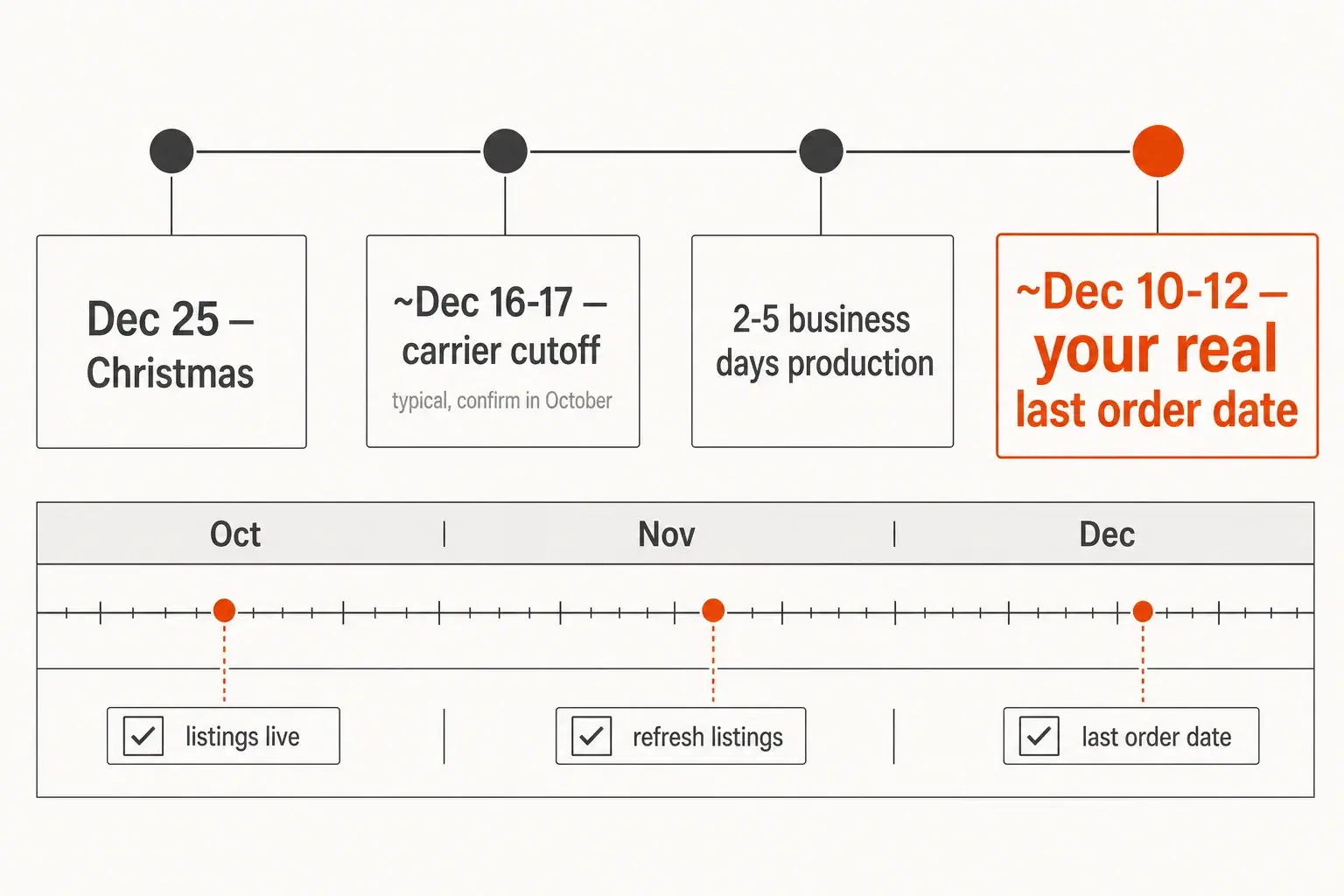
Here's the piece almost nobody publishes. Carriers set their ground shipping cutoffs in mid-December, and they publish final dates in October each year. In recent seasons those ground deadlines have clustered around December 15 to 17, with two-day options running to roughly December 22.
But that carrier date isn't your deadline. Print on demand apparel has to be produced first, and apparel production typically runs two to five business days before a package is even handed to a carrier.
Subtract that and your realistic last-order date for standard shipping is somewhere around December 10 to 12. Christmas 2026 falls on a Friday, which compresses the final delivery window further. Confirm the exact 2026 carrier dates when they publish in October, then set your storefront messaging to the production-adjusted date rather than the carrier one.
The Q4 2026 Calendar, Month by Month
| By this date | Milestone | Why it matters |
|---|---|---|
| Sept 1 to 30 | Designs finalized, mockups rendered, catalog built | This must be finished before the upload window, not during it |
| Fri Oct 16 | Holiday listings live | Six weeks before Black Friday, the outer edge of the ranking window |
| Fri Oct 23 | Last upload for the early-December clothing peak | Six weeks before roughly Dec 4 |
| Sat Oct 31 | Halloween | Real orders at low stakes. Treat it as a fulfillment rehearsal |
| Nov 6 to 13 | Refresh and relist selected products | Times the 14 to 21 day recency boost to land on Black Week |
| Mon Nov 23 to Sun Nov 29 | Black Week | Thanksgiving 26th, Black Friday 27th, Small Business Saturday 28th |
| Mon Nov 30 | Cyber Monday | Adobe recorded $14.25 billion here in 2025, up 7.1%2 |
| Dec 1 to 10 | Last-minute gifting window | SEO is finished. This is paid and social territory |
| ~Dec 10 to 12 | Realistic last-order date for POD apparel | Production time plus ground shipping |
| Mid-December | Carrier ground cutoffs | Confirm exact dates when carriers publish in October |
| Fri Dec 25 | Christmas |
September: build the catalog
September is production month. Every design, mockup, and listing asset should be finished before October opens.
The temptation is to design as you go, uploading a few products a week through October. Resist it. Staggered uploads mean staggered ranking data, and you lose the ability to make a clean judgment about what's working when November arrives.
Build the full set, then ship it in one deliberate push. Rendering a full catalog of mockups used to be the bottleneck here, which is exactly why the AI Mockup Generator exists. Getting from design to listing-ready imagery in a day rather than three weeks is the difference between hitting October 16 and missing it.
October: upload, index, and rehearse
Mid-October is when listings go live. After that, October's job is to generate early data and shake out operational problems while the stakes are still low.
Crocs offers a useful illustration of treating October as the run-up rather than the warm-down. During its Super Brand Day in October 2024, the brand pulled in $1 million in sales and saw a 28,300% increase in live shopping sales compared with the period before the event, according to Modern Retail.6 That's a large brand with a large budget, but the timing logic scales down. October is when you build the momentum that November spends.
Halloween on October 31 is your free rehearsal. You'll find out whether your fulfillment routing works, how your customer service holds up, and where your listing copy confuses people. Finding that out on November 27 is considerably more expensive.
Cassiy Johnson walks through Q4 prep from a seller's perspective, including stock issues, shipping delays, and support volume: Etsy Print On Demand Q4 Prep Guide.
November: Black Week is the quarter
Thanksgiving falls on November 26, Black Friday on November 27, Small Business Saturday on November 28, and Cyber Monday on November 30. That six-day stretch carries a disproportionate share of the quarter.
The scale is worth internalizing. Adobe Analytics reported that US consumers spent more than $4 billion in a single day on 25 separate days during the 2025 season, up from 18 days in 2024. The peak isn't one day anymore. It's a fortnight.
Mobile is where it happens. Adobe put mobile at 56.4% of online transactions for the season, peaking at 66.5% on Christmas Day.2 If your listing images don't read on a phone screen at thumbnail size, that's the constraint that matters most.
December: the last-minute window
By December, search rankings are locked. New listings will not index in time to matter.
Rankings are locked, but discovery isn't finished. One surface is still growing quickly: shoppers asking AI assistants what to buy. Adobe measured traffic from AI tools up 693.4% over the 2025 season compared with 2024. "This 2025 holiday season, consumers embraced generative AI more than ever as a shopping assistant in their purchasing decisions," said Vivek Pandya, lead analyst at Adobe Digital Insights, in the company's holiday shopping report.2
The practical read for a small brand is that plain, factual product copy travels further in December than keyword-dense copy does. Spell out the fabric, the fit, and the shipping cutoff in language a person would actually say out loud.
December is for converting traffic you're already getting and buying the traffic you aren't. It's also when shipping messaging becomes a conversion lever rather than a footnote. State your production-adjusted cutoff clearly and prominently, because the brands that publish an honest last-order date outsell the ones that let customers guess.
What's Actually Trending for Q4 2026 Clothing
Trend research matters less than timing, but it isn't nothing. A few Q4-specific signals are worth designing against.
Heuritech, which forecasts fashion demand from social image data, projects Big Dots up 147% in Q4 2026, building on 87% visibility growth through 2025.7 Plaid is forecast up 16% for menswear in the same quarter and 12% for womenswear over the following year, which makes it one of the few genuinely gender-inclusive winter prints.
The broader Q4 shift is toward texture and weight. Fleece, heavyweight cotton, and coordinated sets outperform lightweight tees for obvious seasonal reasons, and they carry better margins.
One structural point that changes your design brief: in Q4 the buyer often isn't the wearer. Gift purchasing rewards designs that are legible at a glance and safe to buy for someone else. Niche in-jokes that convert brilliantly in July underperform in December, because a gift-giver won't risk them.
For the year-round picture of where clothing brands are heading, our clothing brand trends for 2026 guide covers the structural shifts. This section deliberately covers only what changes for the fourth quarter.
The Best Q4 Print on Demand Products, Ranked by Margin
Most Q4 product lists are published by print providers and read like catalogs of what those providers happen to print. Here's a margin-first view for apparel specifically.
Base costs below are typical published ranges across major POD providers and vary by blank, print method, and volume. Confirm against your own catalog before pricing.8
| Product | Typical POD base8 | Retail range | Q4 read |
|---|---|---|---|
| Heavyweight hoodie | $18 to $28 | $45 to $70 | Best margin-per-order in Q4. Higher AOV absorbs shipping cost |
| Crewneck sweatshirt | $16 to $24 | $38 to $58 | Gift-friendly, less sizing anxiety than fitted styles |
| Beanie | $8 to $14 | $22 to $32 | Low return risk, one size, genuine winter staple |
| Heavyweight tee | $10 to $16 | $28 to $40 | Reliable but lower ceiling. Better as a bundle add-on |
| Coordinated set | Varies | $70 to $110 | Highest AOV, highest inventory-mismatch risk |
| Fitted or cropped styles | $12 to $20 | $30 to $45 | Approach carefully. Sizing-driven returns spike in Q4 |
Where the money is
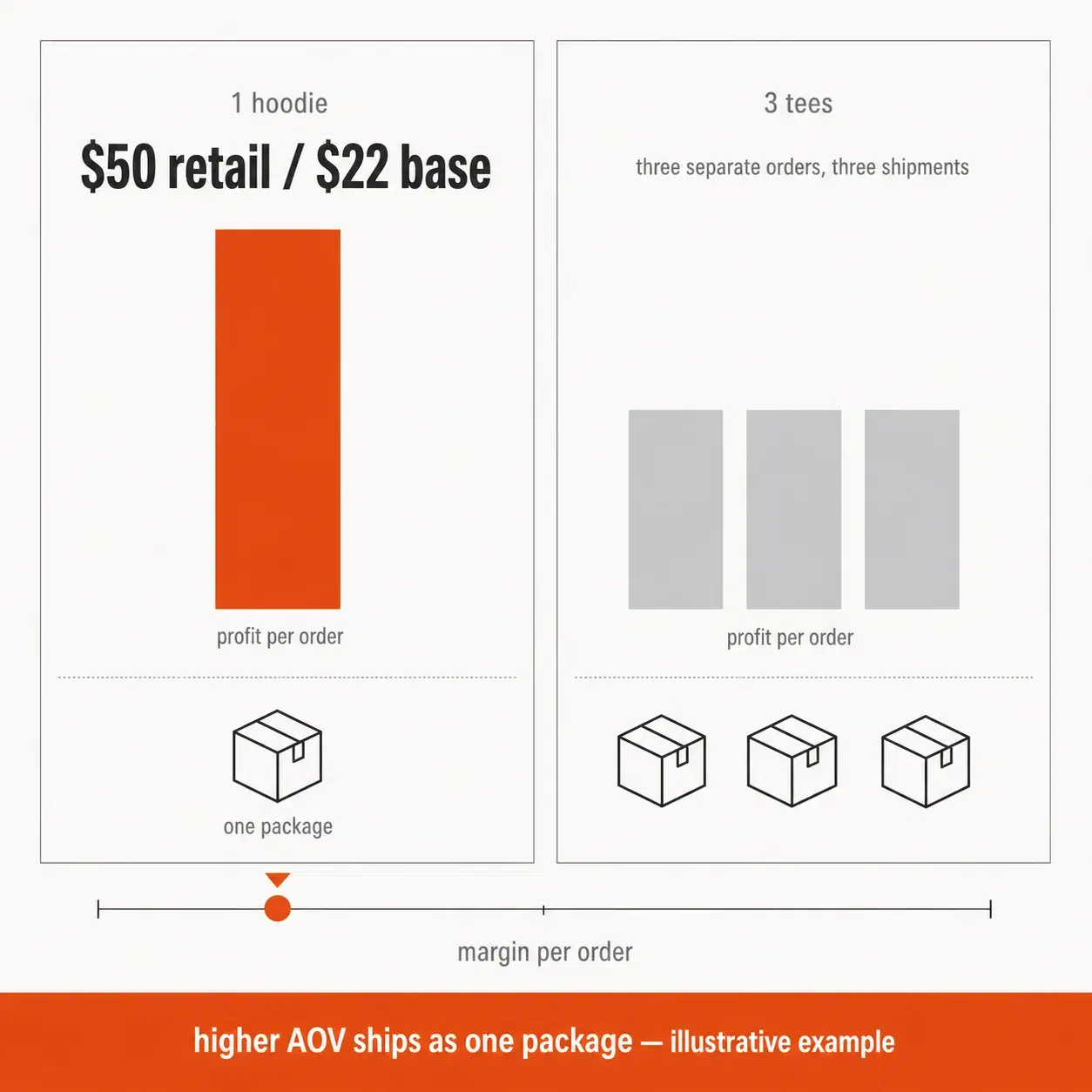
Fleece is the Q4 answer. Take an illustrative case: a hoodie at a $50 retail price against a $22 base cost earns more per order than three tees would, and it ships as one package rather than three.8
That last point matters more than founders expect. Shipping cost is charged per order, not per margin point, so a higher average order value quietly improves your whole unit economics during the most shipping-intensive quarter of the year.
What to avoid
Returns are the silent Q4 killer, and apparel returns are driven overwhelmingly by fit. Every sizing-sensitive SKU you add raises your return rate at exactly the moment your support capacity is thinnest.
Be conservative with fitted and cropped styles in Q4, and be precise about sizing in your listings. If you're weighing which blanks to build on, our guide to choosing blanks for your clothing brand goes deeper on fit consistency.
Ready to see your designs on real Q4 products before you commit? Start a free trial →
Don't Rebuild Your Whole Catalog for One Quarter
A holiday design is a wasting asset. On December 26 it stops earning, and it earns nothing again for ten months.
The common recommendation among experienced sellers is to keep somewhere between 70% and 80% of your catalog evergreen and put the remaining 20% to 30% into seasonal work.5 That's a heuristic rather than a measured finding, but the logic holds up: seasonal designs are a short-dated bet funded by products that pay all year.
The practical version is to favor winter over Christmas wherever you can. A design about cold weather, cozy nights, or December in general sells from October through February. A design with a Santa hat on it sells for six weeks.
Reading This in October or November? Start Here
Most Q4 advice assumes you're reading it in August. Plenty of people aren't. Here's the honest version of what still works.
If it's October
You've got a compressed but workable window. Cut the catalog to your ten strongest ideas rather than fifty mediocre ones, and get them live inside two weeks.
Skip anything that needs a long ranking runway and concentrate on products where you already have ranking history you can extend. Adding a holiday variant to a listing that already performs beats launching a cold one.
If it's November
Stop optimizing for search. It won't index in time, and every hour spent on keywords is an hour not spent on the thing that still works.
In November, traffic is bought or earned socially, not ranked. This is where live selling has become genuinely significant for small brands. Modern Retail reported that Dani Morgan's Boutique generated $100,000 from a single 15-hour live session using countdown bidding, which is the kind of result that simply isn't available through search in November.
The wider data supports the small-brand case here. US small businesses on TikTok Shop, defined as sellers under $15 million in annual revenue, grew sales 66% in 2025, and 72% of brands discovered by TikTok Shop users over the prior twelve months were businesses under that threshold.9 If you're setting the channel up now, start with our guide to selling clothing on TikTok Shop, and note that TikTok Shop selling is currently US-only.
Video is the unit of work in November. Our guide to product videos for clothing brands covers the formats that convert, and the AI Product Video Generator exists for exactly this compression problem.
If it's December
Focus entirely on conversion and clarity. Publish your production-adjusted last-order date, tighten your listing images for mobile, and put your remaining budget behind products that are already selling.
Then start your January planning, because next year's October deadline is closer than it looks.
Q4 Print on Demand Mistakes That Cost Clothing Brands the Quarter
- Treating December as the deadline. The deadline is October 16. December is delivery.
- Uploading everything in September. The recency boost peaks before anyone is shopping.
- Publishing the carrier cutoff as your order cutoff. Production time comes first, so you're roughly five days earlier than you think.
- Building a holiday-only catalog. You've bought a six-week asset with twelve weeks of work.
- Ignoring mobile. Adobe put mobile at 56.4% of holiday transactions.2 Your thumbnails are the storefront.
- Discounting to match large retailers. You can't win Black Friday on price against national brands. Win it on product specificity.
- Skipping the Halloween rehearsal. Every operational flaw you find on October 31 is one you don't find on Black Friday.
FAQ
When should I start preparing for Q4 print on demand? Start design work in September and have holiday listings live by October 16, 2026. That's six weeks before Black Friday, which matches the four to six week window seller tools report for a new listing to accumulate ranking data.
Is it too late to start print on demand for Christmas? Not until roughly December 10. Search-based strategies stop working in November, but paid traffic, live selling, and social video still convert right up to the production-adjusted shipping cutoff.
What sells best in Q4 for clothing brands? Fleece leads. Heavyweight hoodies and crewneck sweatshirts carry the best margin per order and the lowest sizing risk. Beanies are a strong low-return add-on, and coordinated sets deliver the highest average order value.
What's the last day to upload listings for Christmas sales? For listings that need to rank in search, October 23. After that you can still add products, but assume they'll need paid or social traffic rather than organic discovery.
Should I discount on Black Friday as a small brand? Compete on specificity rather than depth of discount. A modest offer on a product nobody else sells outperforms a steep discount on a product available from twenty other shops.
The Bottom Line
Q4 print on demand rewards preparation far more than it rewards effort. The brands that win the quarter aren't working harder in December. They finished the work in October.
Three dates decide it. October 16 is when your listings need to be live. November 6 to 13 is when you refresh so the recency boost lands on Black Week. December 10 to 12 is when ordering realistically closes for standard shipping.
The rest is execution. Build a catalog you can defend, keep most of it evergreen so it earns past December 26, and be honest with customers about when you can actually deliver. Adobe's $49.0 billion apparel figure is a real number, and a meaningful share of it goes to small brands who simply showed up on time.2
If you're reading this in August, you're early enough to do this properly. That's a better position than most of your competitors will be in.
Track what's moving in your category with Shop Insights, and see what's trending before you commit design time with the AI Trend Finder.
Footnotes
-
Outfy, "How Long Does It Take for Etsy SEO to Work?" (2026). Reports a four to six week window for listing data to mature, with movement visible at two to four weeks. Not an official Etsy figure. https://www.outfy.com/blog/how-long-does-etsy-seo-take-to-work/ ↩
-
Adobe Analytics, "Adobe: Holiday Shopping Season Drove a Record $257.8 Billion Online," January 2026. Figures cover November 1 to December 31, 2025: $257.8B total online spend (+6.8% YoY), apparel $49.0B (+7.4%), Cyber Monday $14.25B (+7.1%), mobile 56.4% of transactions peaking at 66.5% on Christmas Day, and traffic from AI tools up 693.4% versus 2024. The Vivek Pandya quotation is reproduced verbatim from this release; his title there is Lead Analyst, Adobe Digital Insights. https://news.adobe.com/news/2026/01/adobe-holiday-shopping-season ↩ ↩2 ↩3 ↩4 ↩5 ↩6
-
Marmalead, "How Etsy's Algorithm Works in 2026." Reports the new-listing recency boost at roughly 14 to 21 days, reduced from approximately 30. Not an official Etsy figure. https://blog.marmalead.com/etsy-algorithm-2026/ ↩ ↩2 ↩3
-
Derived estimate, not a published date. Carriers publish final Christmas cutoffs each October; recent seasons have placed ground deadlines around December 15 to 17. Subtracting typical POD apparel production time of two to five business days gives a practical last-order date of roughly December 10 to 12. Confirm against carrier schedules when 2026 dates publish. ↩
-
Seller heuristic, not a measured finding. The 70/30 to 80/20 evergreen-to-seasonal split is widely recommended in POD seller guidance, including Skup's seasonal strategy guide (2026). https://skup.net/blog/the-complete-seasonal-strategy-guide-for-print-on-demand-how-to-maximize-sales-year-round-2026/ ↩ ↩2
-
Modern Retail, "Big-name brands like Crocs and Pacsun are powering TikTok Shop's livestream bet," September 15, 2025. Crocs' October 2024 Super Brand Day generated $1 million in sales and a 28,300% increase in live shopping sales versus the pre-event baseline. https://www.modernretail.co/technology/big-name-brands-like-crocs-and-pacsun-are-powering-tiktok-shops-livestream-bet-but-us-shoppers-still-favor-short-videos/ ↩
-
Heuritech, "FW26 Fashion Trends: What Consumers Will Really Wear." Forecasts Big Dots +147% in Q4 2026 (following +87% visibility growth in 2025) and Plaid +16% for menswear in Q4 2026, +12% for womenswear over the following twelve months. https://heuritech.com/articles/fall-winter-2026-trends/ ↩
-
Planning ranges compiled from major POD providers' published base pricing (Printful, Printify) as of August 2026. Base costs vary by blank, print method, placement count, and volume tier. The hoodie margin comparison is an illustrative calculation, not a reported result. ↩ ↩2 ↩3
-
Modern Retail, "TikTok Shop says sales from U.S. small businesses climbed 66% in 2025," May 19, 2026. US sellers under $15 million annual revenue grew sales 66% in 2025; 215,000+ active US small businesses (+25% YoY); 72% of brands discovered were under the $15M threshold; Dani Morgan's Boutique generated $100,000 from a single 15-hour live session. https://www.modernretail.co/operations/tiktok-shop-says-sales-from-u-s-small-businesses-climbed-66-in-2025/ ↩