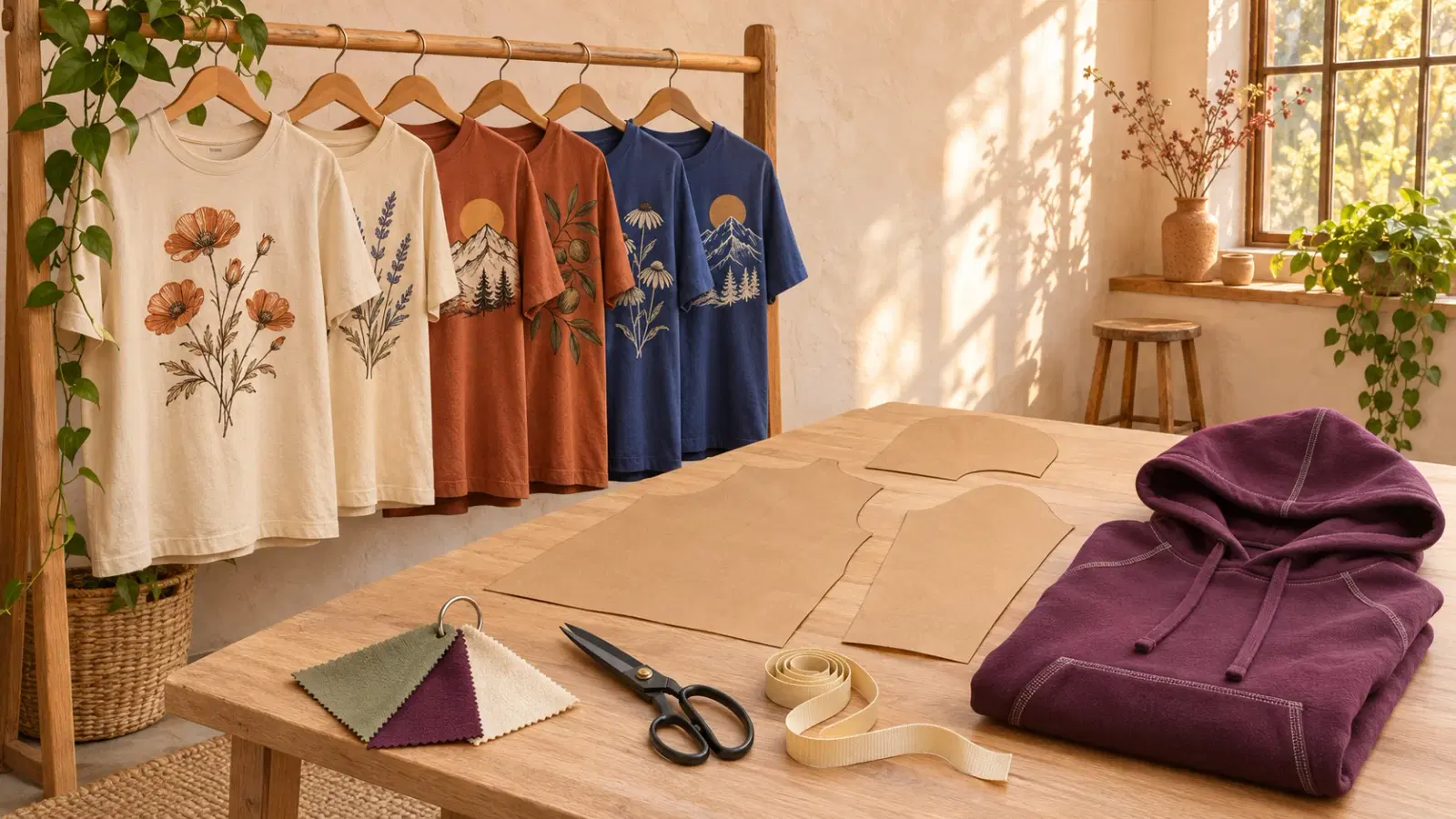
Print on demand vs custom manufacturing comes down to one trade. Print-on-demand (POD) prints a stock blank after each order, with no minimum and no upfront cost.1 Custom manufacturing makes your own garment, from your fabric and pattern, in runs. One California factory sets that run at 300 pieces per style, after paid patterns and samples.2
Most brands shouldn't pick one forever. Test designs on demand, then make the proven winners in a run.
Here's the part most comparisons skip. Plenty of brands that feel they've outgrown print-on-demand don't need a factory at all. They need the same blank, printed in a batch by a print shop. A factory earns its minimums only when the garment itself, not the print, is what you sell.
You already know POD is the easy start. This guide shows what each model costs and commits you to, with real minimums and lead times from factories' own pages. It also covers the signals that a design is ready to leave print-on-demand, and how to run both models at once. When you've decided, our guide on how to find clothing suppliers takes it from there.
Key Takeaways
- Print-on-demand has no upfront cost.1 Printful's price covers the garment and one print: a Bella+Canvas 3001 in black, size M, was $11.92 on November 16, 2026, before shipping.3
- Custom runs are set per style and per color. Mola, a Vernon, California factory, asks for 300 pieces per style and 100 per color, and takes runs from 75 pieces at a 20% surcharge.2
- Before bulk, a custom garment needs a pattern ($200 to $300 per style at Mola) and samples ($100 to $250 each).2 PROFADE quotes 15 days for a prototype and 35 to 55 days for bulk.4
- Of 16 US-based cut-and-sew manufacturers in Vaybel's Supplier Directory that make T-shirts, four state a number for a custom run, from 35 to 2,400 pieces, and one says it has none.5
- The safest path is hybrid: keep new and slow designs on demand, and move a design to a run only once it sells every week.
Print on Demand vs Custom Manufacturing at a Glance
The two models differ on almost every line that matters to a small brand. This table uses the figures each business publishes, so treat them as examples, not market averages.
| Print-on-demand | Custom manufacturing | |
|---|---|---|
| What gets made | Your design printed on a stock blank | Your own garment: fabric, fit, cut, labels |
| Minimum | None; one piece per order1 | 300 per style, 100 per color at Mola;2 35 to 2,400 among directory profiles that state one5 |
| Upfront cost | None1 | Pattern $200 to $300 per style, samples $100 to $250 each (Mola)2 |
| Production time | 2 to 5 business days to fulfill each order, plus shipping (Printful)6 | 15-day prototype, then 35 to 55 days for bulk (PROFADE)4 |
| Who holds stock | Nobody | You, or a fulfillment warehouse you pay |
| What you control | Design, print placement, inside label | Everything about the garment |
Read the minimum row twice. A factory minimum often isn't "300 pieces total." At Mola, it's 300 per style and 100 per color, so one hoodie in three colors fills the run at 100 each.2
What Each Model Costs You
The cost question isn't which is cheaper per piece. It's when you pay, and for what.
Print on Demand: You Pay per Order, After the Sale
With print-on-demand, the provider charges you when a customer orders. Printful's pricing page puts it plainly: "There are no upfront costs when selling with Printful."1 For direct-to-garment (DTG) printing, its product price covers "The product itself" and "One print design (any placement)."1
Branding costs extra, but it's possible. Printful charges $0.99 for a printed inside label and $2.49 for a printed outside label.1 So "POD can't carry my brand" isn't quite true. What POD can't change is the garment under the print: the fabric, cut, and fit of the blank you picked.
On-demand orders don't get cheaper as one design sells more. Printful's product discounts come from its Growth plan (up to 33% off product pricing) or a bulk order.1 That's why per-order cost is the line that tells you when a best seller should move. Our guide to the best blank T-shirts for a clothing brand compares the blanks most brands print on.
Custom Manufacturing: You Pay Before You Sell Anything
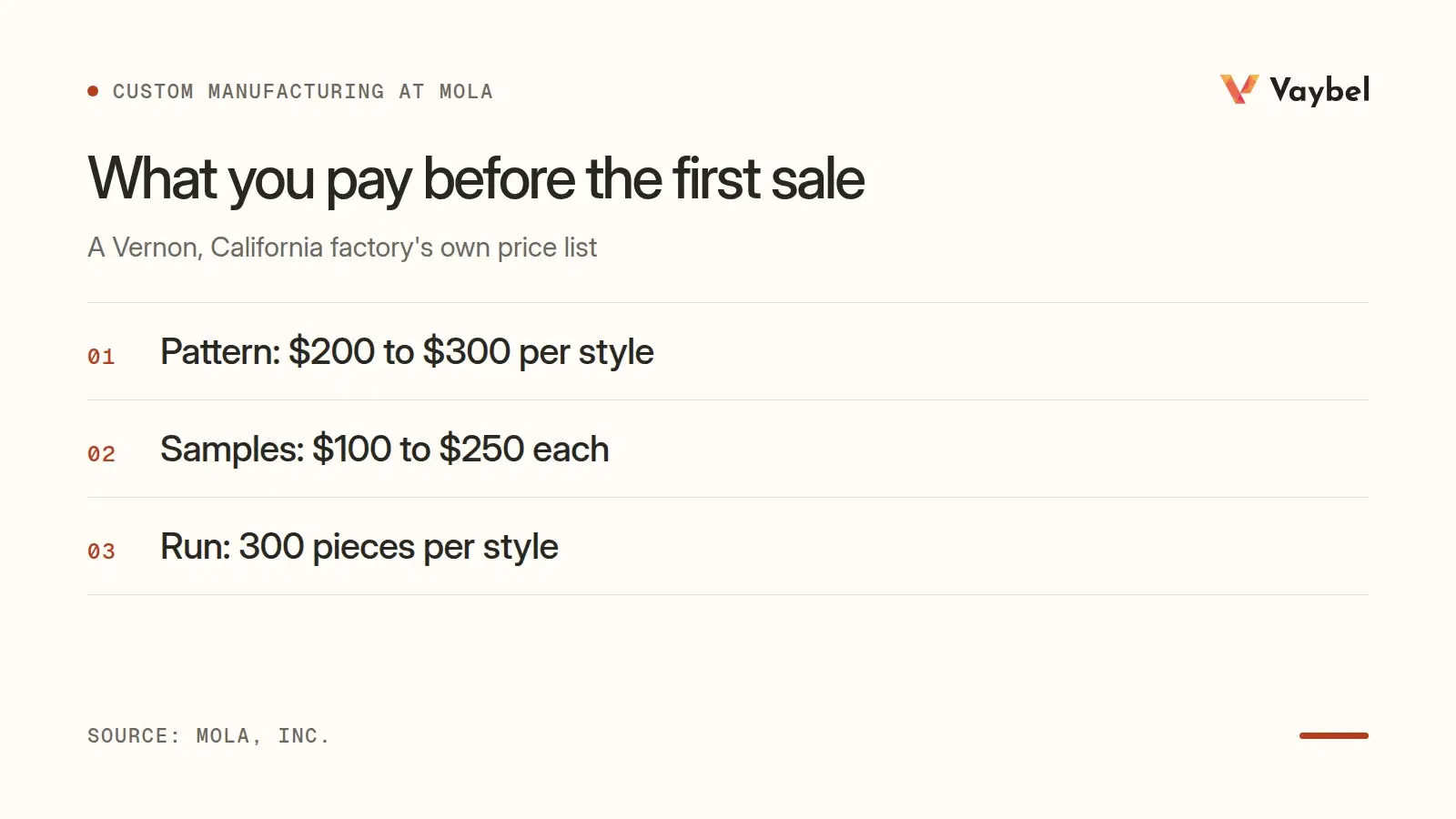
A custom garment costs money long before the first order arrives. Mola's development page lists the steps and their prices:
- Pattern: "$200 - $300 depending on the style."2
- Samples: "$100- $250 depending on garment construction, dyes, embellishments, size sets, etc."2
- Bulk: "300 pieces per style /100 pieces per color."2
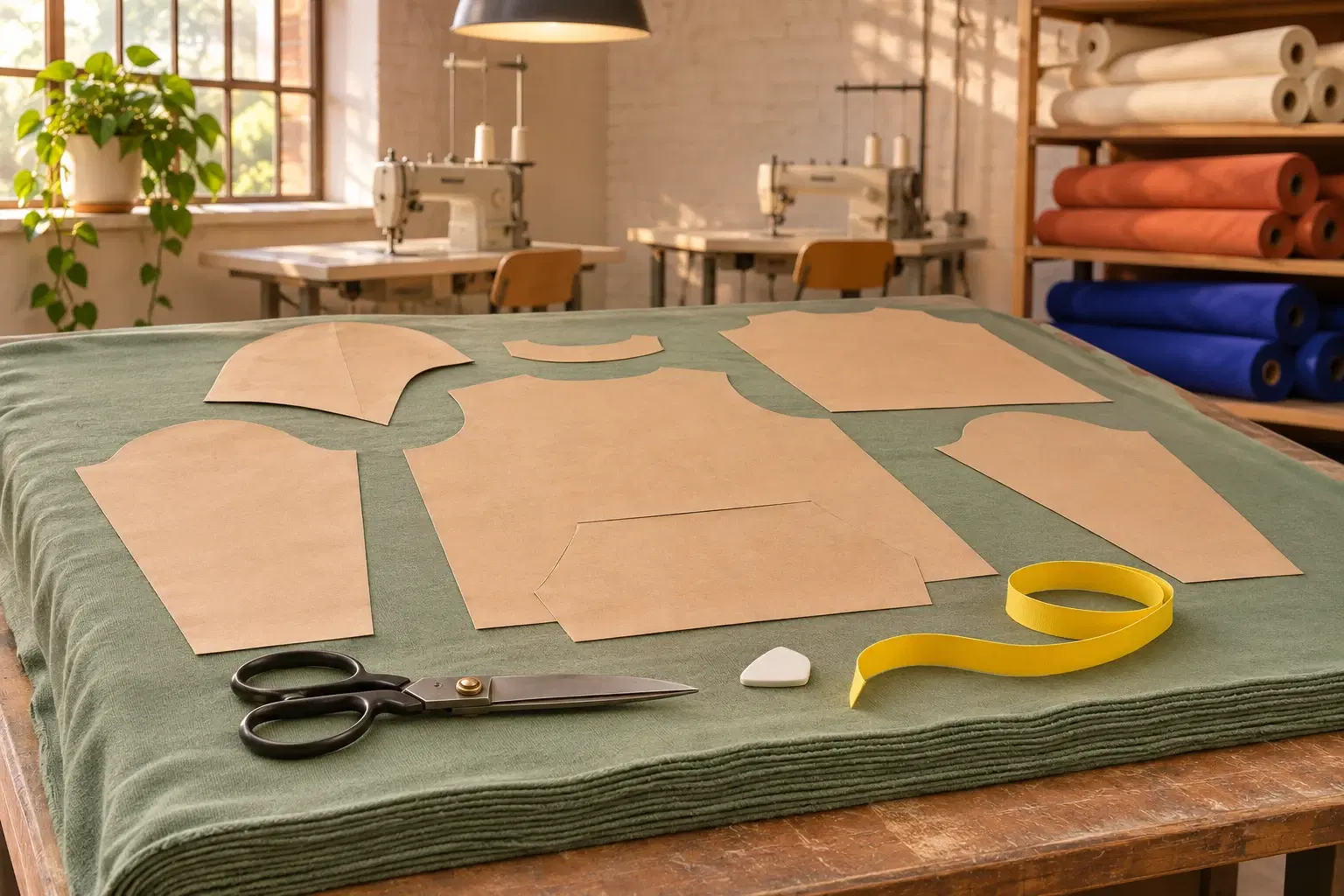
Then you pay for the run itself, plus shipping to wherever your stock lives. Factories quote a price per piece only once they've seen your spec, so no honest guide can give you one number. What you can count on is the shape: cash goes out first, and it comes back only as the stock sells.
Want to know what sells before you spend on a pattern? Vaybel turns a design idea into mockups and listings for Etsy, Shopify, and TikTok Shop, so you can test your designs on demand first. Start a 7-day free trial.
What Each Model Commits You To
Money is one commitment. Quantity and time are the other two, and they catch more founders out.
Minimums Are per Style and per Color
Small runs exist, but they cost more and limit your options. Mola's smaller tiers show how:
| Run size at Mola | Surcharge | Colors allowed |
|---|---|---|
| 300+ pieces per style | None | No cap; 100 pieces per color |
| 200 to 299 pieces | 10% | Up to 3 |
| 75 to 199 pieces | 20% | Up to 22 |
Other factories count differently. PROFADE Apparel lists 300 to 500 pieces as its minimum for woven and knit cut and sew.4 Its directory profile places it in San Diego and says that minimum applies per colorway.5 Ask every factory what its number counts: the order, the style, the color, or the size.
That uncertainty is the norm. Vaybel's Supplier Directory lists 666 clothing manufacturers that do cut and sew.5 Filter to those based in the US that make T-shirts and 16 remain. Four state a number for a custom run:5
- Mega Apparel: "35–50-piece starting quantities"5
- Mola: "300 per style / 100 per colour"5
- PROFADE Apparel: "300–500 per colourway"5
- Pima Apparel: "custom: 600–2,400 by specification"5
One more, LA Sublimation, says it makes custom apparel with no minimum. The other 11 state no custom minimum at all, or only one for stock garments or printing. Plan on asking.
Lead Times Run in Weeks, Not Days
Print-on-demand works in business days. Printful says its "fulfillment time average is 2–5 business days for all products," with shipping time added on top.6
A custom run works in weeks. PROFADE quotes "Prototype Sample: 15 days" and "Bulk Production: 35 to 55 days, based on category, material & quantity."4 That's before any fit revisions, and before freight from the factory to you.
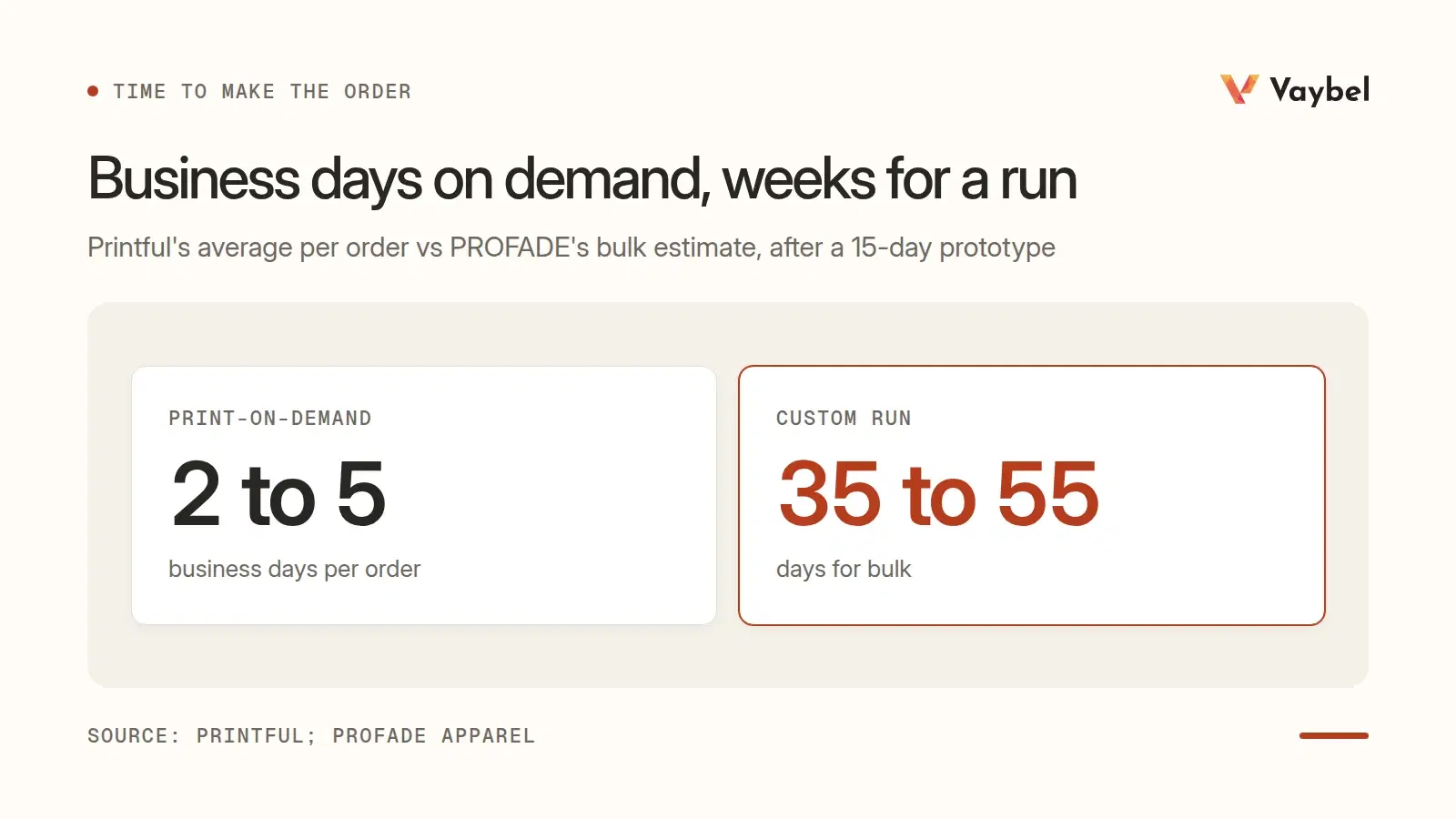
The timing changes how you plan a drop. A trend you spot this week can be on sale on demand in days. The same idea as a custom garment is a next-season product.
Stock Is Yours Once It Arrives
Printful sums up the POD side in one line: "Because Printful produces every item to order, you never pay for unsold inventory."1 With a custom run, every unsold piece is cash on a shelf. You also need someone to ship each order: you, a fulfillment warehouse, or a supplier that holds stock for you.
There's a Middle Step: Bulk Printing on Blanks
Print on demand vs custom manufacturing sounds like two choices. In practice there are three, and the middle one is often the right first move.
A print shop prints your design on the same kind of blank, in a batch. You keep the garment your customers already like, and the cost per piece usually drops. Vaybel's guide to moving from print-on-demand to bulk covers that step.
Screen printing is the usual reason a batch gets cheaper. It needs a screen for each color, so the setup cost spreads thinner the more pieces you print. Mola charges $100 per screen and color, for example.2
So ask one question before you email a factory: is it the print you want to make cheaper, or the garment you want to change? If it's the print, you need a print shop. If it's the garment, you need a manufacturer.
Signs You've Outgrown Print on Demand
You don't outgrow print-on-demand as a brand. One design outgrows it at a time. These are the signals worth acting on, adapted from that Vaybel guide on moving to bulk:
- The design sells every week. Steady sales, not one spike after a launch or a promo.
- Customers ask for what POD can't make. A heavier fabric, a boxier cut, a color your provider doesn't stock, or a technique it doesn't offer.
- Per-order cost eats most of the margin. Your price can't rise, and per-order production cost won't fall on demand.
- You can hold and ship stock. Or you've lined up a fulfillment service that can.
Signals 1, 3, and 4 point to a print shop run, and so does a request for a color or technique your provider lacks. Only a request for a fit or fabric no stock blank offers points to a manufacturer.
When You Haven't Outgrown It
Volume alone isn't a reason to leave. itsjusta6, an entertainment brand with a YouTube channel and a merch line, used to order and ship its merch itself. Printful's case study says the team found that "too time-consuming and costly" and moved to Printful.7
On print-on-demand it averages "6.5K orders a month," and it says the switch let it "triple our product catalog."7 That's Printful's own case study, so read it as a vendor story. Still, it shows the trade clearly: more designs live beats a lower cost on a few.
If your sales are spread thinly across many designs, that's your answer. A run of 300 pieces of one style, Mola's standard, suits a brand with a hit.2 It doesn't suit a brand with forty designs that each sell a few a month.
To see which designs earn their place, Vaybel's Shop Insights shows product performance across your connected shops on the Growth plan and above.
The Hybrid Path: Test on Demand, Make the Winners
The hybrid path is what most brands should run. Vaybel's guide on which supplier you need says it outright: "Mixing suppliers is normal."
Here's how it works in practice:
- Launch every new design on demand. No minimum, no stock, and you can drop a design that doesn't sell.
- Watch weekly sales by design. A design that sells every week for a couple of months is a candidate. A launch spike isn't.
- Move the winner to a print shop run first. Same blank, lower cost per piece, and you learn to hold and ship stock.
- Keep POD running for everything else. Your slow sellers, new tests, and odd sizes stay on demand.
- Make a custom garment only for a proven style. When customers want a fit or fabric no blank offers, brief a manufacturer.
Step 5 is where a factory earns its minimum. The pillar guide on choosing blanks for your clothing brand makes the same case: let real sales tell you which products deserve a custom version.
Vaybel fits the front of this path. It doesn't print or ship.
In the words of its trial page: "Connect Printful or Printify in integration settings. Vaybel helps prepare the product; your provider makes and ships it."8 So a design you test ties up no stock.
Ready to find your next winner? Start your 7-day Vaybel trial and get new designs live on demand before you commit to any run.
Frequently Asked Questions About POD vs Custom Manufacturing
Is print on demand cheaper than custom manufacturing?
It's cheaper to start. Print-on-demand has no upfront cost and no minimum, so your first sale costs only that one piece.1 Custom manufacturing can cost less per piece at volume, but you pay for patterns, samples, and a full run first. Which is cheaper overall depends on how many pieces you sell.
What is the minimum order for a custom clothing manufacturer?
It varies by factory and by garment. Mola in California asks for 300 pieces per style and 100 per color, with smaller runs from 75 pieces at a surcharge.2 PROFADE lists 300 to 500 for cut and sew.4 Most US-based T-shirt makers in our directory don't state one,5 so ask what the minimum counts.
How long does custom clothing manufacturing take?
Expect weeks, not days. PROFADE quotes 15 days for a prototype sample and 35 to 55 days for bulk production, before shipping.4 Fit revisions add more time. Print-on-demand providers like Printful average 2 to 5 business days to fulfill each order, before shipping.6
When should a clothing brand switch from print on demand?
Switch one design at a time, when it sells every week and the per-order cost eats your margin. If you only want a lower cost per piece on the same blank, a print shop run is the next step. Choose a manufacturer only when customers want a fit or fabric no blank offers.
Can I use print on demand and a manufacturer at the same time?
Yes, and many growing brands do. Keep new and slow designs on demand, and make proven best sellers in a run. Vaybel's supplier guide calls mixing suppliers "normal."
Print on Demand vs Custom Manufacturing: Make the Call One Design at a Time
The print on demand vs custom manufacturing choice isn't a one-time decision for your whole brand. It's a call you make for each design, as the sales come in.
- Start every design on demand. No minimum and no upfront cost means a failed test costs you nothing.
- Move a weekly seller to a print shop run when per-order cost is the problem.
- Brief a factory only when the garment itself needs to change, and budget for a pattern, samples, and a run of a few hundred pieces per style.
Once you know which kind of supplier you need, our guide on how to find clothing suppliers walks through filtering, comparing, and sampling, step by step.
Start your 7-day free trial → Test your next designs on demand with Vaybel, and let real sales decide what you make in a run.
Footnotes
Footnotes
-
Printful, Pricing, retrieved November 16, 2026. Product price inclusions, label prices, discounts, and the "unsold inventory" line are quoted from this page. ↩ ↩2 ↩3 ↩4 ↩5 ↩6 ↩7 ↩8 ↩9 ↩10
-
Mola, Inc., Development & Manufacturing, retrieved November 16, 2026. Minimums, surcharge tiers, pattern charges, sample prices, and screen charges are quoted from this page, also summarized on Mola's Vaybel directory profile. ↩ ↩2 ↩3 ↩4 ↩5 ↩6 ↩7 ↩8 ↩9 ↩10 ↩11 ↩12 ↩13
-
Printful, Unisex Staple T-Shirt, Bella + Canvas 3001, black, size M, $11.92 in the page's product data and in Printful's catalog API, retrieved November 16, 2026. Prices change. ↩
-
PROFADE Apparel, MOQ & Lead Times, retrieved November 16, 2026. ↩ ↩2 ↩3 ↩4 ↩5 ↩6
-
Vaybel Supplier Directory, clothing manufacturers; counts from the open supplier list at api.vaybel.com/suppliers/, queried November 16, 2026: 666 suppliers for "Clothing manufacturers" plus "Cut and sew"; 16 after adding "T-shirts" and "Based in: United States." Minimum wording is quoted from each profile's stated minimum. Counts change as profiles are added and updated. ↩ ↩2 ↩3 ↩4 ↩5 ↩6 ↩7 ↩8 ↩9 ↩10
-
Printful, itsjusta6 case study, retrieved November 16, 2026. Figures are self-reported by Printful. ↩ ↩2
-
Vaybel, 7-day free trial, retrieved November 16, 2026. ↩