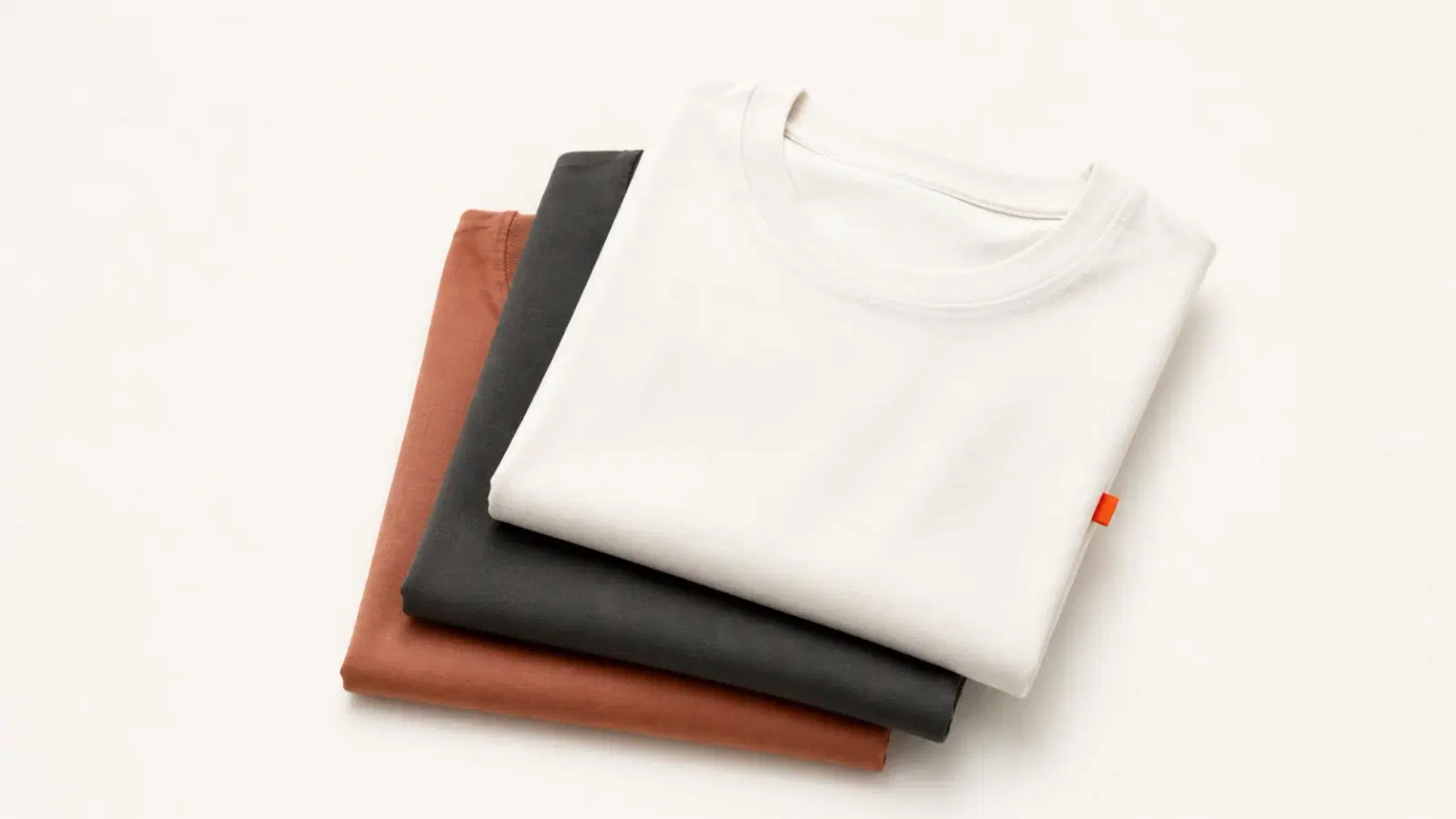
The best all-around blank t-shirt for a clothing brand in 2026 is the Bella+Canvas 3001 for soft, detailed graphic tees, the Gildan 64000 Softstyle when you need print quality on a budget, and the Comfort Colors 1717 when your brand sells a vintage, garment-dyed look. Pick by print method and margin, not by softness alone.
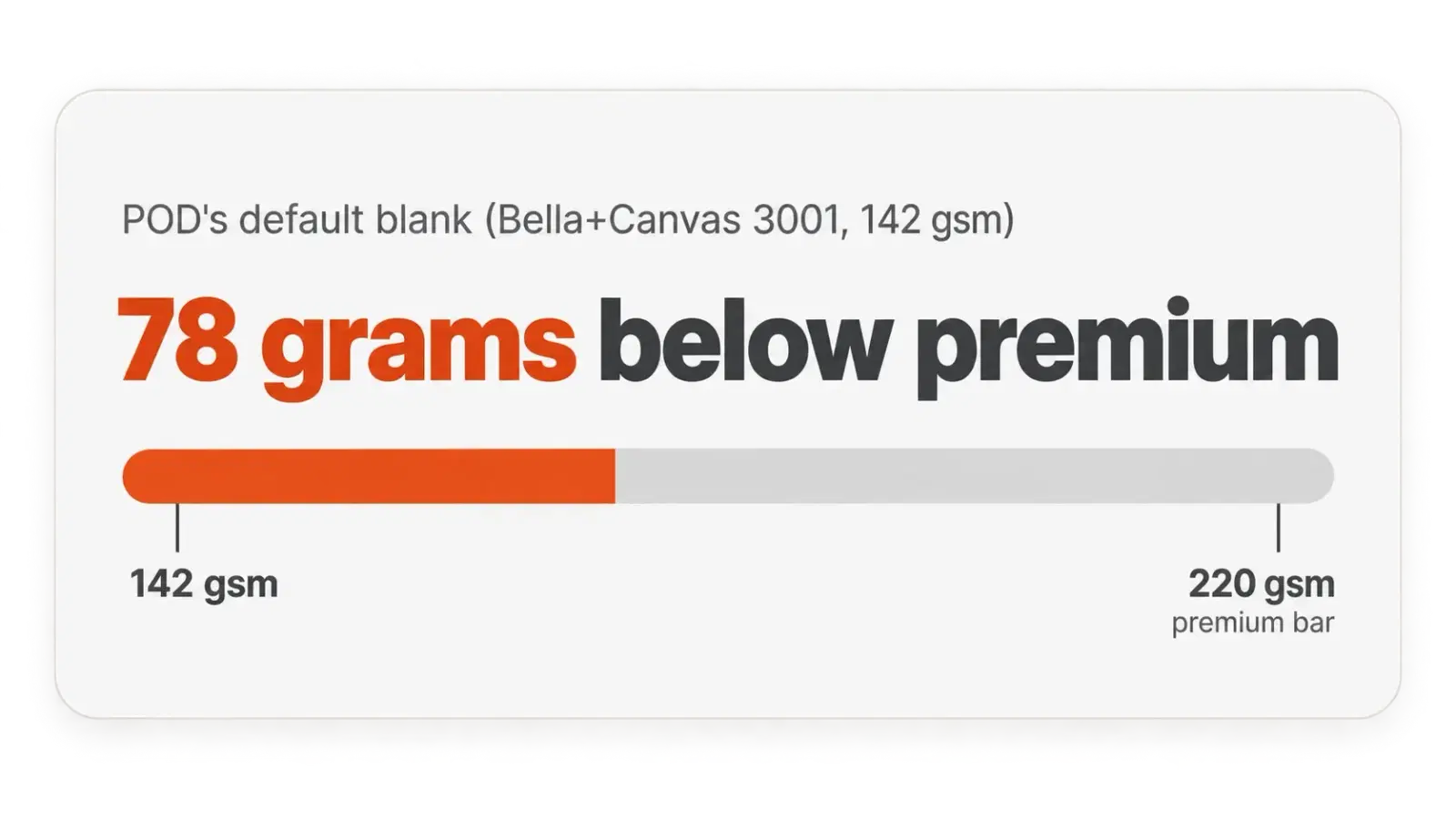
Now here's the part nobody on page one will tell you. The most-recommended blank in print-on-demand, the Bella+Canvas 3001, weighs 4.2 oz/yd² (142 g/m²), according to Printful's own spec sheet. Meanwhile the operator standard that premium brands hold themselves to, published by apparel consultant Hunter Harms, is blunt: "The standard for a premium blank in 2026 is 6.5 oz (220 gsm) at the minimum. Anything under that is a commodity."1
So the default recommendation of the entire print-on-demand industry sits roughly 78 grams under the bar that the premium end of the industry uses to define "not a commodity." Both camps are right, and neither one says so out loud.
That gap exists because almost every "best blank t-shirts" article is written by someone with a stake in the answer. Wholesale and cut-and-sew guides rank beautiful boutique blanks you'd have to buy by the case. Print-on-demand blogs rank their own catalog, which means they can never tell you a shirt is too thin.
This guide does neither. Every blank below is orderable today with no minimum, every spec is sourced, and every entry gets an honest weakness.
Key Takeaways
- Softness and weight are different things. The Bella+Canvas 3001 is a genuinely excellent print surface at 4.2 oz (142 gsm), but it's a lightweight tee, not a premium-weight one, and pricing it like heavyweight is how brands lose repeat buyers.
- The heavier Gildan is the worse print. The Gildan 5000 runs 5.0 to 5.3 oz but uses open-end cotton, while the lighter Gildan 64000 Softstyle uses ring-spun, which is what direct-to-garment ink actually needs.
- Your base cost decides your niche. At Printful, DTG on a Gildan 5000 starts at $6.95 versus $11.50 on a Bella+Canvas 3001, and that spread is the whole difference between a viable impulse tee and an unviable one.
- Streetwear runs out of mainstream catalog. Printify calls 240gsm "your premium brand builder" and says it supports a $10 to $20 premium per item, but the best heavyweight options in most catalogs stop just above 200 gsm.
- The same style number isn't the same shirt. On a multi-provider network, one SKU is fulfilled by different printers at different prices, so you lock the provider, not just the style code.
In this guide:
- How we ranked these
- The 9 best blank t-shirts, ranked
- The top four, reviewed honestly
- Best blank by use case
- Why the heavier shirt isn't the better print
- If you're building streetwear, the catalog runs out
- What each blank actually costs you on TikTok Shop
- Same style number, different shirt
- Shortlist before you sample
- The blanks you'll graduate to
- FAQ
How We Ranked These
Five criteria, applied in this order.
1. You can actually order it. Every blank in the main ranking is available through a mainstream print-on-demand provider with no minimum order. That single filter removes most of what competing lists recommend.
2. Weight class. The boundaries genuinely vary by who's defining them, which is worth knowing before someone quotes one at you as gospel. One blanks specialist puts lightweight below 160 gsm, midweight at roughly 180 to 220, and heavyweight at 240 and up, with 280 to 300 as "genuine statement territory". Weight drives drape, opacity, and what your customer feels when the box opens.
3. Yarn construction. Ring-spun versus open-end matters more than weight for print sharpness, and it's the single most under-explained spec in this category.
4. Print-method fit. Direct-to-garment wants combed ring-spun cotton. Direct-to-film handles blends, polyester, and dark garments without pre-treatment.
5. Landed cost against channel fees. A blank you can't sell profitably after marketplace commission isn't a good blank, however nice it feels.
This is deliberately a shortlist with verdicts, not a decision framework. If you want the full reasoning behind fabric weight, construction, fit, and return risk, that lives in our guide to how to choose blanks for your clothing brand. This article assumes you've made those decisions and now want style numbers.
New to this and not sure which direction your brand should go first? Start with how to start a clothing brand with no experience, then come back for the shortlist.
The 9 Best Blank T-Shirts for Clothing Brands in 2026
| # | Style | Weight2 | Yarn | Fit | Best print method | Best for |
|---|---|---|---|---|---|---|
| 1 | Bella+Canvas 3001 | 4.2 oz / 142 gsm | Airlume combed ring-spun, 32 singles | Retail, side-seamed | DTG | Detailed graphic tees |
| 2 | Gildan 64000 Softstyle | 4.5 oz | Ring-spun | Semi-fitted | DTG | Best print per dollar |
| 3 | Comfort Colors 1717 | 6.1 oz / 205 gsm | Ring-spun, garment-dyed | Relaxed, tubular | DTG, screen | Vintage and washed looks |
| 4 | AS Colour 5001 Staple | 180 gsm | Combed cotton | Regular | DTG, screen | Fashion-led brands |
| 5 | Bella+Canvas 3010 | 6 oz / 203 gsm | Airlume combed ring-spun | Boxy | DTG, embroidery | Heavyweight upgrade path |
| 6 | Hanes 5180 Beefy-T | 6.1 oz | Ring-spun, 20 singles | Classic | DTG, screen | Durability on a budget |
| 7 | Stanley/Stella STTU169 | 5.3 oz / 180 gsm | Organic combed ring-spun | Relaxed | DTG | Eco-positioned brands |
| 8 | Next Level 3600 | 4.3 oz | Combed ring-spun, side-seamed | Fitted | DTG | Fitted, fashion-forward cuts |
| 9 | Gildan 5000 | 5.0 to 5.3 oz / 170 to 180 gsm | Open-end, tubular | Boxy, classic | DTF, screen | Lowest landed cost |
Specs above come from manufacturer and provider documentation, cited in the reviews below. Base costs move constantly and vary by provider, so confirm the current number in your own catalog before you price a single product.
One structural note about this ranking. It's ordered for a founder building a brand, not for the cheapest possible unit, which is why the Gildan 5000 at $6.95 for DTG sits at the bottom rather than the top. It's a fine shirt. It's just the wrong first choice for a brand that wants customers to reorder.
The Top Four, Reviewed Honestly
1. Bella+Canvas 3001: the default, and its one real weakness
Specs: 4.2 oz/yd² (142 g/m²), combed and ring-spun cotton, side-seamed, modern fitted unisex cut with slimmer sleeves. Airlume cotton at 32 singles gives it an unusually smooth print surface.
What it's genuinely good at. Detail. The tight, fine yarn holds crisp line work and gradients that a coarser shirt smudges, which is exactly what water-based direct-to-garment ink needs. The side seams give it a retail silhouette instead of a boxy promo-tee shape. If you sell illustrated or typographic graphics, this is the safe answer.
Where it lets you down. It's light. At 142 gsm it sits comfortably in the lightweight class, and reviewers note the fabric can read slightly sheer over a dark undergarment. The same review makes the commercial point sharper than we would: a lighter blank sold at a premium price "erodes trust fast, especially for repeat purchases."
Verdict: pick this if your product is the graphic and your price point is accessible. Don't pick it if your brand promise is heavyweight, boxy, or premium-feel, because the shirt will contradict your marketing the moment it's unboxed.
2. Gildan 64000 Softstyle: the value pick that beats its heavier sibling
Specs: 4.5 oz, 100% ring-spun cotton, semi-fitted, high stitch density.
What it's genuinely good at. Print quality per dollar, and it's the clearest illustration of this article's central point. The Gildan 64000 is lighter than the Gildan 5000 and costs a little more, yet it prints better, because ring-spun yarn is finer and tighter than open-end and gives ink a smoother surface to sit on.
Where it lets you down. It's still a budget shirt with a budget hand-feel, and the fit is less distinctive than the Bella+Canvas 3001 or the Next Level 3600. Nobody has ever bought a tee because it was a Gildan 64000.
Verdict: pick this if you're testing designs and want the best print you can get without committing to premium base costs. It's the smartest way to validate a graphic before you upgrade the blank underneath it.
3. Comfort Colors 1717: the vintage look, and what it costs
Specs: 6.1 oz (205 gsm), ring-spun cotton, garment-dyed, relaxed fit, no side seams. It's the only blank on this list where the color process is the product.
What it's genuinely good at. Garment dyeing gives you a soft, faded, lived-in shirt on day one, plus muted earthy tones that a piece-dyed blank can't replicate. At 205 gsm it's a substantial upper-midweight, so it feels like more shirt than the Bella+Canvas 3001 without reaching true streetwear heavyweight territory.
Where it lets you down. Cost, and consistency. At $14.00 for DTG on Printful it's roughly double the Gildan 5000 base, which forces a higher retail price. Garment dyeing also means shade varies slightly between units, charming for a vintage brand and a returns problem for a brand promising exact color matching.
Verdict: pick this if your aesthetic is vintage, collegiate, or washed, and your pricing supports it. This is a positioning shirt, not a volume shirt.
4. AS Colour 5001 Staple: the fashion-brand blank
Specs: 180 gsm, 100% combed cotton, with heather colors at 15% viscose, regular fit, built as a clean canvas for screen printing and direct-to-garment.
What it's genuinely good at. Restraint. AS Colour built its reputation on consistent sizing and minimal branding, which is why fashion-led and streetwear-adjacent labels default to it. At 180 gsm it's solidly midweight, a noticeably more substantial shirt than the Bella+Canvas 3001 without jumping to heavyweight cost.
Where it lets you down. Availability is narrower than the Gildan or Bella+Canvas catalog across print-on-demand providers, so check that your specific provider stocks it before you build a line around it. Wholesale, it's around $15.60 at 50 units, which is real money if you ever move off print-on-demand.
Verdict: pick this if you're building a minimal, design-led brand where fit consistency matters more than the loudest possible print.
Ready to see these on your actual design? You can render a graphic across all four of these blanks, in every colorway, before you spend anything on samples. Try the AI Mockup Generator free →
Best Blank T-Shirt by Use Case
- Best overall: Bella+Canvas 3001
- Best on a budget: Gildan 64000 Softstyle
- Best for DTG detail: Bella+Canvas 3001, then the Gildan 64000
- Best for dark garments and DTF: Gildan 5000
- Best garment-dyed vintage look: Comfort Colors 1717
- Heaviest inside a mainstream catalog: Comfort Colors 1717 or Bella+Canvas 3010
- Best organic and eco-positioned: Stanley/Stella STTU169
- Best fitted silhouette: Next Level 3600
- Best durability per dollar: Hanes 5180 Beefy-T
Why the Heavier Shirt Isn't Always the Better Print
Here's the comparison that reorganizes how you read every spec sheet from here on.
The Gildan 5000 weighs 5.0 to 5.3 oz (170 to 180 g/m²) and uses standard open-end cotton yarn in a tubular body with no side seams. The Gildan 64000 Softstyle weighs 4.5 oz and uses ring-spun cotton. The lighter shirt is the better print surface, every time.
The reason is mechanical. Ring-spinning twists and thins the cotton strands continuously, producing a finer, tighter yarn with a smoother face. Open-end spinning is faster and cheaper and leaves a coarser surface. When water-based direct-to-garment ink hits that coarser face, it scatters into the fiber instead of sitting cleanly on it, and fine detail goes soft.
So treat these as two separate dials:
- Weight buys drape, opacity, and perceived quality in the hand.
- Yarn buys print sharpness, color vibrancy, and softness against the skin.
A 6 oz open-end tee feels substantial and prints mediocre. A 4.5 oz ring-spun tee feels slight and prints beautifully. Most "best blanks" lists collapse both into a single quality score, which is how founders end up disappointed by a shirt that looked great on the spec sheet.
Want the full head-to-head on the two brands this comparison keeps circling? We wrote that one separately: Gildan vs Bella+Canvas.
If You're Building Streetwear, the Mainstream Catalog Runs Out
This is where honest advice diverges hardest from vendor advice.
Printify's own guidance calls 240gsm "your premium brand builder", credits it with the structured boxy fit modern streetwear depends on, and says it supports a $10 to $20 premium per item. That's the benchmark, and it lines up with the blanks specialist definition that puts true heavyweight at 240 gsm and up. The problem is that the heaviest common options in mainstream catalogs land well short of it, with the Comfort Colors 1717 at 205 gsm and the Bella+Canvas 3010 close behind.
Read that gap carefully, because it's the single most useful thing on this page for a streetwear founder. The blanks the whole industry recommends are roughly a full weight class below what your customer pictures when you say "heavyweight." Three honest ways to close it:
Accept upper-midweight and compete on design. Plenty of successful graphic brands sell right around the Comfort Colors weight. Just don't market that shirt as heavyweight streetwear, because the customer who cares about weight will notice the moment they pick it up.
Move to a specialist provider. Some print-on-demand networks exist precisely for this gap. Tapstitch defaults to heavyweight blanks with 250 gsm snow-washed tees and a native TikTok Shop integration, and Apliiq carries the heaviest blanks in print-on-demand at up to 490 gsm with real woven labels sewn in. Neither is going to appear in a Printify or Printful article, for obvious reasons.
Validate first, then go custom. Prove the design sells on a midweight blank, then move the winner to heavier production once volume justifies it.
Before you commit to a weight class, it's worth checking what your niche is actually buying right now, since heavyweight and oversized cycle in and out like any other trend. Vaybel's AI Trend Finder surfaces what's rising in a category so the decision isn't a guess.
What Each Blank Actually Costs You on TikTok Shop
Most blank guides stop at the shirt. Your margin doesn't.
Start with the base. At Printful, direct-to-garment printing on a single area runs $6.95 on a Gildan 5000 and $11.50 on a Bella+Canvas 3001. That $4.55 gap is small in isolation and enormous across a catalog.
Now layer the channel. On TikTok Shop, "most products carry a 6% referral fee, while some jewelry items are charged 5%," calculated on product price before tax and shipping. Printify's worked example puts a $50 item at $3.00 in referral fee with net earnings of $42.23 after fulfillment and withdrawal costs, or 84.46% retained.
Affiliate commission is the variable that actually decides things, and it's the one every guide fudges. Sellers set their own creator rates, and there is, in the words of one fee analysis, "no defensible universal '2026 average' for every category." Treat any article quoting you a single industry-standard affiliate percentage as unsourced.
Put those two numbers together and the blank decision stops being about softness. Here's the same tee priced at $32 across three of the ranked blanks, using Printful's published base costs and the 6% referral fee:
| Blank | Printful DTG base3 | Kept after referral fee | Gross margin |
|---|---|---|---|
| Gildan 5000 | $6.95 | $30.08 | $23.13 |
| Bella+Canvas 3001 | $11.50 | $30.08 | $18.58 |
| Comfort Colors 1717 | $14.00 | $30.08 | $16.08 |
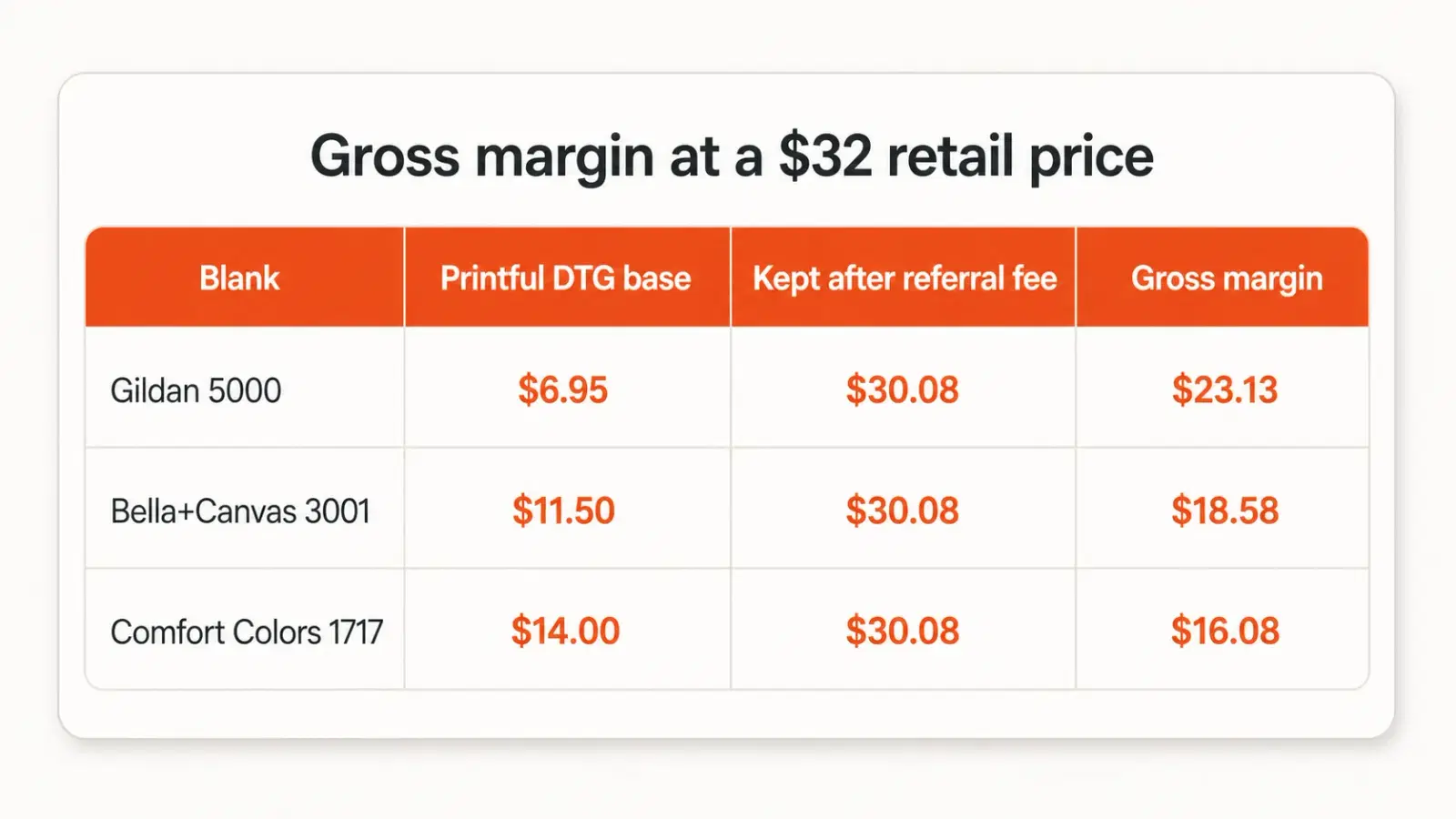
That's arithmetic on the two sourced figures above, and it deliberately excludes shipping, creator commission, ad spend, and returns. Add those and the spread between the top and bottom row is often the entire difference between a product that funds its own marketing and one that doesn't.
So the useful question isn't "which blank is best." It's this: at your retail price, after your base cost, the platform referral fee, and whatever commission you offer creators, does the premium blank still leave enough room to pay for the content that sells it? For a low-priced impulse tee, usually not. For a higher-priced garment-dyed piece with a vintage story, often yes.
Vaybel is an official TikTok Shop App Store partner, so the publishing side is a certified integration rather than a workaround. But no integration fixes a blank you chose above your price point. If you're still setting the channel up, start with our guide to selling clothing on TikTok Shop.
Same Style Number, Different Shirt
A detail that costs founders real money.
On a multi-provider network, the same style code is fulfilled by different print shops in different locations, at different prices and different quality levels. Printify bases start lower, with tees from around $6.31 and the Gildan 5000 from about $5.50 depending on supplier, while Printful runs a single in-house operation with more consistency and higher prices.
That means "I use the Bella+Canvas 3001" is an incomplete sentence. Two sellers can both use the Bella+Canvas 3001 and ship visibly different products, because the pre-treatment, the printer calibration, and the quality control belong to the provider, not the shirt.
The rule is simple. Lock the provider, then sample from that specific provider, then build your listings around what you received. Switching providers later without re-sampling is how a brand's reviews quietly fall apart.
Shortlist Before You Sample
Ordering samples of every blank on this list is the advice you'll get everywhere, and it's expensive advice taken literally. Four blanks, in two colorways each, plus shipping and a week or two of waiting, is real money and real delay before you've validated a single design.
There's a cheaper sequence. Render your design across the candidates first, judge how it reads on each weight, color, and fit, then order a sample of the finalist only. You go from four sample rounds to one.
This isn't theoretical. The operator behind @maverickecom credits an AI-mockup-first workflow for taking a print-on-demand brand from zero to roughly half a million dollars in about four months with almost no sample spend, an operator claim rather than an audited figure, but a well-documented one worth studying. The mechanic underneath it is the same one that applies here: don't pay to print something you haven't seen on your own design yet.
Vaybel's AI Mockup Generator renders your artwork across candidate blanks, colorways, and fits in minutes, and those same images become your product listing photos. If the print file itself still needs building for the method your blank requires, the AI Design Generator handles the resolution and transparency side. We walk through the whole process in how to make clothing mockups with AI.
One honest caveat, because the rest of this page is built on being straight with you. Mockups shortlist; they don't replace a sample. Hand-feel, true colorfastness after a wash, and how a size medium actually fits a real torso are things you confirm with a physical shirt. Use renders to get from nine candidates to one, then spend the sample budget where it matters.
If you want to see three of the blanks on this list handled side by side before you commit, this hands-on comparison of AS Colour, Bella+Canvas, and Comfort Colors ordered through Printful is a useful outside perspective:
The Blanks You'll Graduate To
Every list like this one eventually runs into the tier above it, and pretending otherwise would be dishonest.
Hunter Harms' operator guide ranks blanks most print-on-demand sellers can't touch, led by the Los Angeles Apparel 1801GD at 6.5 oz (220 gsm), made in the USA, retailing around $26 direct-to-consumer, followed by boutique names like WATC Studio and Zuni Sportswear. These are excellent shirts. They're also bought by the case, held as inventory, and shipped by you.
That tier is real and worth aiming at. Los Angeles Apparel runs three factories in South Los Angeles where workers earn up to $25 an hour, and its 1801 in saturated garment dye and pigment dye was picked up by the streetwear and fashion brands buying its blanks, according to WWD. That's what a blank looks like when it becomes a brand's signature rather than its cost line.
The full custom step costs more than founders expect. Hunter Harms puts cut-and-sew at roughly 144 units per style as a minimum, with budgets starting around $15,000. That's the number to hold in your head when someone tells you to start with premium blanks on day one.
The sequence that actually works: validate the design on a catalog blank, prove a SKU sells, then upgrade the garment underneath a proven winner. Our pillar guide covers when to graduate from blanks to cut-and-sew in more depth.
Frequently Asked Questions
What is the best blank t-shirt for a clothing brand? For most brands, the Bella+Canvas 3001 for detailed graphic tees, the Gildan 64000 Softstyle for the best print quality per dollar, and the Comfort Colors 1717 for vintage garment-dyed looks. The right answer depends on your print method, your niche, and your retail price.
What blanks do real clothing brands use? Print-on-demand brands mostly use Bella+Canvas, Gildan, Comfort Colors, AS Colour, and Stanley/Stella. Established streetwear labels tend to move up to boutique blanks like Los Angeles Apparel or straight to custom cut-and-sew once volume justifies it.
Is Bella+Canvas actually good, or just popular? Both. It's a genuinely excellent print surface thanks to combed ring-spun Airlume cotton. It's also a 4.2 oz lightweight shirt, so it's the wrong choice if your brand promise is heavyweight.
What GSM should my t-shirt be? Midweight, roughly 180 to 220 gsm, suits most retail brands. Streetwear expects heavier, closer to 240 and up. Our guide to choosing blanks breaks the weight classes down properly.
What's the best blank t-shirt for DTG printing? Any 100% combed ring-spun cotton shirt. The Bella+Canvas 3001 and Gildan 64000 Softstyle are the two most reliable options, because ring-spun yarn gives water-based ink the smooth surface it needs.
What's the cheapest blank that still looks premium? The Gildan 64000 Softstyle. It uses ring-spun cotton at a budget base cost, which gets you most of the print quality of a premium blank without the premium price.
Can I use any blank with print on demand? No. You can only use what your provider stocks, and the same style number can be fulfilled by different printers with different results. Lock your provider before you build a catalog around a shirt.
Do I need to order samples before selling? Order at least one, of your finalist, from the exact provider you'll ship from. Use mockups to narrow the field first so you're paying for one sample instead of nine.
The Bottom Line
The best blank t-shirt for your clothing brand isn't the one ranked first on a wholesale blog or the one your print-on-demand provider happens to sell. It's the one that's actually in your catalog, matched to your print method, honest about its weight, and still profitable after your channel takes its cut.
Four things to carry out of this guide. Ring-spun beats heavy for print quality. Lightweight blanks are fine until you price them like heavyweight ones. Your provider matters as much as your style number. And you can see a design on nine shirts before you buy one.
Start by narrowing to two or three candidates from the ranking above, render your actual artwork on each, then sample only the finalist. Once you're live, let sell-through pick your house blank rather than deciding it in advance; Shop Insights shows which SKU is actually converting.
See your design on any blank, free → No credit card required, and no sample shipping to wait on.
Footnotes
-
Hunter Harms, "The Best Blank T-Shirts for Brands in 2026: The Operator's Guide," https://www.hunterharms.com/learn/best-blank-t-shirts-for-brands-2026 ↩
-
Weights and constructions in this table are drawn from manufacturer and print-provider documentation: Printful's Gildan 5000 and Bella+Canvas 3001 specs (https://www.printful.com/blog/gildan-5000-vs-bella-canvas-3001), AS Colour's Staple Tee 5001 page (https://ascolour.com/staple-tee-5001/), BlueCotton on the Comfort Colors 1717 (https://www.bluecotton.com/blog/garment/comfort-colors-1717-vs-bella-canvas-3001/), and T-Shirt Elephant's Gildan 64000 teardown (https://www.tshirtelephant.com/resource-guide/gildan-64000-review). Base costs move; confirm current figures in your own provider catalog. ↩
-
Base costs are Printful's published direct-to-garment prices for a single print area (https://www.printful.com/blog/gildan-5000-vs-bella-canvas-3001). "Kept after referral fee" applies TikTok Shop's 6% US referral fee (https://printify.com/blog/tiktok-shop-fees/) to a $32 retail price. Gross margin is base cost subtracted from that figure, and excludes shipping, creator commission, ad spend, and returns. ↩