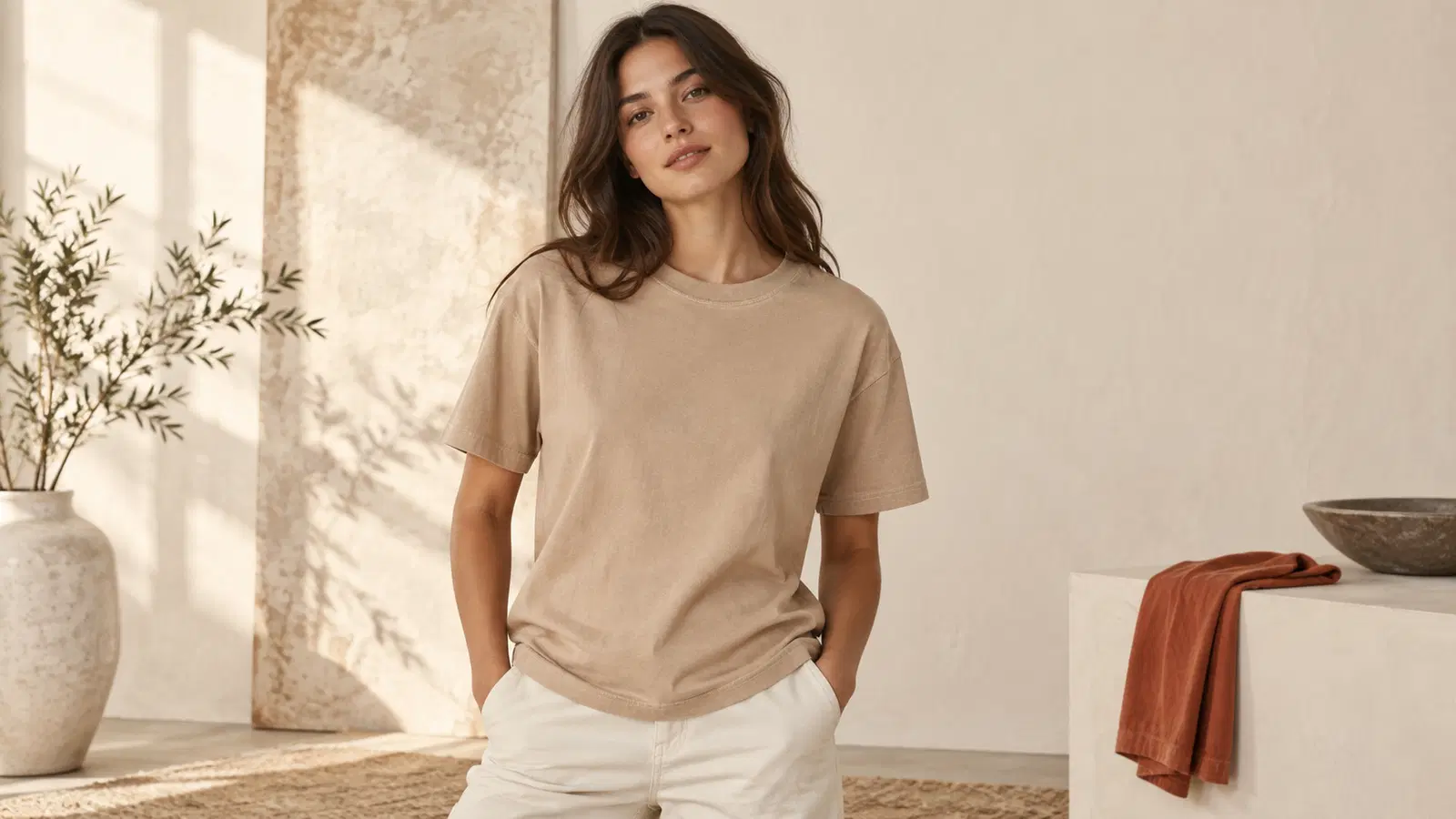
An AI fashion model is a synthetic person, generated rather than photographed, wearing your garment in a product image. For an independent clothing brand it replaces most of a photoshoot at a fraction of the cost, and it is allowed on every major selling channel. What it cannot do is carry your Etsy thumbnail, prove how a garment fits a real body, or go live without disclosure in a growing number of places.(1)(2)(3)
That last part is where brands are getting caught.
In August 2025, Guess ran a two-page spread in Vogue featuring two AI-generated women. The ad carried a disclosure, in print small enough that most readers walked straight past it: "Produced by Seraphinne Vallora on AI." A TikTok video pointing at that line collected more than two million views, and the backlash landed on Guess and Vogue at once.(4) The disclosure was technically there. It just wasn't doing any work.
You already know AI models save money. Every vendor selling one will tell you that, and they're right. What none of them will tell you is which shots still need a camera, how the images fail when they fail, and what you're now obligated to say out loud.
This guide covers all three.
Key Takeaways
- Etsy will not let an AI model image be your first photo, unless a production partner prints your design. Etsy requires the first image to be the actual item, though a seller whose design is printed by a production partner onto a blank may use a mockup to show the end product.(2)
- TikTok Shop requires a label when AI materially creates the visual, including synthetic models, and prohibits using AI to fabricate a product display in a way that misleads. Light edits such as color correction don't trigger it.(3)
- EU AI Act transparency duties started August 2, 2026, but the machine-readable marking obligation sits with your AI provider, not with you. Your obligation as a deployer is narrower than most articles claim.(1)
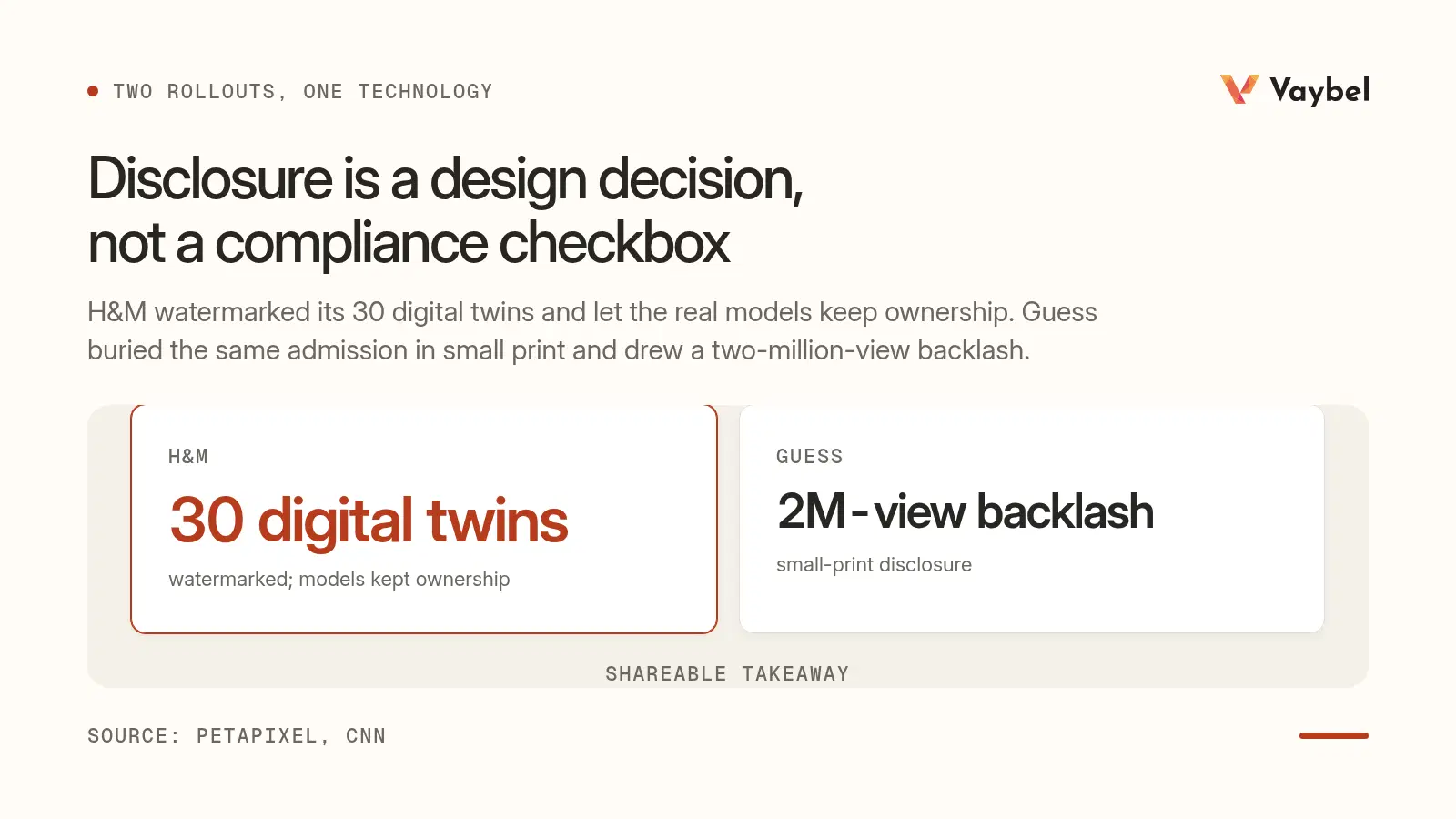
- The two biggest AI-model rollouts in fashion split on disclosure, not technology. H&M watermarked its 30 digital twins and let the real models keep ownership of them; Guess buried the same admission in small print and drew a two-million-view backlash.(4)(5)
- The conversion percentages circulating for on-model imagery have no traceable source. Ignore them, and choose the format based on what your buyer is actually unsure about.
In this guide:
- What an AI fashion model actually is
- Where AI fashion models earn their keep
- The four failure modes
- What you have to disclose in 2026
- When not to use an AI fashion model
- Frequently asked questions
What an AI Fashion Model Actually Is
An AI fashion model, also sold as a virtual model, is a generated human figure wearing your product, produced from your design and a garment specification rather than from a photoshoot. The model does not exist. The garment does.
Two things get called the same name and shouldn't be:
- AI fashion model is seller-facing. You generate a person to display your product in a listing.
- Virtual try-on, in the consumer sense, is buyer-facing. A shopper uploads their own photo to see the garment on themselves.
Both get labeled "virtual try-on," which is why searching for one buries you in tools for the other. This guide is about the first.
Here is where an AI clothing model sits against the alternatives.
| Format | What it proves | Cost per product | Etsy first image? |
|---|---|---|---|
| Flat lay | The print, the color, what's in the box | Lowest | Yes, and usually the right call(2) |
| Ghost mannequin | Construction, drape, how it holds shape | Low | Yes |
| AI fashion model | Fit, scale, styling, brand feel | Low | Only via the production-partner route(2) |
| Real photoshoot | All of the above, on a real body | Highest | Yes |
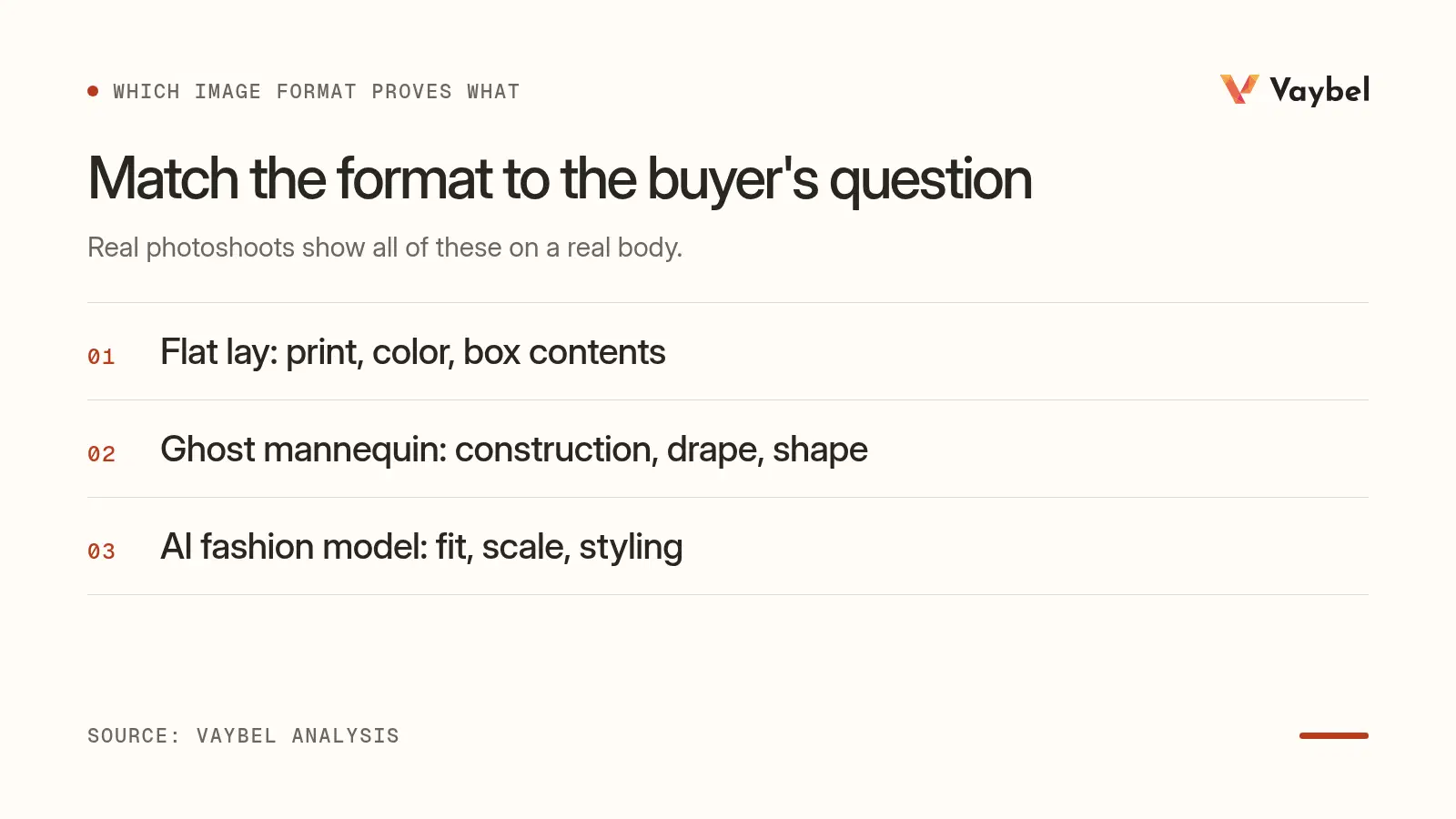
The honest summary: an AI fashion model is very good at the shots that answer "what would this look like on a person" and bad at the shots that answer "what exactly am I receiving." Our guide to lifestyle mockups versus flat lays covers how to split those jobs across a listing, including where ghost mannequin fits.
Want to see what a generated model set looks like on your own design? Explore the AI Mockup Generator →
Where AI Fashion Models Earn Their Keep
Two jobs, specifically. Not "everything."
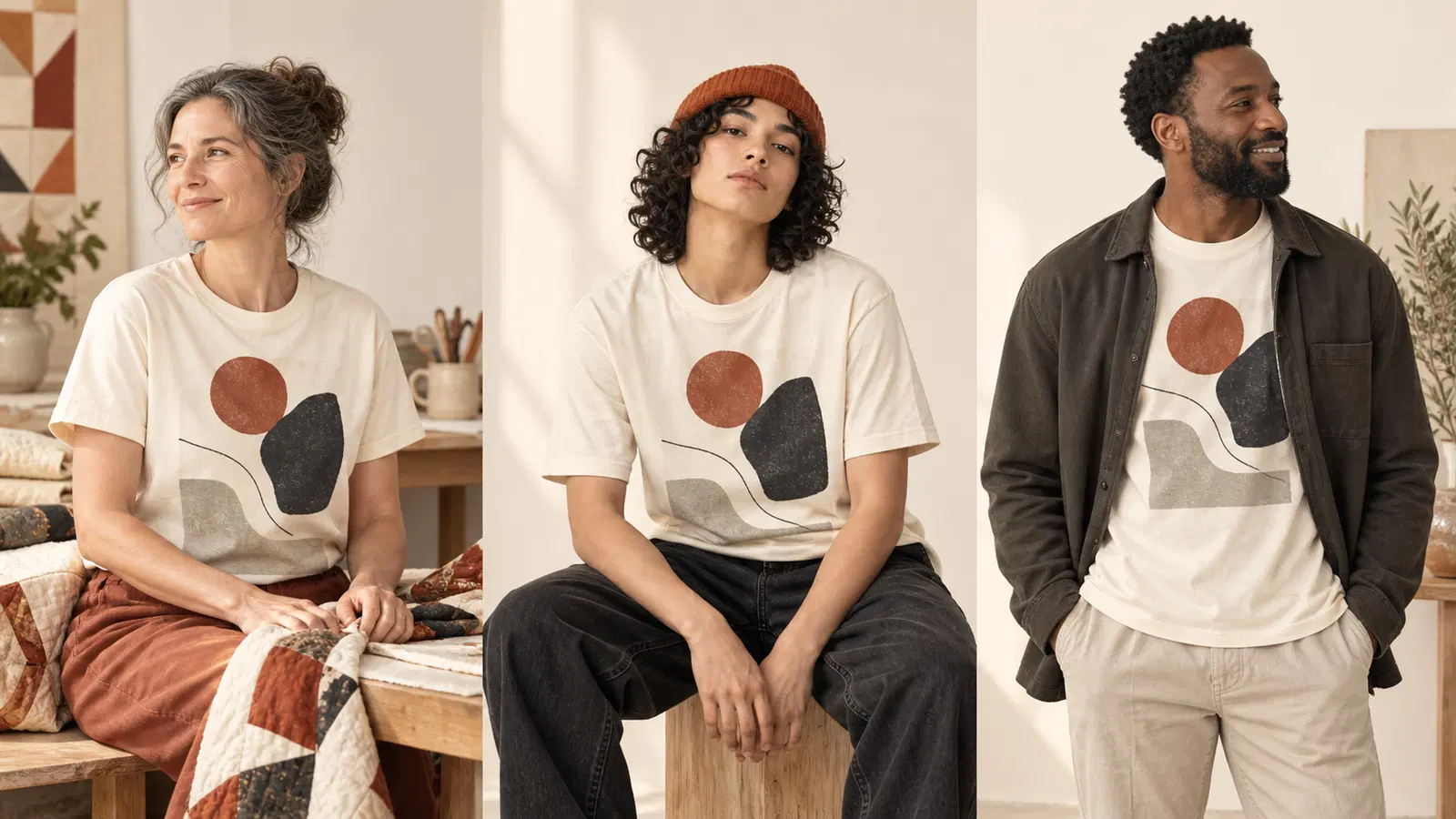
Matching the model to your buyer
A stock mockup gives you whoever the template vendor hired. That's fine until you're selling to a specific person, which is the entire premise of a niche clothing brand. Virtual model mockups change that calculation, because the person is a parameter rather than a casting decision.
If your buyer is a 45-year-old quilter, a 22-year-old streetwear model is working against you. Generated models can be matched on gender, age range, and aesthetic, so the person wearing the garment reads as the person buying it. That's the actual argument for synthetic models, and it's a better one than cost.
Covering colorways and sizes without a reshoot
This is where the economics stop being theoretical. A brand carrying one design across six colorways needs six on-model shots. With a camera that's one shoot and six garment changes, and every new colorway later means going back.
Generated imagery decouples that. The blank, the colorway, and the pose become parameters rather than a scheduling problem, which is why brands using AI models tend to list more variants rather than the same number more cheaply.
One note on the numbers you'll see quoted. Confident percentages get thrown around for how much on-model imagery lifts conversion. Trace any of them back and you land on a vendor blog citing another vendor blog.
So we won't repeat them. Choose the format based on what your buyer is unsure about, not on a statistic nobody measured.
If you want to see the flat-lay-to-model pipeline run end to end before you build your own, this walkthrough covers the repeatable version:
The Four Failure Modes
Generated model images fail in predictable ways. Knowing the four means you catch them in review instead of in a customer complaint.
1. Identity drift across the gallery
The most common and most damaging. You generate eight images for one listing and the "model" is subtly a different person in each: face shifts, body proportions change, hair length moves. Shoppers may not consciously register why, but the gallery stops reading as a real brand.
This is a gallery-level problem, not an image-level one, so reviewing images one at a time will not catch it. Lay the full set side by side. Vaybel's AI Mockup Generator carries a consistent model across a product's gallery for this reason, but whatever tool you use, the review step is the same.
2. Hands, seams, and print warp
Hands remain the reliable tell. So do seams that terminate in the wrong place, and prints that warp across a chest in a way fabric physically doesn't.
Print warp is the one that matters commercially, because it changes what the buyer thinks they're getting. Zoom to the print at full size and confirm the artwork's proportions survived.
3. Fabric drape that misrepresents the garment
A generated image will happily render a boxy 6.0 oz cotton tee with the drape of a tri-blend. It looks better. It's also the version of this problem that carries actual risk, because TikTok Shop explicitly prohibits using AI to fabricate a product display in a way that misleads buyers about the product.(3)
Check the generated garment against the real blank's weight and cut. If you sell a Gildan 5000 and the image drapes like a Bella+Canvas 3001, that's not a style choice.
4. Skipping the physical sample
No generated image tells you whether the print cracks after three washes or whether the neckline runs tight. AI models are a photography replacement, not a sampling replacement, and treating them as both is how brands end up with a returns problem.
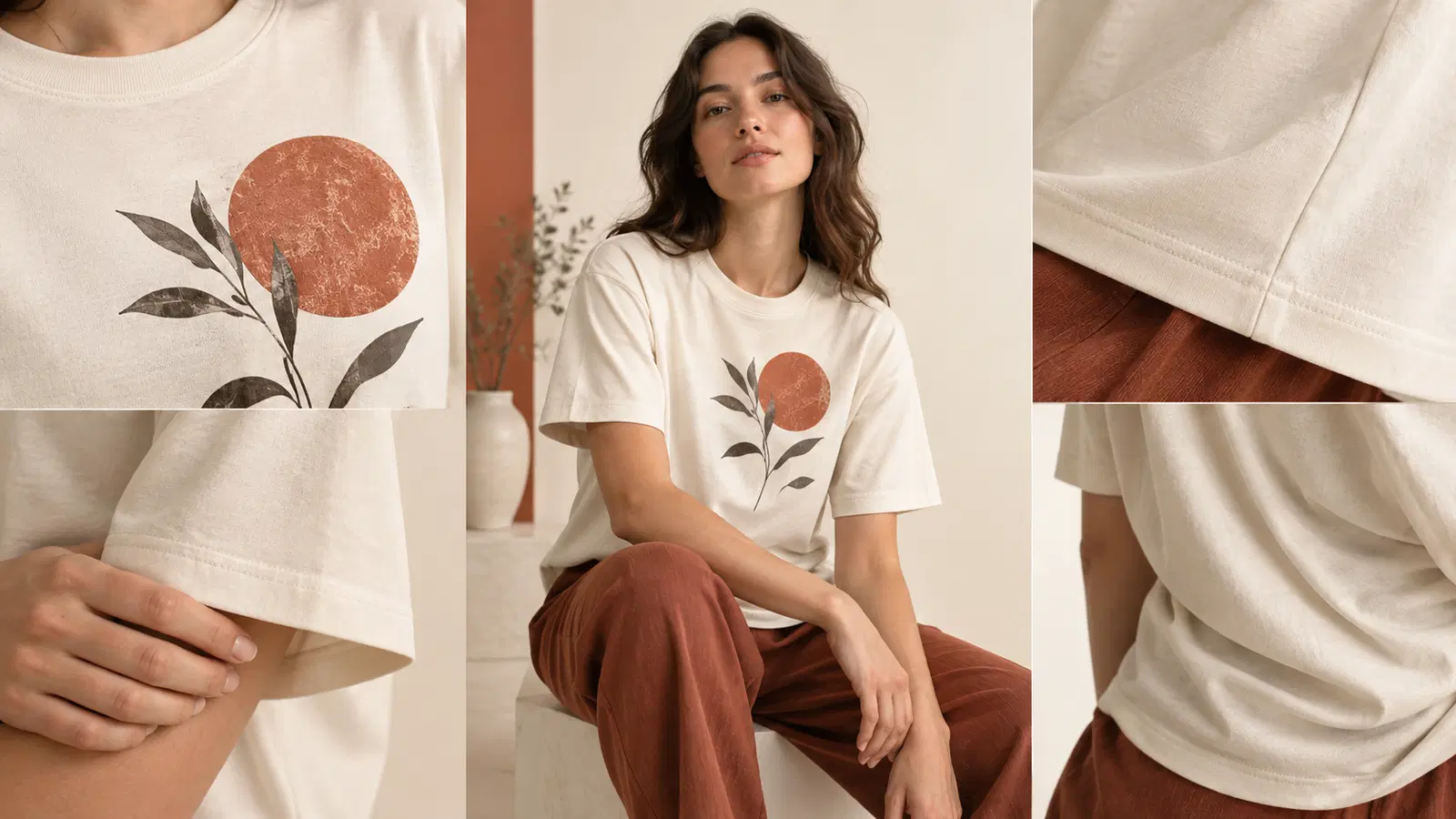
The review pass before anything goes live
Four checks, in order:
- Gallery consistency. All images open at once. Same person throughout?
- Print fidelity. Zoom to the artwork. Correct proportions, no warp, text legible?
- Garment truth. Does the drape match the blank you actually sell?
- Hands and edges. Fingers, cuffs, hems, seams.
Ready to run that check on your own products? Start a free 7-day trial and generate a full model set from one design. No credit card required.
What You Have to Disclose in 2026
Here's where most coverage of AI fashion models goes wrong. There isn't one disclosure rule. There are three separate questions, and they get conflated constantly.
| The question | What triggers it | Who it binds |
|---|---|---|
| Is your design AI-generated? | Prompting the artwork you print | Etsy: disclose in the listing description(2) |
| Is your image AI-generated? | A synthetic model or scene | Etsy: real item in the first image, production-partner exception aside. TikTok Shop: label it(2)(3) |
| Do you sell into the EU? | Any generative output | Your provider marks it machine-readably. Your own duty is narrower(1) |
Question 1: is your design AI-generated?
This is about the product, not the photo. Etsy's Creativity Standards treat seller-prompted AI creations as sellable, and require sellers to disclose in the listing description when an item was created using AI.(2)
If you prompted the graphic on your tee, that's the rule that applies to you. It has nothing to do with whether a model in your photo is real.
Question 2: is your product image AI-generated?
A different question with a different answer, and the one that actually constrains AI fashion models.
Etsy requires listing images to show the real item rather than a rendering or stock photo, and wants the first image to be the actual product a buyer receives. There's a specific carve-out that matters enormously for print-on-demand: if you create an original design that a production partner prints onto a base item like a t-shirt, you may use a mockup to illustrate the end product.(2)
Read that carefully, because it defines your workflow. A print-on-demand clothing brand fulfilling through a production partner is inside the exception. A brand sewing garments itself is not, and must lead with a real photo. Either way, computer-generated mockups are explicitly allowed in the additional image slots.
TikTok Shop runs on different logic. Disclosure is required when AI materially contributes to the visual, including synthetic avatars and models, and the platform can apply an AI-generated label automatically. Minor edits such as color grading, cropping, or noise reduction don't require it. Failing to disclose when AI played a significant role is a violation that can get products pulled.(3)
Question 3: do you sell into the EU?
The EU AI Act's transparency obligations began applying on August 2, 2026.(1) Almost every article on this subject gets the next part backwards, so here is the distinction that matters.
Article 50 splits the duty in two.
Providers of generative AI systems must mark outputs in a machine-readable format, so they're detectable as artificially generated. That's your tool vendor's job, not yours.
Deployers carry a narrower duty, written around deepfakes. Where it applies, the disclosure has to be clear and easy to spot, and it has to land no later than the first time someone sees the image.(1)
Whether a generated model who portrays no real person falls inside the deepfake definition is genuinely unsettled, and anyone telling you it's clearly settled either way is overstating it. The practical read: the marking duty is your vendor's problem, the visible disclosure question is open, and disclosing is cheap. This isn't legal advice, and if you sell at volume into the EU it's worth twenty minutes with someone who does that for a living.
The part that isn't about law at all
Two rollouts in 2025 show the real stake, and they split on presentation rather than technology.
H&M built digital twins of 30 real models with the Swedish firm Uncut and published the first campaign images in July 2025. The images were watermarked and labeled, the models retained ownership of their twins, and their likenesses weren't used without consent.(5) Guess ran generated models in Vogue's August 2025 issue with a disclosure line set in small print, and drew a backlash that reached more than two million views on a single TikTok.(4)
Same underlying technology. One brand treated disclosure as a design decision and absorbed the story; the other treated it as a compliance checkbox and became the story.
Put the disclosure where a buyer will actually see it. A short line in the image caption or the top of the description does the job: "Product images use AI-generated models. Garment photography is of the actual product." Buyers who were going to care will find a buried line anyway, and they'll be angrier about the burying than the AI.
When Not to Use an AI Fashion Model
Four situations where the answer is a camera, or no model at all.
| Situation | Why a generated model fails | Use instead |
|---|---|---|
| Fit is the product | Technical fits and compression wear need a real body. A misleading image here turns into a return | Real photo on a fit model |
| You're making a fit claim | "True to size" is a claim about physical reality | Real photo plus the provider's size chart |
| The image implies a real customer | A synthetic person shown as a happy buyer is a fabricated endorsement, a sharper problem than an unlabeled model | Genuine customer photos, with permission |
| Authenticity is the brand | Handmade and slow-fashion positioning depends on believing what you see | Real photography throughout |
That last one deserves a sentence more. If your whole pitch is that a person made this, a synthetic person modeling it undercuts you. For Etsy sellers in handmade categories, that's the whole ballgame.
For everything else, which is most print-led apparel, generated models do the job. Our AI mockup generator guide for print-on-demand covers how the full image set comes together.
Frequently Asked Questions
Do I have to tell customers the model is AI-generated? On TikTok Shop, yes, when AI materially created the visual.(3) Selling into the EU, your AI provider carries the machine-readable marking duty, and your own visible-disclosure obligation is narrower and currently unsettled.(1) Etsy's AI disclosure rule is about the item being AI-created rather than the photo.(2) Disclosing plainly is the low-cost option in every case.
Can I use an AI fashion model as my main Etsy photo? Only if a production partner prints your design onto a blank. Etsy wants the first image to be the real item, with a specific exception for designs a production partner prints onto a base product. Computer-generated mockups are allowed in the additional slots either way.(2)
Will Etsy or TikTok Shop remove my listing for using AI images? Not for using them correctly. Both platforms allow generated product imagery. Takedowns come from undisclosed AI where disclosure was required, or from images that misrepresent the product.(2)(3)
Do AI fashion models look real enough to sell? For print-led apparel, generally yes. The failures are specific and checkable: identity drift across a gallery, hands, and print warp. Run the four-step review pass above before publishing.
Can I use the same AI model across my whole store? Yes, and a consistent model is usually better for brand recognition. The difficulty is holding that person stable across many generations, which is what identity drift describes. Tools differ a lot here, so test it before committing a catalog to one face.
What's the difference between an AI fashion model and virtual try-on? An AI fashion model is a generated person wearing your product in your listing images. Consumer virtual try-on lets a shopper see a garment on their own uploaded photo. Different tools, different buyers, frequently the same label.
The Bottom Line
An AI fashion model is a photography replacement, not a sampling replacement and not a fit-proof replacement. Used for what it's good at, which is showing a real garment on a plausible person at a cost that lets you list every colorway, it's the most useful thing to happen to independent clothing brand imagery in years.
The three rules worth carrying: lead Etsy listings with the real item unless a production partner prints your design, label generated visuals where the platform asks, and never let a generated drape misrepresent the blank you actually ship.
And disclose where people can see it. The Guess spread had a disclosure. It sat in small print, and the small print is what the story became.
Pick one product. Generate the set, run the four checks, write one honest line about it in the description, and get it live.
Start your free 7-day trial → Generate flats, detail shots, and on-model sets from a single design.