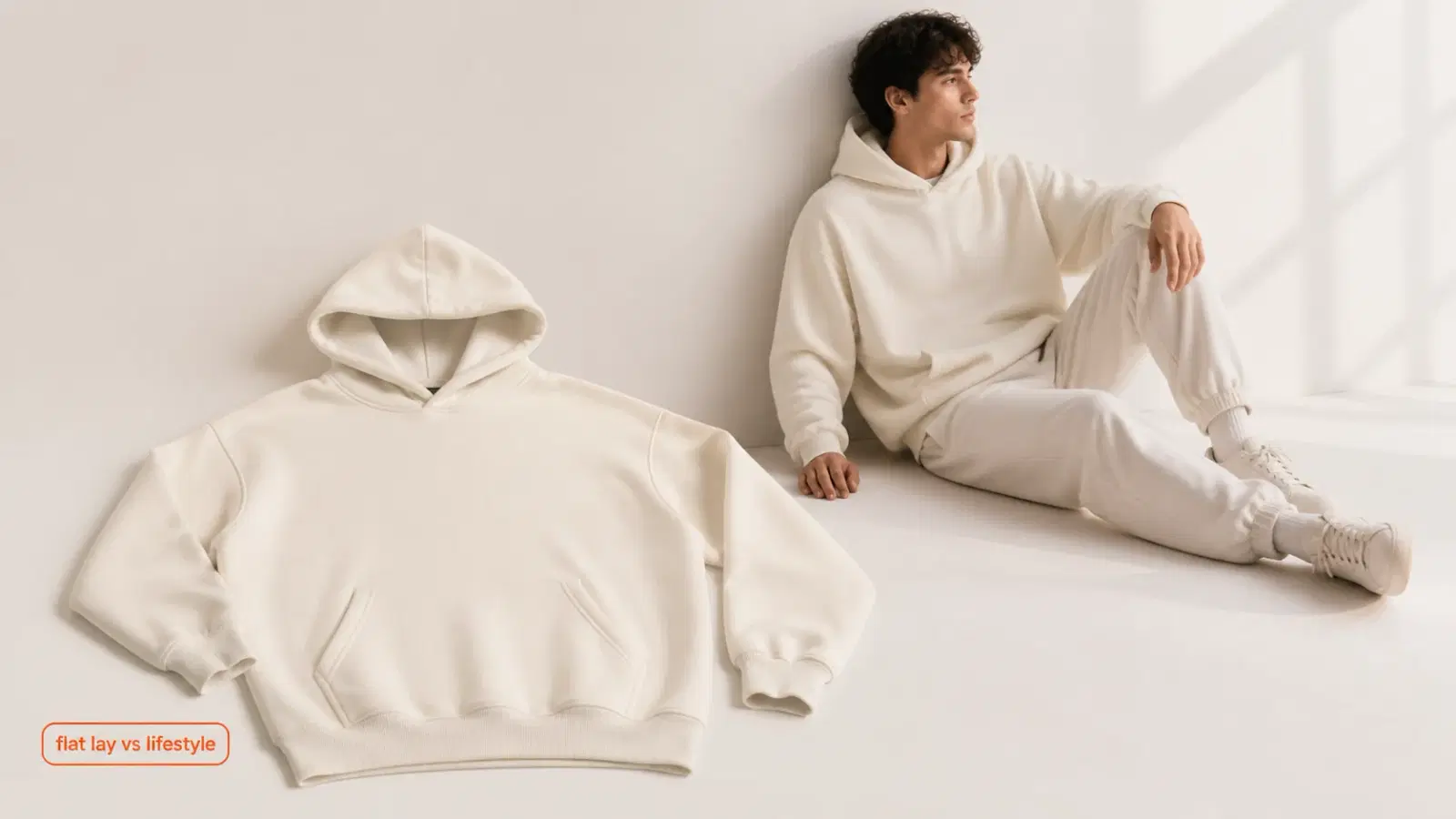
The short version of lifestyle mockups vs flat lays: use a flat lay when the print is the product, and a lifestyle or on-model mockup when the fit is the product. A graphic tee sells on the artwork, so a clean flat lay shows the buyer what they're paying for. An oversized hoodie sells on how it hangs, and no flat image can answer that.
Now the part every other version of this comparison gets wrong: the conversion statistics they all quote don't come from anywhere.
You've probably seen the numbers. One widely repeated comparison states that on-model images convert 20 to 30% higher than flat-lay images across most clothing categories. Follow its citation and it points to another AI mockup vendor, which publishes no methodology and no dataset. Two companies selling the same kind of tool, citing each other, with no study underneath.
So this guide skips the fake math. Below you'll find what actual UX research says, a decision rule based on what your buyer is uncertain about, the third format nobody mentions, and the disclosure rules that can get an AI model shot taken down.
Key Takeaways
- The widely quoted conversion percentages for on-model versus flat lay imagery have no traceable source. Treat them as marketing, not data.
- Baymard Institute's research is qualitative but real: without a human model, shoppers estimate fit from less helpful images, which produces lower confidence and lower likelihood to purchase.
- Match the format to the buyer's doubt. Print-led designs (DTG graphic tees) do fine on flat lays. Fit-led garments (oversized, activewear, outerwear) need a body in the frame.
- Ghost mannequin is the missing third option, and it's the efficient pick for structured garments where drape matters but a model doesn't.
- If you publish AI-generated model or scene imagery, both Etsy and TikTok Shop expect disclosure. Check the current policy before you upload.
Lifestyle Mockups vs Flat Lays: The Short Answer
A flat lay is your garment photographed from directly above, laid flat, usually on a plain surface. A lifestyle mockup puts that same garment on a person in a real setting. On-model sits between the two: a body wearing the product, without the styled scene.
The question isn't which one wins. It's which one answers the thing your buyer is stuck on.
| Buyer's unspoken question | Format that answers it |
|---|---|
| "Is this artwork any good?" | Flat lay |
| "What exactly am I getting?" | Flat lay |
| "How does this hang on a real body?" | On-model |
| "Will this look right on someone like me?" | On-model or lifestyle |
| "Is this brand worth following?" | Lifestyle |
| "How is this cut and structured?" | Ghost mannequin |
Read that as a diagnostic, not a ranking. Most brands need three or four of those rows covered across a listing.
What the Conversion Data Actually Says (and Doesn't)
Here's the honest state of the evidence, because the alternative is repeating numbers nobody can stand behind.
The circulating percentages are unsourced. Search this topic and you'll find conversion lifts quoted to the percentage point, plus an oddly precise claim about lifestyle images in the first three photo slots of an Etsy listing. None of them cite a study. Several sit on the blogs of companies selling the exact tool the number recommends, and the ones that do cite something tend to cite each other. That's not evidence, that's a sales page with a footnote missing.
What is real is qualitative. Baymard Institute runs large-scale usability testing on ecommerce sites. Its guideline on showing apparel on a human model is about as close to a primary source as this question has. The finding: without a model for scale, shoppers "must estimate the suitability of a product based on other less helpful images and product information, resulting in lower confidence and lower likelihood to move forward with purchasing."
Notice what that does and doesn't say. It says human-model images build purchase confidence for apparel. It does not attach a conversion percentage to that finding, because Baymard never published one and neither did anyone else.
Directional beats fabricated. You can act on "a body in the frame builds confidence for fit-dependent garments" without pretending to know a percentage. That's enough to make every decision in this article.
Want to see how the formats compare on your own design? Explore the AI Mockup Generator →. For the full picture of what the mockup cluster covers, start with our AI Mockup Generator for print-on-demand guide, the pillar behind the whole mockup-and-photos cluster.
When Flat Lays Beat Lifestyle Mockups
Flat lay gets treated as the budget option. It isn't. For a large share of independent clothing brands, it's the correct primary image.
Print-led designs, where the artwork is the purchase
If you're selling a DTG graphic tee, the buyer is buying the graphic. They want to see line weight, color, placement, and how the print sits on the chest. A model in a golden-hour street scene actively obscures all four.
This is the split most guides miss. A DTG print lives inside a fixed rectangle on the front of a garment, and that rectangle is your product. All-over print is the opposite case, since the pattern wraps every panel and you need a body or a form to show the wrap.
Flat lay photography for clothing: the minimal setup
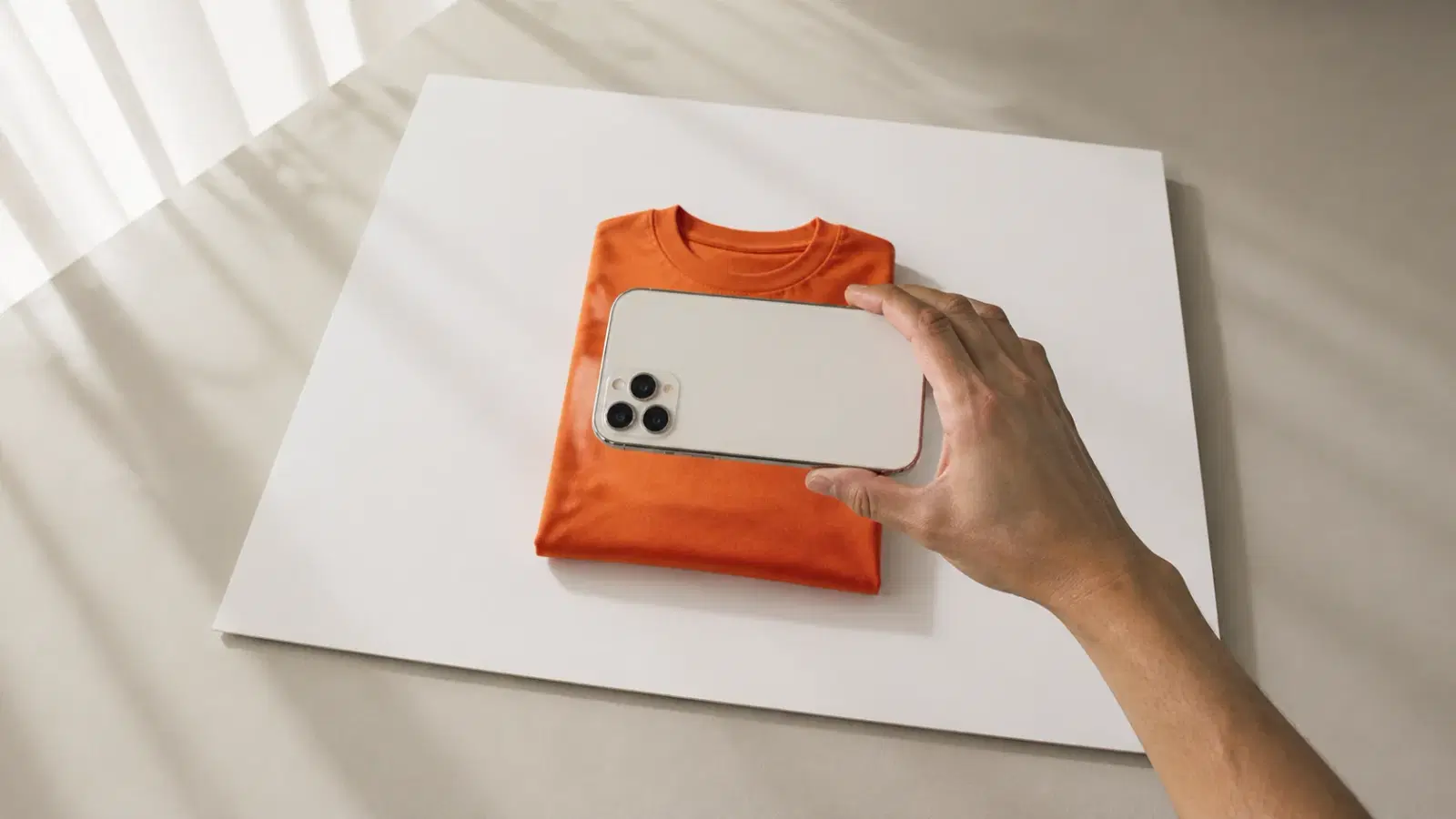
You don't need a studio. A flat lay clothing photography setup needs three things: a large sheet of poster board or a wrinkle-free backdrop, indirect window light from one side, and a phone held parallel to the surface.
The two things that separate amateur from professional here are steaming the garment and shooting straight down. Angle drift is the most common tell, and it's free to fix.
Money With Mak walks through an AI mockup workflow for Etsy listings in this step-by-step tutorial, which is useful if you'd rather watch the process than read it.
Common flat lay mistakes
- Shooting at an angle. It reads as sloppy and distorts the print.
- Wrinkles. A steamer costs less than one round of paid traffic.
- Prop clutter. Coffee cups and sunglasses pull attention off the garment.
- Inconsistent backgrounds across a catalog, which makes a brand look assembled rather than designed.
- Cropping the hem. Buyers read a cut-off garment as a hidden flaw.
When Lifestyle and On-Model Mockups Win
The moment fit becomes part of the product, a flat image stops answering the question. If you need to see the garment move, that's where product videos for clothing brands pick up where a lifestyle mockup leaves off — the b-roll that sells the drape in motion.
Fit-led garments need a body
Oversized streetwear is the clearest case. The entire value proposition is proportion: how far the shoulder seam drops, where the hem lands, how much room there is through the body. Laid flat, an oversized tee and a boxy tee are the same rectangle.
Activewear has the same problem in a different direction, since compression and drape only exist on a body. The same goes for outerwear, knitwear, and anything with an intentional silhouette. If you sell these, the blanks you choose are a fit decision, and your imagery has to show the fit you paid for.
Scene and model matching
A lifestyle mockup carries a second payload beyond fit: it tells the buyer who this brand is for. That's an advantage, and it's also where it goes wrong. A skate-inspired graphic on a model in a corporate lobby reads as stock imagery, and buyers now spot that instantly.
Match the model and the setting to the person you're actually selling to. Vague inputs produce the uncanny generic look; specific ones produce something that reads as a real brand.
The scale case for this is no longer theoretical. Around 70% of Zalando's editorial campaign assets in Q4 2024 were AI-generated, according to Retail Systems. Production time fell from six to eight weeks down to three to four days, at roughly 90% lower cost. Matthias Haase, the company's VP of Content Solutions, framed it as speed: "AI gives us the ability to move at the pace of culture, from spotting a trend to producing tailored content in under 24 hours."
That's a European retail giant describing the same constraint an independent brand faces on a smaller budget. Trends move faster than photoshoots.
The Third Option Nobody Mentions: Ghost Mannequin
Ghost mannequin (sometimes called invisible mannequin) shows the garment holding a three-dimensional human shape with the mannequin edited out. It sits precisely between flat lay and on-model, and it's oddly absent from the lifestyle mockups vs flat lays debate despite steady search demand.
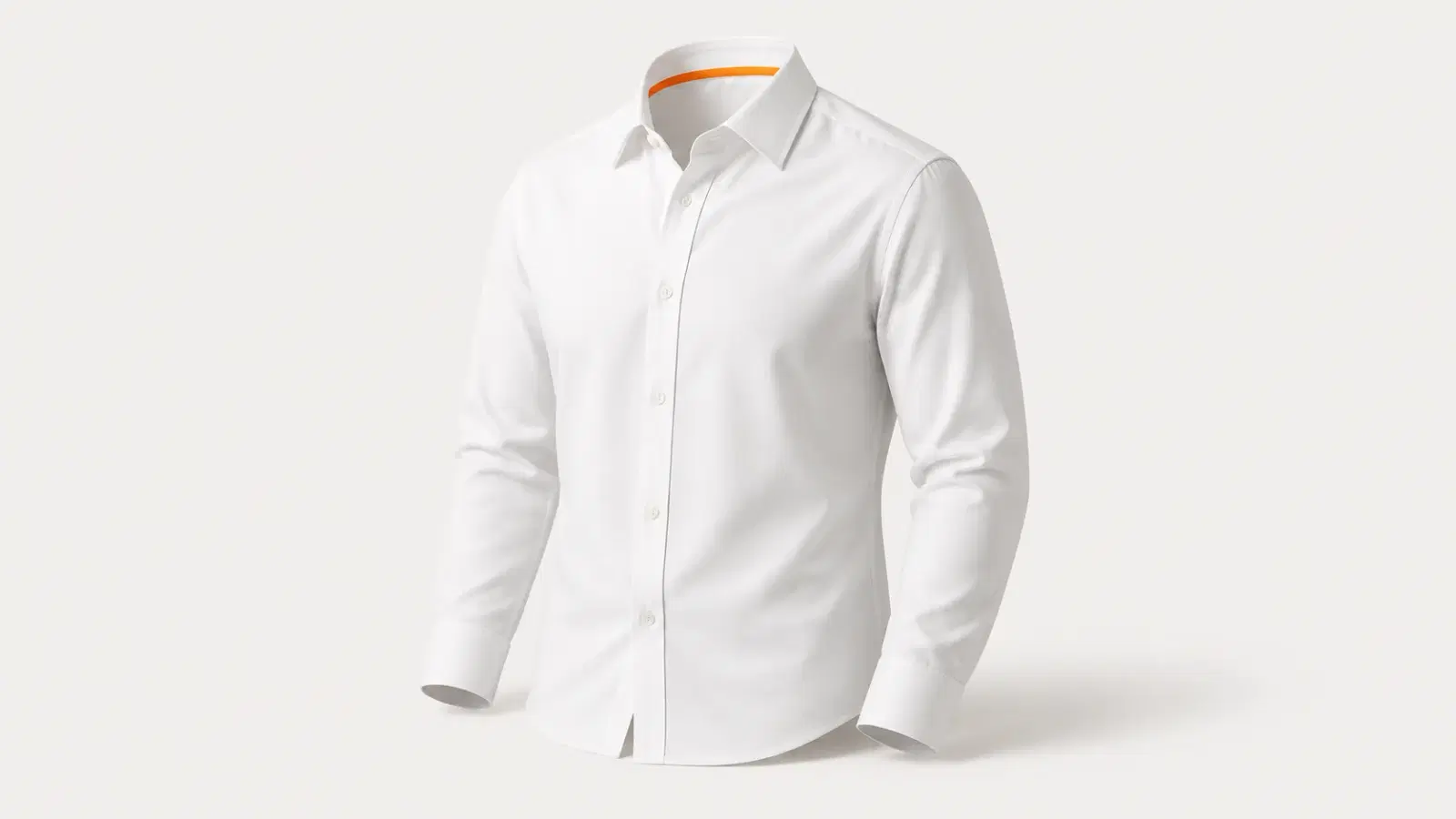
It's the right pick when structure matters but a model doesn't. Think button-downs, jackets, structured knitwear, and anything where the collar, shoulder, and drape are selling points. It also keeps a catalog visually consistent in a way lifestyle imagery struggles to, since there's no model, styling, or location to match across 40 products.
The tradeoff is honest: ghost mannequin shows the garment's shape, not a person's. It builds confidence about construction, not about whether the buyer will look good in it.
If You Can Only Make One Image, Make This One
Every other guide on this topic ends at "use both." That's true and useless when you have one design, limited credits, and a listing to fill today.
Here's the rule, by channel:
| Channel | Make this one first | Why |
|---|---|---|
| Etsy | Flat lay or clean product shot | Etsy buyers arrive by search and compare thumbnails. Clarity beats mood at thumbnail size. |
| TikTok Shop | Clean product image for the main slot | The main image has to pass review, so the on-model hero belongs in a secondary slot. |
| Shopify | On-model | It's your own site. Nobody is comparing thumbnails, and the product page has to do the persuading alone. |
| Instagram / Pinterest | Lifestyle | These are discovery surfaces where the scene is the reason someone stops. |
Here's the tradeoff in practice. Say you're launching one graphic tee and one oversized hoodie in the same drop, and you have credits for two renders. Put the flat lay on the tee, where the print is the product, and the on-model shot on the hoodie, where the drape is. Splitting one render per product beats making two renders of your favorite design.
Ready to stop choosing? Vaybel generates flats and on-model mockups from one design, so the constraint above mostly disappears. Start a 7-day free trial →
Before You Publish an AI Model Shot: Disclosure Rules
This is the part missing from every competing article on this topic, and it's the part that can cost you a listing.
Both major marketplaces now expect sellers to be transparent when AI generates the substance of an image, and the direction is consistent even as the details shift.
Etsy requires sellers to disclose AI use in the listing, and expects listing images to represent the actual item being sold. The canonical rules live in Etsy's Creativity Standards. A single honest line in the description is generally enough.
TikTok Shop treats AI-generated models and fabricated scenes as content requiring disclosure, while light AI editing like background removal and color correction is handled as ordinary post-production. Undisclosed synthetic imagery risks reduced distribution or removal.
Two practical notes. First, the line is substance, not assistance: cleaning up a real photo is different from generating a model who doesn't exist. Second, these policies are moving quickly, so check the current text before a launch rather than trusting any blog post, including this one.
There's also a likeness question worth understanding. When H&M built AI "digital twins" of 30 of its models in 2025, the arrangement included consent, model ownership of the twin, and per-use compensation, as CNN reported. That's the standard the industry is converging on. Generating a synthetic person is fine; generating a specific real person's likeness without permission is not.
You Don't Actually Have to Choose
The premise of this entire comparison is a budget constraint. One design, one shot, pick wisely.
That constraint is a photoshoot constraint, and it's the thing AI mockups remove. The AI Mockup Generator renders a clean flat, an on-model shot, and a lifestyle scene from the same design file, which turns "which format?" back into "which slot?"
That's the better question anyway. A complete listing does several jobs at once: the thumbnail earns the click, the flat proves what's in the box, and the on-model shot closes the fit doubt. Our guide to making clothing mockups without Photoshop covers the full slot-by-slot image set. And if you sell on marketplaces, remember that Etsy sellers face different thumbnail dynamics than TikTok Shop.
Frequently Asked Questions
Do lifestyle mockups convert better than flat lays?
In the lifestyle mockups vs flat lays comparison, lifestyle probably wins for fit-dependent garments, but nobody has published credible numbers. The percentages circulating online have no traceable source. What research does support is that human-model images help apparel shoppers judge fit and build purchase confidence, per Baymard Institute. For print-led products like graphic tees, a clean flat lay is often the better main image.
What is the difference between a flat lay and a lifestyle mockup?
A flat lay shows the garment laid flat and shot from directly above, with no model and usually no scene. A lifestyle mockup shows the garment worn by a person in a real setting. Flat lays communicate product detail; lifestyle mockups communicate fit, scale, and brand identity.
Which mockup should I use as my main listing image?
On Etsy, lead with a clean flat lay or product shot, because buyers compare thumbnails at small sizes. On TikTok Shop, the main slot needs a clean product image to pass review, so put the on-model hero in a secondary slot. On your own Shopify store, lead with on-model.
Is flat lay photography still worth doing?
Yes, especially for graphic tees, accessories, and any product where the artwork is what's being bought. Flat lay also keeps a catalog visually consistent across dozens of products, which is harder with lifestyle imagery.
Do I have to disclose AI-generated mockups?
If AI generated the substance of the image, such as a model or a scene, both Etsy and TikTok Shop expect disclosure. Light editing like background removal generally doesn't trigger it. Policies change often, so check the current rules before you publish.
The Bottom Line
The lifestyle mockups vs flat lays debate has a real answer, and it isn't a percentage.
Flat lay when the print is the product. On-model when the fit is the product. Ghost mannequin when the construction is the product. Lifestyle when the brand is the product. Match the image to the doubt in your buyer's head, and you'll make better calls than anyone optimizing toward a statistic that was never measured.
Then stop treating it as a choice. A finished listing needs the clean shot that proves what's in the box and the worn shot that closes the fit question. The only reason to pick one was ever cost, and that reason is mostly gone.
Pick your next product, decide what your buyer is actually unsure about, and build the image that answers it.
Start your free 7-day trial → and generate flats, on-model shots, and lifestyle scenes from one design.