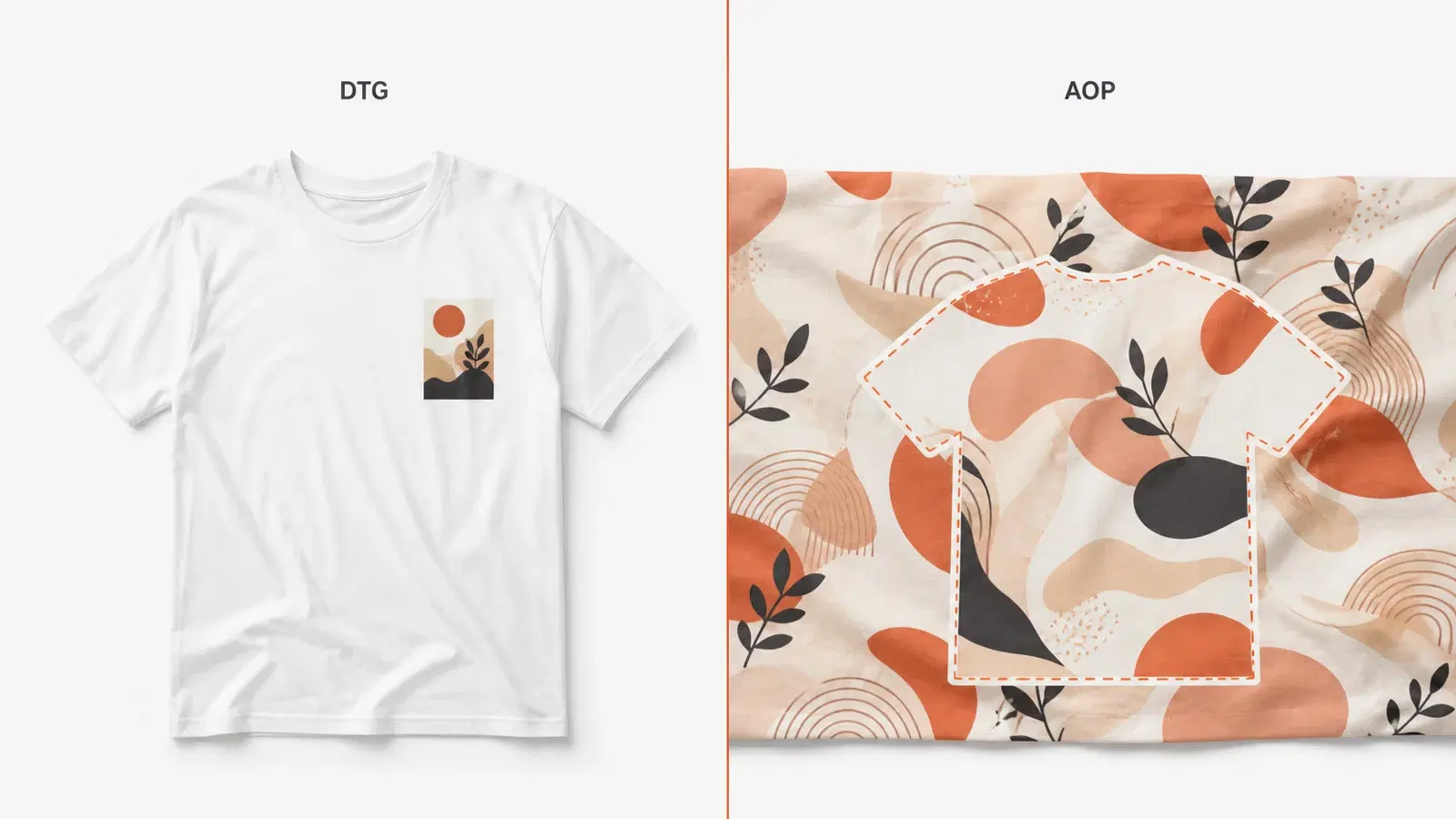
The short version of DTG vs all-over print: DTG sprays ink onto a finished garment inside a fixed rectangle. It's cheaper, works on cotton, and suits designs with one clear focal point. All-over print (AOP) prints the fabric first, then the garment gets cut and sewn from it. The artwork covers every panel, costs roughly twice as much, and needs a tiling pattern instead of a graphic.
Now the part almost every comparison guide skips: the method with the worse profit margin is usually the better business decision.
You've probably read a dozen versions of this comparison already. Nearly all of them were written for print shops deciding which machine to buy. You're not buying a machine. You're deciding what your next drop looks like, what it costs you, and what it earns.
So this one is written the other way around. Below you'll find real base costs pulled from live product pages, the margin math that explains why AOP keeps getting skipped, and the design-file difference that kills most first attempts. It ends with a per-product rule you can apply to your whole catalog in about ten minutes.
Key Takeaways
- DTG costs about half what AOP costs. Printful lists its Bella+Canvas 3001 staple tee at $11.92 and its all-over print crew neck at $22.84.
- AOP earns a worse margin percentage and more dollars per order. That trade is the whole decision, and optimizing for percentage is what makes brands skip AOP.
- The two methods need different artwork. DTG wants a contained composition on a transparent background; AOP wants a pattern that repeats and wraps, as covered in our guide to AI prompts for clothing design.
- AOP has failure modes the product pages bury. Printful states outright that "exact alignment across seams, armpits, and the collar can shift slightly".
- You don't pick one for your brand. You assign one per product, and most catalogs end up running both.
DTG vs All-Over Print: The Short Answer
DTG (direct-to-garment) printing works like an inkjet printer aimed at a finished shirt. All-over print works like printing wallpaper, then sewing a shirt out of the wallpaper. Everything else follows from that one difference.
| DTG | All-Over Print (AOP) | |
|---|---|---|
| What gets printed | The finished garment | Flat fabric panels, sewn afterward |
| Print area | One rectangle, 12″ × 16″ up to 15″ × 18″ (full print specs) | Every panel, edge to edge |
| Fabric | Cotton and cotton blends | Polyester for sublimation; cotton versions use direct-to-fabric ink |
| Base cost, tee | $11.92 on the Printful staple tee | $22.84 on the Printful AOP crew neck, $20.81 on the Printify cut-and-sew tee |
| Artwork needed | Contained graphic, transparent background | Repeating pattern with bleed |
| Production speed | Faster | Slower, since garments are cut and sewn per order |
| Best for | Graphic tees, text, logos, character art | Statement hoodies, patterns, activewear, textiles |
Read that table as a menu, not a verdict. A catalog built entirely from one row is leaving money on the table.
Want to see both file types generated from the same idea? Vaybel's AI Design Generator builds print-ready output for DTG and AOP from one prompt.
What DTG Printing Actually Does
A DTG printer holds the garment flat and sprays water-based ink directly into the fibers. On light cotton, the ink soaks in and the print feels close to the fabric. On dark cotton, the printer first lays down a white underbase so the colors read, which is why dark DTG prints have more hand-feel than light ones.
The economics are the reason DTG dominates print-on-demand. Printful lists the Bella+Canvas 3001 unisex staple tee at $11.92, made from 100% cotton. That base cost leaves room for a normal retail price without asking a first-time buyer to gamble $60 on an unknown brand.
DTG also rewards good blank selection more than good printing. Ring-spun cotton takes ink more cleanly than open-end cotton, and heavier weights hide underbase texture better. If you haven't settled on a blank yet, our breakdown of Gildan vs Bella+Canvas covers how the two behave under DTG specifically.
Where DTG stops being the answer is coverage. The print lives inside a rectangle on the chest, the back, or a sleeve. Push a design to the edge of that rectangle and you get a visible hard border, not a garment that reads as designed. Anything meant to wrap a body needs the other method.
What All-Over Print Actually Does
All-over print solves the problem DTG can't: coverage that runs past the edge of a print rectangle and keeps going across seams, sleeves, and the back. It gets there by reversing the order of manufacturing. That reversal explains every advantage and every limitation below.
Why AOP Is Cut-and-Sew, Not Just Bigger Printing
All-over print isn't DTG with a wider printhead. Print first, sew second. The pattern goes onto flat fabric before the garment exists, and a person then cuts panels from that fabric and stitches them together. Printify describes its AOP tees as 100% polyester microfiber-knit, cut and sewn after printing.
That order of operations buys you full coverage with no faded edges at the seams. It also makes AOP slower and pricier. You're not paying for ink here, you're paying for a garment that gets manufactured to order.
Dye sublimation is the usual technique, and it bonds dye into synthetic fibers rather than sitting on top of them. Printful is direct about the constraint: sublimation "only works on synthetic materials. Pure cotton can't handle the heat". Cotton AOP exists, but it uses a different process, direct-to-fabric printing with water-based inks.
The Tradeoffs the Product Pages Bury
Here's what the marketing copy tends to leave out, and what your customers will notice first.
Seams shift. Printful states plainly that "exact alignment across seams, armpits, and the collar can shift slightly" and that front-to-back alignment isn't guaranteed. Panels are aligned by hand, and fabric stretches during sewing. A design with hard horizontal stripes will show every millimeter of drift.
Dark fills can streak white. The same guide warns that "dark backgrounds can show visible white streaks when the fabric stretches", and that it shows up worst near seams and underarms. If your brand is built on black, test a sample before you build a whole drop on it.
Color density is real feedback, not theory. On Printful's cotton all-over print crew neck, which lists at $25.49, buyer reviews flag exactly this. One reviewer notes that "the color density is low which makes the tshirt itself gray not black." Another writes that "the blend used for these shirts is not able to fully take the sublimation dye."
None of that makes AOP a bad method. It makes AOP a method with a design brief attached. Replace hard alignment points with florals, textures, gradients, or scattered icons, and the eye has no single line to track across a seam.
The Cost Math Nobody Runs: Percentage vs Dollars
This is where the DTG vs all-over print decision usually goes wrong, and it goes wrong in a way that looks responsible.
Put both products through the same worked example. Base costs below are live third-party figures; the retail prices are illustrative examples chosen to sit at the normal market band for each product type. This margin framework is Vaybel's original analysis of those inputs, not a measured Vaybel platform metric or benchmark.
| DTG tee | AOP tee | |
|---|---|---|
| Base cost | $11.92 (Printful staple tee) | $22.84 (Printful AOP crew neck) |
| Illustrative retail | $28.00 | $52.00 |
| Gross profit per unit | $16.08 | $29.16 |
| Margin percentage | 57% | 56% |
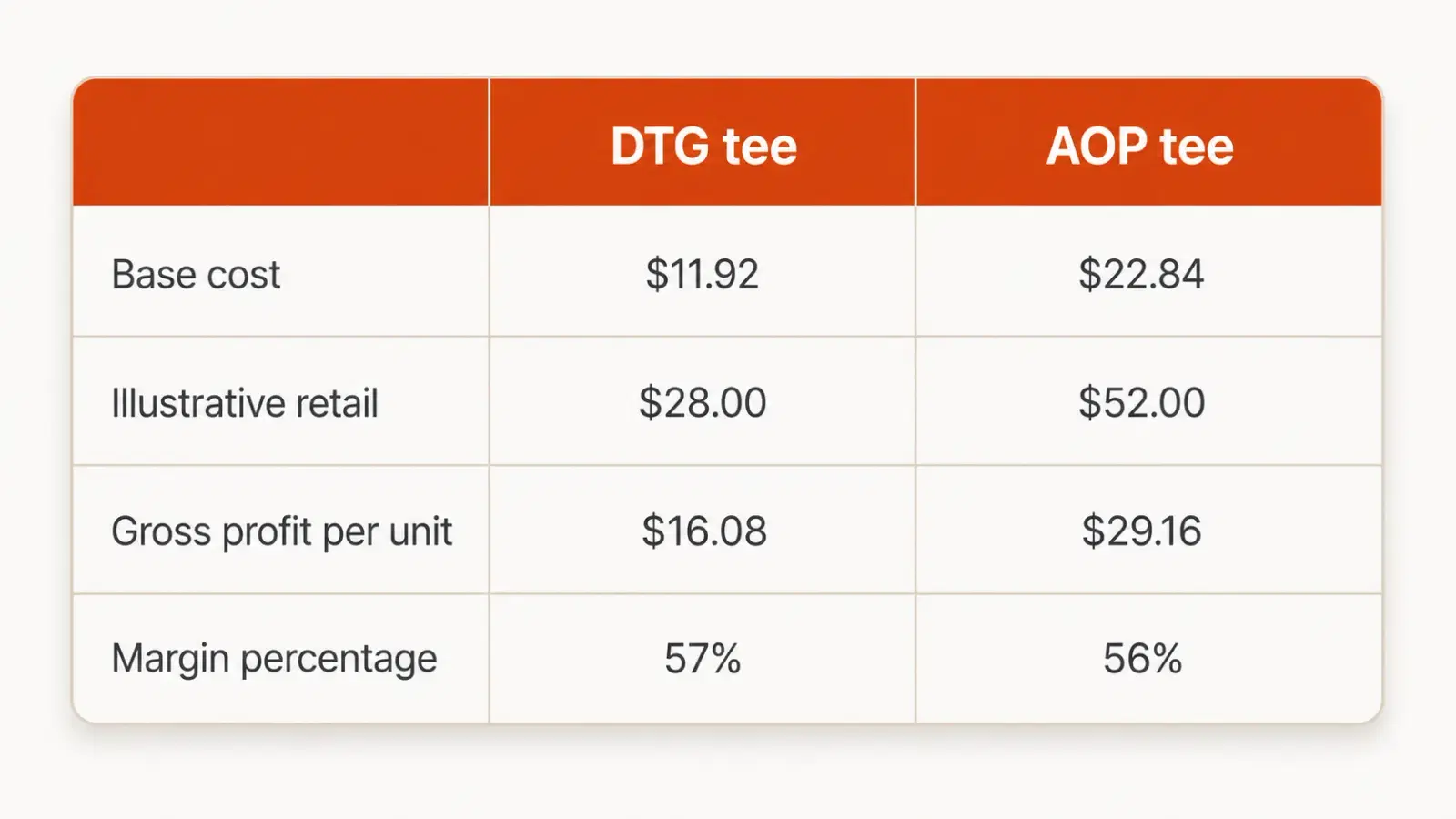
Now change one number. Price that same $22.84 AOP tee at $44 instead, which is where a lot of founders land when they get nervous about the sticker: margin drops to 48%, and gross profit per unit is still $21.16. That's $5.08 more per order than the DTG tee, at a margin percentage that looks eight points worse.
A dashboard sorted by margin percentage will tell you to kill the AOP product. Your bank account disagrees. Percentage margins across print-on-demand products cluster in a narrow band, so the number that separates a good catalog from a mediocre one is dollars per order, not the percentage next to it.
The practical version: AOP raises your average order value without raising your ad spend, because the customer who was going to buy one thing buys a more expensive one thing. Fixed costs per order, shipping, transaction fees, and acquisition, get spread across a bigger number.
Run your own numbers before you commit. Vaybel's ROI calculator lets you plug in base cost, retail price, and volume to see where each product actually lands.
Printful's team ran every customization option side by side in this April 2026 comparison, which is worth watching if you want to see the finished textures rather than read about them.
How DTG vs All-Over Print Changes Your Design File
The two methods don't just print differently. They need genuinely different artwork, and this is where most first AOP attempts fail.
A DTG file is a contained composition. Focal point in the middle, hard cutoff at the edges, transparent background so the shirt color shows through. What you see in the file is what lands on the chest.
An AOP file is a tile. It has to repeat on all four sides without a visible join and extend past the panel edge with bleed. Then it has to survive being cut apart and stitched back together at unpredictable points. There's no focal point, because there's no fixed place for one to sit.
Both need 300 DPI at final print size, with 150 DPI as the floor. Our guide to writing prompts that produce print-ready files covers the pixel math and the prompt keywords for each method in detail, so this article won't repeat it.
The practical consequence is that "just make it bigger" doesn't convert a DTG design into an AOP design. A chest graphic scaled up and tiled produces visible seams in the pattern itself, on top of the seams in the garment. The artwork has to be built as a repeat from the start.
A Per-Product Rule for Choosing DTG vs All-Over Print
Stop deciding at the brand level. Decide at the product level, using the design you already have.
- Does the design have one focal point? Text, a logo, a character, a slogan. Go DTG. Tiling a focal point destroys it.
- Is the design a pattern, texture, or scene? Florals, camo, marbling, abstract color fields. Go AOP, where full coverage is the entire value.
- Does the customer need to read something? Legibility across a curved, seamed surface is unreliable. DTG.
- Are you selling cotton comfort or synthetic performance? Cotton basics point to DTG. Activewear, leggings, and jerseys point to AOP.
- Is this a volume product or a hero product? Volume products need the lower base cost. Hero products carry the higher one and lift your average order value.
- Would a seam mismatch ruin it? Hard geometry, stripes, and grids are risky on AOP. Organic patterns forgive drift.
Where Each Method Sells Best
Channel changes the answer too. On Etsy, buyers arrive through search with a specific phrase in mind, and DTG graphic tees match that intent cleanly at a price point that converts cold traffic. On TikTok Shop, the product has to survive a video, and full-coverage AOP pieces read as designed garments on camera in a way a small chest print doesn't.
On your own Shopify storefront you control the merchandising, so run both. Use DTG basics as the entry price and one or two AOP pieces as the anchor that makes the rest of the catalog look reasonably priced.
Whichever way you split it, both product types need photography before they can sell. Vaybel's AI Mockup Generator renders DTG and AOP products on the same virtual models, so a mixed catalog still looks like one brand.
Where DTF and Screen Printing Fit
Search for this topic and half the results compare DTG to DTF or screen printing instead. Quick orientation, since those methods solve different problems.
DTF (direct-to-film) prints onto film, then heat-presses the transfer onto the garment. It handles cotton, polyester, and blends, which DTG can't, and it holds color on dark fabric without an underbase. The print sits on top of the fabric, so it feels more like a patch than a stain.
Screen printing pushes ink through a stencil, one screen per color. It's the cheapest method at volume and the most durable, but the setup cost per color makes it wrong for print-on-demand, where every order might be a different design.
Sublimation is the technique underneath most AOP products, which is why "DTG vs sublimation" and "DTG vs all-over print" return nearly the same answer. Sublimation is the process; all-over print is what you get when you apply it to fabric before cutting.
For on-demand clothing brands with no inventory, the real choice stays DTG or AOP. The other two matter once you're printing in bulk.
Frequently Asked Questions
What's the difference between DTG and all-over print? DTG prints ink onto a finished garment inside a fixed rectangle, typically 12″ × 16″. All-over print prints the fabric first and the garment is cut and sewn from the printed fabric, so artwork covers every panel including sleeves and seams.
Is all-over print more expensive than DTG? Yes, roughly double. Printful lists a DTG staple tee at $11.92 against $22.84 for an all-over print crew neck. Printify's AOP cut-and-sew tee lists at $20.81.
Can you do all-over print on cotton? Standard sublimation can't, because pure cotton can't take the heat. Cotton all-over print products exist and use direct-to-fabric printing with water-based inks instead, though buyer reviews on Printful's cotton AOP tee report weaker color density on dark shades.
Which lasts longer, DTG or all-over print? Sublimated AOP generally holds color longer because the dye bonds into synthetic fibers rather than sitting on the surface. DTG on cotton fades gradually with washing, and dark garments with a white underbase show wear sooner than light ones.
What are the disadvantages of DTG printing? Limited print area, cotton dependence, and softer color on dark garments because of the required white underbase. It also can't wrap a design around a body, which is the gap all-over print fills.
Should a new clothing brand start with DTG or AOP? Start with DTG for your first products. The lower base cost lets you test more designs for the same money, and cotton tees convert better to buyers who've never heard of you. Add an AOP hero piece once a design proves it has demand.
Assign the Method to the Product, Not the Brand
The DTG vs all-over print question has a boring answer and an interesting one. The boring answer is that DTG is cheaper and cotton-friendly while AOP covers the whole garment for about twice the base cost. The interesting answer is that brands leave money on the table by treating this as a one-time choice.
Three things to take away. Judge products on gross profit per order rather than margin percentage, because that's the number AOP wins on. Build AOP artwork as a repeating tile from the start instead of scaling up a chest graphic. And test any dark AOP fill with a sample before you build a drop around it, because the streaking is documented and real.
The pipeline matters as much as the decision. A design generated as a DTG file and an AOP tile, rendered on real blanks, and published to your channels in one pass is how a mixed catalog stays manageable for a solo founder.
Ready to build both? Try Vaybel free for 7 days and generate your first DTG design and AOP pattern from the same idea.