Evergreen niches are categories whose demand holds steady for years, like nurse shirts or fishing shirts, and they are the only designs that can earn search traffic. Trend designs sell faster and die faster, which makes them a push-channel product. The split between them is not a matter of taste. It's a question of which sales channels you actually control.
Here's the part that gets missed. Print-on-demand removed the inventory risk from trend-chasing, so trends should be nearly free to chase. You hold no stock. A miss costs you a design file and an afternoon.
That reasoning is wrong, and the reason is measurable.
You already suspect that chasing every aesthetic on your feed is a treadmill. What you probably haven't seen is the arithmetic proving it, or the data showing that "evergreen" and "trending" aren't two categories at all. They're two life stages of the same thing.
This article covers three things: why a trend design usually can't reach buyers through search, how to tell a durable niche from a dying one, and what share of your catalog each deserves.
Key Takeaways
- A trend design's problem isn't inventory risk, it's time. Rankings take 30 to 90 days to settle,1 and
mob wife aestheticfell roughly 90% from its Google Trends peak within about eight weeks of hitting it.2- Evergreen niches and trends are life stages, not categories.
gorpcorehas climbed for five straight years and now draws 33,100 searches a month, up 83% year over year.2- Press coverage is not a demand signal.
balletcoreandmermaidcorewere covered heavily by fashion media and never exceeded single-digit relative interest on Google Trends in five years.2- Seasonal is not trending.
teacher shirtpeaks every August and September and troughs every December, four cycles running, which makes it an evergreen you time rather than a trend you chase.2- Your trend allocation should be capped by the push distribution you actually own. With no TikTok presence and no ad budget, there is no mechanism to sell a trend design inside its lifespan.
All search figures in this article were measured on October 1, 2026 using DataForSEO's Google Ads and Google Trends endpoints, United States, English.2 They are measurements, not estimates.
The Real Cost of a Trend Design Is Ranking Time
A design earns organic traffic only after it ranks. That takes longer than a micro trend lives, and those two timelines are what decide the whole question.
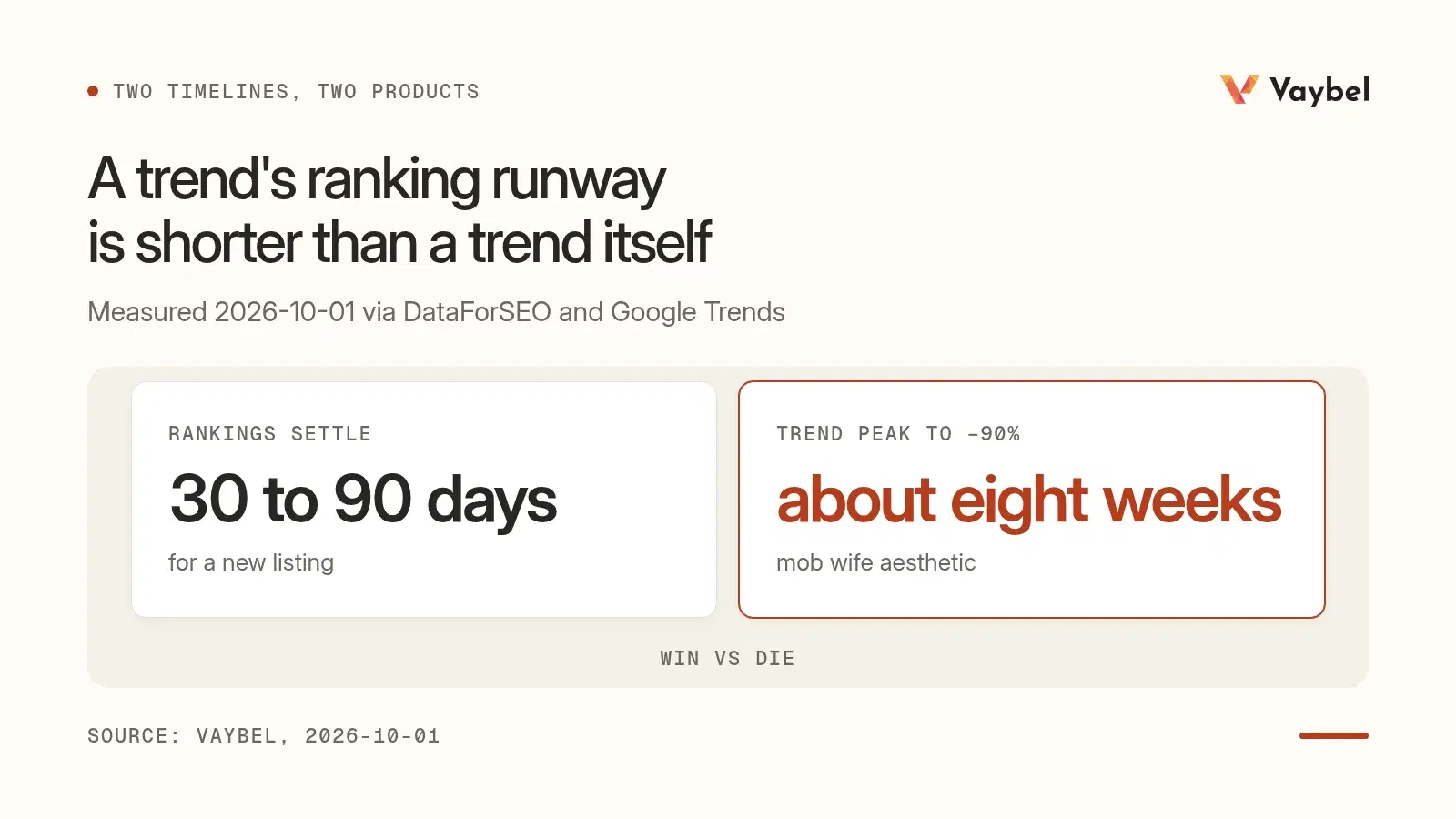
Indexing is quick. A new listing typically becomes findable within 4 to 24 hours. Ranking is a different process. One Etsy SEO analysis reports that rankings take 30 to 90 days to settle, and that a listing from a shop with no sales history averages around 45 days to reach the top five pages for a medium-competition keyword.1 Treat that 45-day figure as directional rather than exact, since the analysis doesn't publish its methodology.
Now put a real trend next to it.
What Happened to the Mob Wife Aesthetic
In early 2024 the mob wife aesthetic was everywhere. On February 3, 2024, AFP reported that Google searches for "mobwife" had risen more than 2,000% in three months, and that the hashtag had drawn 161 million TikTok views according to trend consultancy Journo Research.3
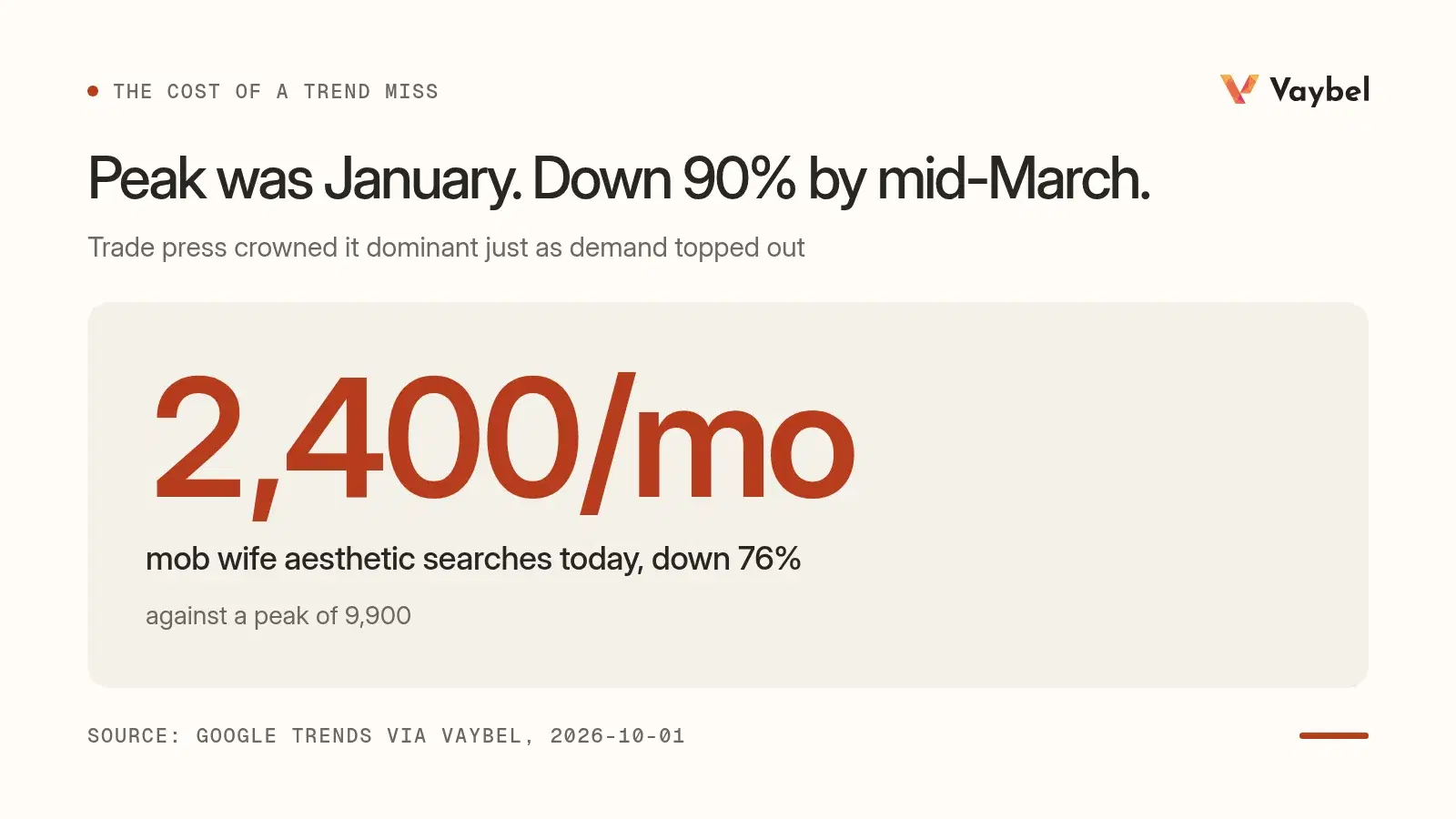
The search data tells a sharper story. On Google Trends, mob wife aesthetic had no measurable interest at all through 2021, 2022, and 2023. It hit its all-time peak of 100 in January 2024. By mid-March 2024 it had fallen to 10.2
Read those two paragraphs together. The trade press was declaring the look dominant at almost exactly the moment demand peaked, and eight weeks later the search interest behind it was down roughly 90%. Today the term draws 2,400 searches a month against a peak of 9,900, down 76%.2
The Collision
Line the two timelines up and the conclusion stops being a matter of opinion.
| What you're racing | Measured timeline | Source |
|---|---|---|
| New listing becomes findable | 4 to 24 hours | Etsy SEO analysis 1 |
| Rankings settle | 30 to 90 days | Etsy SEO analysis 1 |
| New shop reaches top five pages | about 45 days | Etsy SEO analysis 1 |
mob wife aesthetic peak to down 90% | about eight weeks | Google Trends 2 |
A design listed at a trend's peak is still climbing the rankings when the demand it was built for has gone. That isn't bad timing. It's structural.
Trend designs can only ever sell through push channels: the TikTok algorithm, affiliate creators, or paid ads. Evergreen niches are the only designs that can earn pull distribution from search.
This matches what we found writing about Q4 planning for print-on-demand brands, where December rankings are effectively locked and new listings can't index in time to matter. Same mechanism, different season.
So the real question was never "which sells better." Both sell, through different machinery, and that turns this into an allocation decision driven by the channels you operate.
Want to see which aesthetics in your niche are rising rather than cresting? Explore AI Trend Finder, which scores trend lifecycle instead of raw popularity.
Evergreen Niches and Trends Are Life Stages, Not Categories
Nearly every article on this topic treats the two as fixed camps. The data says otherwise. Run a five-year check on a handful of aesthetics and four distinct behaviors show up.
| Behavior | Example | What the data shows | Volume now |
|---|---|---|---|
| Died | mob wife aesthetic | Zero interest 2021 to 2023, peak 100 in January 2024, down to 10 by mid-March 2 | 2,400/mo |
| Graduated | gorpcore | Relative interest 2 in 2021 climbing to 10 to 13 in 2026, up 83% year over year | 33,100/mo |
| Decayed but stayed large | cottagecore | Relative interest 66 in 2021 down to 26 in 2026, a 60% fall that still leaves real volume | 60,500/mo |
| Never real | balletcore, mermaidcore | Never exceeded single-digit relative interest in five years | 2,400/mo, 720/mo |
| True evergreen | nurse shirt | Flat at 6 to 9 relative interest for four and a half years, 0% year over year | 6,600/mo |
| Seasonal evergreen | teacher shirt | Peaks every August and September, troughs every December, four cycles running | 8,100/mo |
Gorpcore Graduated, and That Matters
Gorpcore, the outdoor-technical look translated into streetwear, was a curiosity in 2021 sitting at a relative interest of 2. It has climbed every year since and now pulls 33,100 searches a month, up 83% year over year and sitting at its measured peak.2
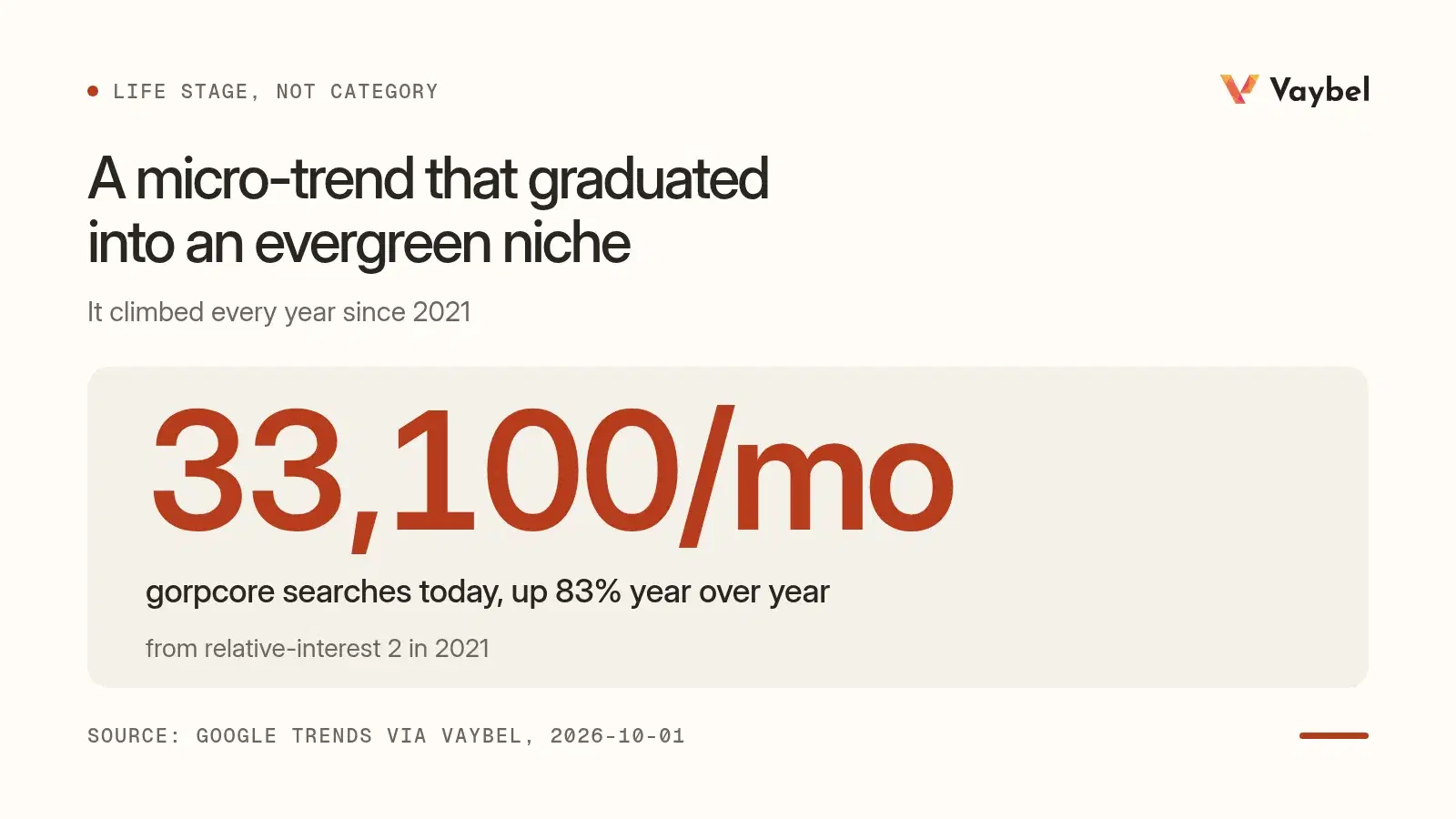
That single row breaks the binary. Gorpcore was a trend. It is now, by any practical definition, an evergreen niche.
The implication is uncomfortable if you only ever design safe. Today's evergreen niches are yesterday's trends that survived. A founder who never takes a trend position is harvesting categories other people established early, and will always arrive after the margin has compressed.
Balletcore and Mermaidcore Were Never Real
Both got extensive fashion-media coverage. Neither ever had meaningful search demand. In five years, neither broke out of single-digit relative interest.2
This is the cheapest mistake on the list to avoid. Press coverage is not a demand signal. An aesthetic can be written about constantly by people paid to write about aesthetics while almost nobody searches for it. For the detection side, see how to spot clothing trends early.
Seasonal Is Not the Same as Trending
teacher shirt looks volatile. Over 12 months it runs from a low of 4,400 searches to a high of 18,100, and a naive year-over-year read makes it look like 83% growth.2
It isn't growth. It's August. The five-year view shows a clean sawtooth: a peak every August and September, a trough every December, four cycles in a row.
A seasonal niche is an evergreen niche with a calendar attached. You don't chase it, you schedule it. That's a planning problem, which is what Drop Planner exists for, and it's nothing like the problem a trend poses.
How to Tell Which One You're Looking At
Two checks separate real evergreen niches from dying trends. The full validation workflow, including buyer definition and cost sheets, lives in our guide to finding profitable print-on-demand niches.
Check the Five-Year Shape, Not the Twelve-Month Window
Most keyword tools hand you a single year of data. One year cannot distinguish a dying trend from a seasonal trough, and it will mislead you in both directions.
Two guardrails make the 12-month view usable:
- Establish a baseline before calling anything a decline. Measured this run,
print on demandfell 18% year over year andhow to start a clothing brandfell 19%. Roughly 18% down is flat in this window.2 Only moves well past that are real. - Pull the five-year curve before quoting any year-over-year figure. The
teacher shirtsawtooth above is the warning. Window-edge seasonality produces confident-sounding numbers that mean nothing.
When Cost Per Click Lies to You
A high cost per click usually signals real buyers, and our t-shirt niche test uses it as one of three gates. It has one failure mode worth knowing.
cybercore reports a cost per click of $44.34, which would read as an enormous buyer signal. Then you pull the actual search results page and find Pinterest, Tumblr, Lemon8, Roblox, a Reddit thread about book recommendations, and Indeed.2
That $44 figure is cybersecurity advertisers bidding on "cyber."2 There is no apparel buyer anywhere in it.
The rule: cost per click is a buyer signal only after you confirm the search results are selling the thing you think they're selling. Any niche name that collides with a high-value business category inherits that category's bids.
To watch both checks run against live niches, Ryan Hogue publishes a weekly teardown of five candidates:
The Allocation Rule: Match Each Design to a Channel
This is where most advice lands on "do both" and stops. Doing both is right, but the useful question is in what proportion.
Since trend designs can't rank inside their own lifespan, the share of trend designs you can justify is capped by how much push distribution you actually control. Not by how good your trend instincts are.
If Your Distribution Is Search
Selling mainly through Etsy search or Google means evergreen niches should dominate heavily. You have no mechanism that moves a product faster than ranking does, and ranking is slower than a trend.
A trend design here is close to dead on arrival. By the time it's findable, the searches have moved on. Spend the design hours on evergreen niches instead and let the listings compound.
If Your Distribution Is Push
An active TikTok presence, an affiliate roster, or a paid budget changes the math completely. Push channels don't wait for indexing, so a trend design can reach buyers inside its window.
This is the engine behind the activewear brand Halara, which runs roughly 1,000 listings on TikTok Shop and converts trends into live products fast, according to estimates compiled by Tramicheck.4 What makes it work is catalog velocity paired with content velocity, and neither one depends on search.
Your trend ceiling rises in proportion to that distribution. Honestly: if you post twice a month and have no creators, the trending niches on your feed aren't addressable for you yet.
If You Run Both
Most brands do, and the practical structure is a durable core that earns search traffic plus a reactive layer that rides push channels.
Two rules keep it from collapsing into chaos:
- The core funds the experiments. Evergreen niches produce the predictable revenue that makes a trend miss survivable. Build the core first.
- Trend designs get a decision date, not an indefinite life. Set one when you list. A trend design that hasn't moved on push channels within its window isn't going to be rescued by search.
What to Do With a Trend Design After the Trend Dies
Don't delete it. A failed trend design sometimes works as a long-tail product, because competitors abandon the category while a trickle of demand remains.
mob wife aesthetic still draws 2,400 searches a month.2 That's down 76% from peak, and it's not nothing once nobody is competing for it. The design is already made, and keeping it listed costs nearly nothing.
How to Build Evergreen Niches and Trends Without Doubling Your Work
The reason founders over-commit to one mode is simple: each design costs a day. Designing, mocking up, writing copy, and listing is a full day per product, so running a durable core and a reactive layer feels like two jobs.
Collapse the per-design cost and the tradeoff mostly dissolves. That's the argument for an AI pipeline here, and it's operational rather than creative. Your taste still decides what gets made.
Two pieces matter for this specific decision:
- Lifecycle scoring, not popularity scoring. AI Trend Finder measures de-seasonalized year-over-year momentum across a five-year Google Trends window. That's deliberate, and it's the same methodology point this article has been making. Tools that read raw 12-month popularity flag an off-season evergreen niche as declining and push you toward micro trends that are already cresting.
- Velocity makes a mixed catalog possible solo. When a design goes from prompt to listed in minutes instead of a day, maintaining an evergreen core while reacting to a genuine trend stops being a staffing question.
Vaybel doesn't pick your niche or replace your judgment about what's worth making. It removes the per-design tax that forces the choice.
Ready to run a core and a reactive layer at the same time? Start a free trial, no credit card needed.
Evergreen Niches FAQ
What are evergreen niches for print-on-demand?
Evergreen niches are categories whose demand holds steady across years rather than spiking and fading. The most durable evergreen t-shirt niches attach to an identity: a profession, a hobby, a pet, or a family role. That's why evergreen merch in those categories keeps selling. Measured over five years, nurse shirt has sat flat at 6 to 9 relative interest on Google Trends and draws 6,600 searches a month.2
Is it better to sell evergreen or trending designs?
Neither is better in the abstract, because they reach buyers through different channels. Evergreen niches can earn search traffic; trend designs cannot, since rankings take 30 to 90 days to settle1 and trends often peak and fall faster than that. If search is your main channel, weight heavily toward evergreen niches. Most lists of the best print-on-demand niches are really lists of evergreen ones, for exactly this reason.
How long do fashion micro trends last?
There is no credible study with a precise figure, and the specific numbers circulating online trace back to unsourced content. Reputable sources stay qualitative. The Global Fashion Agenda notes that companies now design and produce clothing "within just a couple of weeks."5 A measured example is more useful: mob wife aesthetic went from its all-time peak to down roughly 90% in about eight weeks.2
Can a trending niche become an evergreen niche?
Yes, and gorpcore is the clearest case. It sat at a relative interest of 2 in 2021 and has climbed every year since to 33,100 searches a month, up 83% year over year.2 This is why the evergreen and trending labels describe life stages rather than fixed categories.
How many of my designs should be evergreen versus trending?
Cap the trend share by the push distribution you control, not by your confidence in the trend. Without an active social presence, affiliate creators, or an ad budget, there's no way to sell a trend design inside its window, so trend designs should be a small fraction at most. As push distribution grows, so does the ceiling.
Are seasonal designs the same as trending designs?
No, and conflating them causes real mistakes. A seasonal niche repeats on a predictable calendar, which makes it plannable. teacher shirt has peaked every August and September and troughed every December for four consecutive years.2 A trend has one peak and no second act.
How do I know if a trend has already peaked?
Pull the five-year curve rather than the 12-month one, and watch whether mainstream coverage has started. By the time trade press calls an aesthetic dominant, the peak is often behind you. AFP reported the mob wife aesthetic as the look of early 2024 in February, and the Google Trends peak was January.3
Pick Your Split This Week
Evergreen niches win on durability and trends win on speed, but the choice between them isn't about which kind of design is better. It's about which kind of distribution you have.
Three things to take away:
- A trend design can't rank in time to sell. Rankings settle in 30 to 90 days;1
mob wife aestheticlost roughly 90% of its peak interest in about eight weeks.2 - Check five years, not one. Roughly 18% down is flat in the current window, and seasonal troughs masquerade as decline.2
- Let your channels set the ratio. Search-led brands lean heavily evergreen. Push-led brands can afford a reactive layer.
Here's one thing to do before you design anything else. Take your three best-selling designs, pull a five-year curve for each, and sort them into died, graduated, decayed, or evergreen. Most founders discover their reliable revenue comes from a category they never thought of as a strategy.
Then build the core deliberately and treat trends as the reactive layer they are.
Start your free 7-day trial and build a core of evergreen niches while staying fast enough to catch the trends that are actually rising.
Footnotes
Footnotes
-
Etsy New Listing Indexed: How Long to Rank, Listybox. The analysis does not disclose its sample size or methodology, so the 45-day figure should be read as directional. ↩ ↩2 ↩3 ↩4 ↩5 ↩6 ↩7
-
Search volume, cost per click, and competition figures measured October 1, 2026 via DataForSEO's Google Ads
search_volumeendpoint; relative-interest series measured the same day via DataForSEO's Google Trendsexploreendpoint on a five-year window. Location: United States. Language: English. Google Trends values are relative interest on a 0 to 100 scale, not absolute volume. ↩ ↩2 ↩3 ↩4 ↩5 ↩6 ↩7 ↩8 ↩9 ↩10 ↩11 ↩12 ↩13 ↩14 ↩15 ↩16 ↩17 ↩18 ↩19 ↩20 ↩21 ↩22 -
"Mob wife" is flashy fashion look of early 2024, AFP via FashionNetwork, February 3, 2024. TikTok hashtag figure attributed in the article to trend consultancy Journo Research. ↩ ↩2
-
Halara's $101M playbook, Tramicheck. Listing counts and revenue figures are third-party estimates, not company-reported figures. ↩
-
Examining the Era of Micro Trends, Global Fashion Agenda. ↩