To make merch, you work through five decisions in order: find the phrase or image your audience already repeats, build a design around it instead of enlarging your logo, pick a blank that matches how the piece will actually be worn, match the print method to your artwork, then publish to the channels where your audience already shops.
Four of those five get covered everywhere. The third one almost never does.
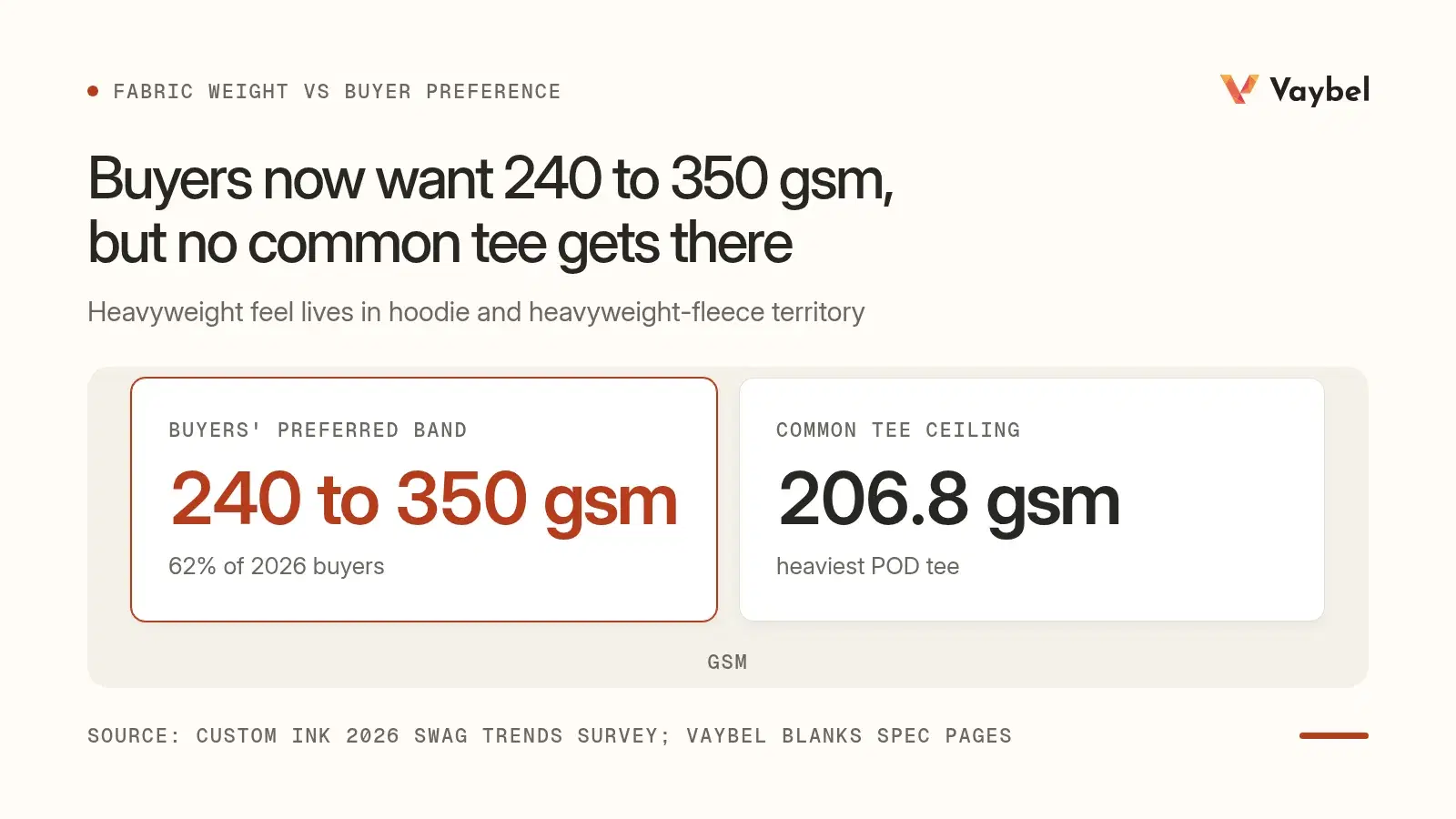
Here's the number that should bother you. The default blank most first merch drops land on, the Bella+Canvas 3001, weighs 142 grams per square meter. In Custom Ink's 2026 Swag Trends Survey of more than 1,000 buyers, 62% said they're moving to heavyweight cotton in the 240 to 350 gsm range, and 45% now rank longevity as the single most important feature when choosing branded apparel.1 Nearly 100 gsm separates what most people print on from what buyers say they want to wear.
You already know the failure mode. A drop goes live, friends and family buy six units, and the rest sits. The usual diagnosis is marketing. Often it's the garment.
This guide walks the full process, and it spends real time on the two layers the other guides hand off to a tool: the blank and the print method. You'll get actual gsm figures, actual costs, and a decision table for matching artwork to printing. By the end you'll know how to make merch that earns a second purchase instead of one sympathy order.
Key Takeaways
- The blank is the decision that determines repeat purchases, and it's the one almost every merch guide skips. 62% of 2026 buyers now prefer 240 to 350 gsm cotton;1 the industry-default Bella+Canvas 3001 is 142 gsm.2
- "Heavyweight" on a product label means nothing. The Comfort Colors 6014 is marketed as heavyweight and measures 206.8 gsm, the same weight as the standard 1717.2
- No common print-on-demand tee reaches the 240 gsm band buyers say they prefer. Hoodies do, which is why a heavyweight hoodie often beats a tee as a first drop.
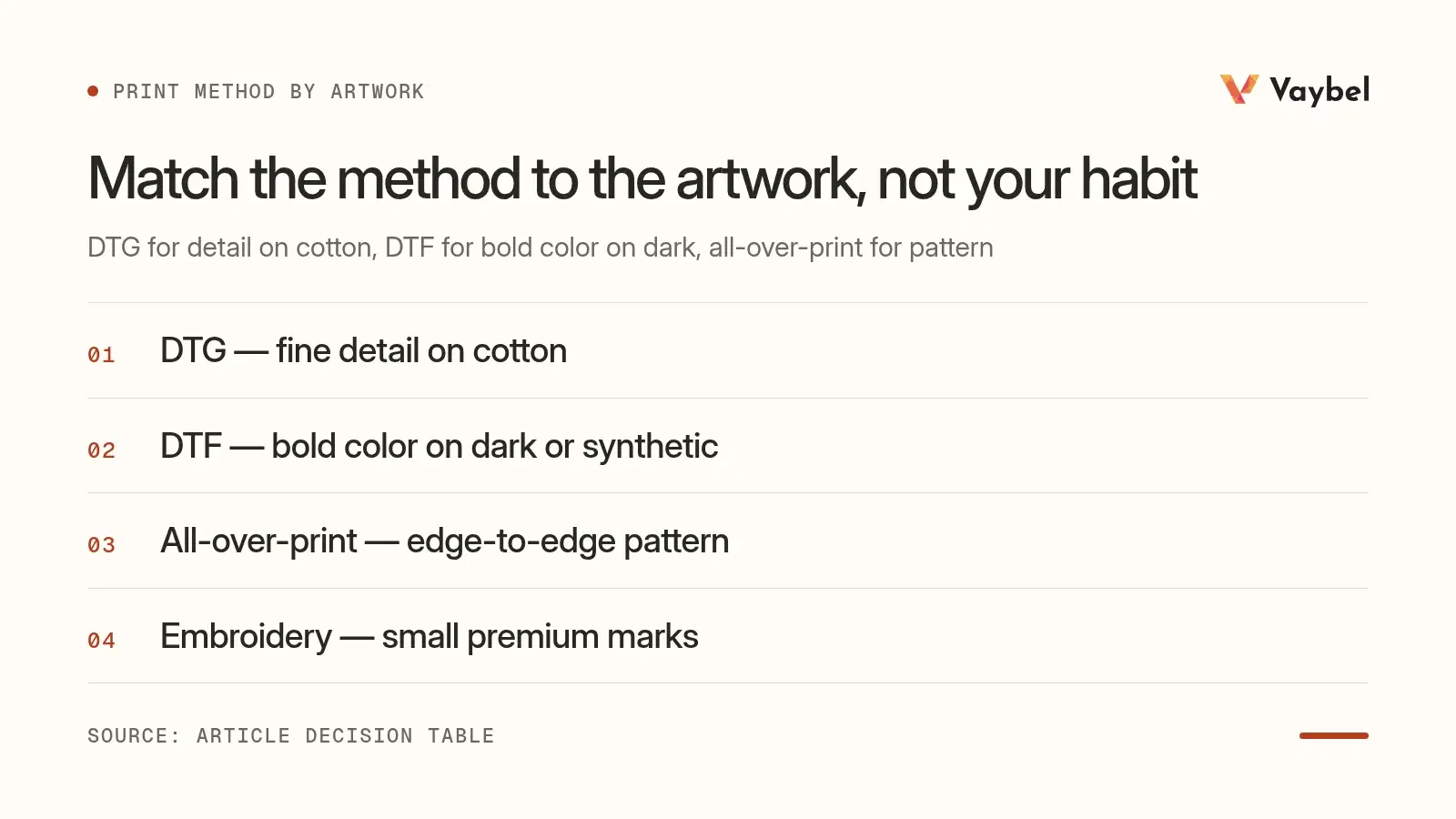
- Match the print method to the artwork, not to habit: DTG for fine detail on cotton, DTF for bold color on dark or synthetic blanks, all-over-print for edge-to-edge pattern.
- Your logo is an input, not a product. Design around the thing your audience already quotes back to you.
How to Make Merch: The Five Decisions That Matter
Every merch project comes down to five choices. Make them in this order, because each one constrains the next.
- Find the signal your audience already repeats back to you.
- Design around that signal, not around your logo.
- Choose the blank by weight, fit, and how the piece gets worn.
- Match the print method to the artwork you just made.
- Publish to the channels where your audience already buys.
Most people run these backwards. They start with a product ("we should do hoodies"), then force a design onto it, then discover the artwork doesn't print well on the blank they picked. Working in order costs nothing and prevents all three mistakes.
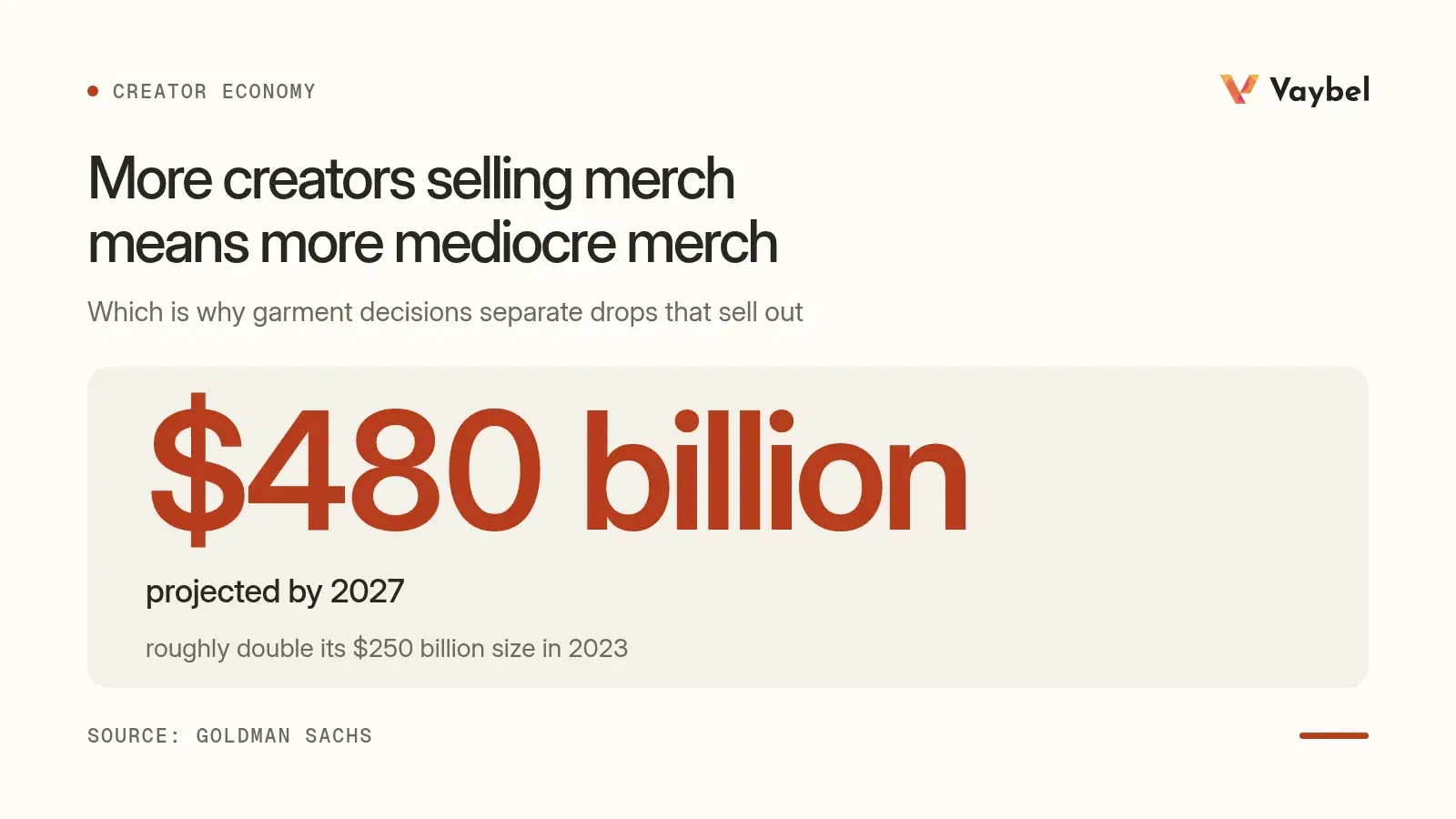
The creator economy makes this worth getting right. Goldman Sachs projects it will approach $480 billion by 2027, roughly double its $250 billion size in 2023, with the global creator base growing 10 to 20% a year.3 More creators selling merch means more mediocre merch, which is exactly why the garment decisions separate the drops that sell out from the ones that don't.
Want the version where this runs as a managed program? See how branded merch collections get built beyond basic logo placement.
Start With What Your Audience Already Repeats
Before you design anything, go read your own comments.
You're looking for repetition: a phrase people quote back at you, a running joke, a visual that shows up in fan art, a reaction you've accidentally become known for.
That repetition is the only reliable signal you have. It means people already adopted the thing on their own. Merch gives them a way to wear it.
Where to look
Pull from four places and write down anything that appears three or more times:
- Comment replies on your five most-viewed posts
- Discord or group chat nicknames and recurring bits
- Quote-tweets and stitches, where people add their own framing
- DMs, which is usually where the most specific requests live
Why the inside joke beats the logo
A logo tells a stranger who you are. An inside joke tells your audience that they were there. Only one of those is worth wearing in public.
This is also what the research on branded apparel keeps finding. A 2026 joint study from the Advertising Specialty Institute and Promotional Products Association International, carried out by a third-party climate advisory firm, measured 80% to 90%+ brand recall for promotional products, with a carbon impact per memorized impression roughly eight times smaller than digital advertising.4 Branded apparel works. But recall is what the brand gets. Whether someone chooses to wear it is a separate question, and that's governed by whether they like the thing.
How many followers you actually need
Fewer than you think, but the math is unforgiving. Plan on 0.5% to 2% of an engaged audience buying on any given drop, then size everything from there: at 1% conversion, 10,000 engaged followers means roughly 100 units. Treat that band as a planning heuristic, not a measurement.5 It's enough to justify print-on-demand and nowhere near enough to justify a bulk order.
Your Logo Is the Input, Not the Product
A logo is an identifier. It's built to be legible at small sizes on a business card or a browser tab. Blown up to 11 inches across a chest, it becomes a billboard for a brand nobody asked to advertise.
The 2026 trend reporting bears this out in the bluntest possible way. In the Custom Ink survey, 24.6% of buyers named the standard unisex cotton t-shirt as the single most overdone item for 2026.1 Merchery's summer 2026 trend report independently flagged the shift toward "logo placement that feels intentional rather than an afterthought."6
So keep the logo. Demote it.
Three ways to build a design around a logo
- Shrink and relocate it. A small left-chest or sleeve hit reads as a label, not an ad. The front becomes available for the actual idea.
- Extract one element. Pull a single shape, mark, or letterform out of the logo and make that the graphic. Fans recognize it; strangers see a design.
- Use the wordmark as type, not as logo. Set your name in the typeface it already uses, then treat it as a typographic composition with real hierarchy.
Designing without a designer
You don't need to hire anyone to learn how to design merch. If you can describe the piece, you can get a usable first draft. Write a brief that names the subject, the mood, the color count, and the print method. Color count matters more than people expect, because a four-color design and a 40-color design behave completely differently on fabric.
Vaybel's AI Design Generator is built for this specific gap: it generates for clothing rather than for images, which means it understands print placement, DTG versus all-over-print pipelines, and 300 DPI print-ready export. Generation runs in under 60 seconds, so you can iterate on ten directions in the time a single round of designer revisions would take.
When a plain logo tee is the right call
Sometimes it is. If your logo is already the thing people recognize and quote, like a team crest or a long-established wordmark, printing it large is the correct move.
The test is one question: would someone outside your audience understand why a person is wearing it? If yes, you have a design. If no, you have an advertisement.
Choosing the Blank: Where Most Merch Fails
This is the section the other guides skip, and it's the one that decides whether anybody buys twice.
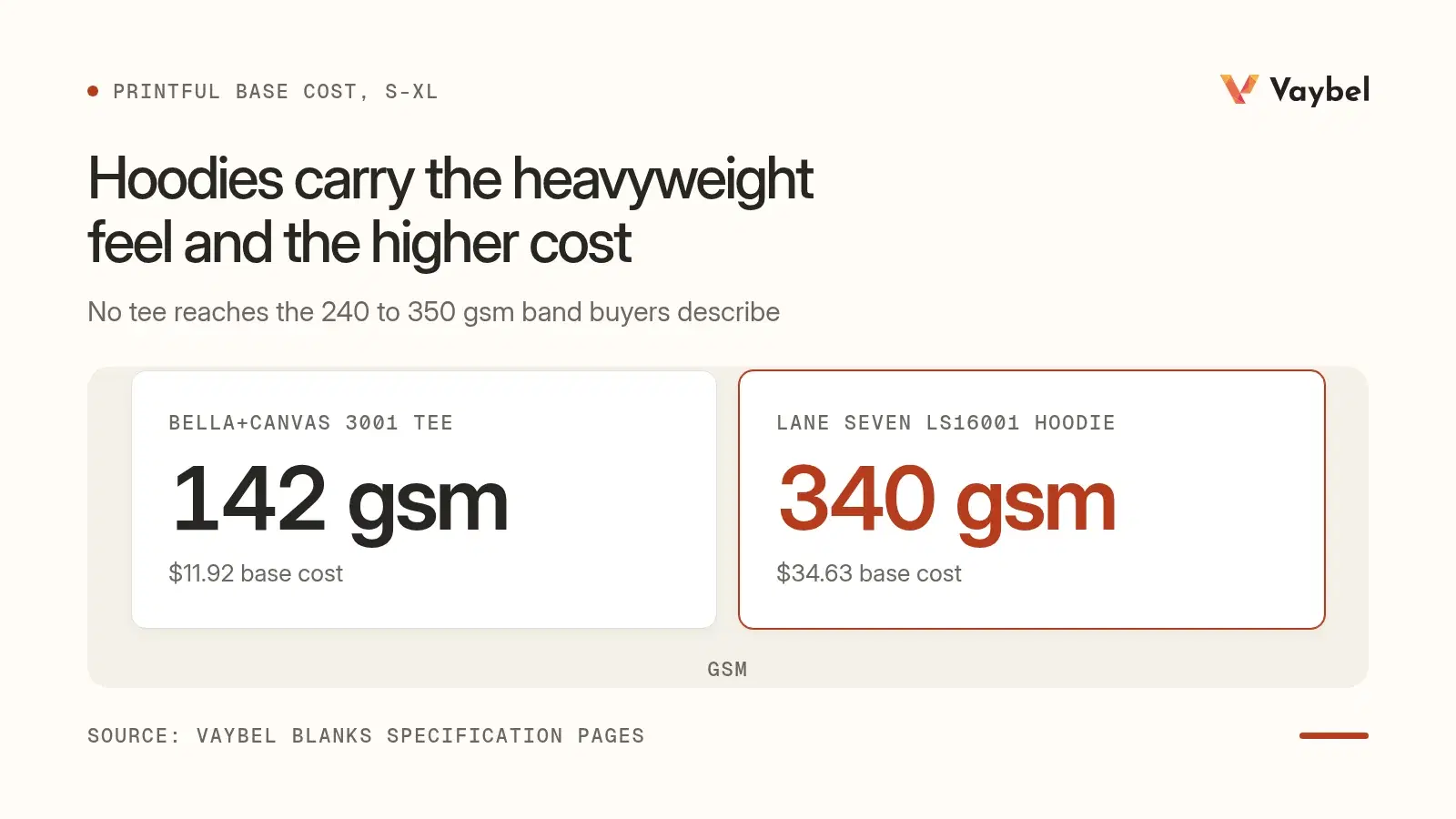
Fabric weight is measured in grams per square meter. Higher gsm means more fabric, more opacity, more structure, and a garment that survives washing without going translucent. Here's what real print-on-demand blanks actually weigh, with current Printful base pricing:
| Blank | Type | Weight2 | Base cost (S–XL) | Colors |
|---|---|---|---|---|
| Bella+Canvas 3001 | Tee | 142 gsm (4.2 oz) | $11.92 | 80+ |
| Comfort Colors 1717 | Tee, garment-dyed | 206.8 gsm (6.1 oz) | $15.60 | 40+ |
| Comfort Colors 6014 | Long-sleeve tee, garment-dyed | 206.8 gsm (6.1 oz) | $20.01 | 30+ |
| Cotton Heritage M2580 | Hoodie | ~288 gsm (8.5 oz) | $27.84–$31.84 | n/a |
| Independent Trading SS4500 | Hoodie | 280 gsm (8.5 oz) | $32.20 | 30+ |
| Lane Seven LS16001 | Hoodie | 340 gsm (10 oz) | $34.63 | 5 |
Read that table against the 240 to 350 gsm band buyers say they prefer,1 and something jumps out.
No tee on this list reaches 240 gsm. The heaviest common print-on-demand tee sits around 207.2 The band buyers describe is hoodie and heavyweight-fleece territory. That's a real constraint, not a sales objection, and it has a practical consequence: if the heavyweight feel is what your audience wants, a hoodie or a garment-dyed tee at 207 gsm gets you closer than any standard tee will.
The label lies; read the gsm
Look at the Comfort Colors 6014 row again. It's sold as a heavyweight tee. It measures 206.8 gsm, exactly the same as the 1717, which is sold as a standard-weight tee.2 Vaybel's own spec page flags it: reviewers note that despite the heavyweight label, this is a medium-weight fabric.
Note what that row does not prove. The 6014 does cost more than the 1717, but it's a long-sleeve garment, so that gap is sleeve fabric rather than a premium for the word "heavyweight." Compare price within a garment type. Compare weight across them.
That's the lesson in one row. Never buy a blank on its marketing adjective. Pull the gsm, pull the oz/yd², and compare. Our blanks library lists the real figures for every garment, including the ones where the label and the number disagree.
The Apparel Sourcing Playbook episode above is worth 10 minutes, partly because it pushes back on the idea that heavier always means better.7
Picking for a first drop
- Lightweight tee (142 gsm): cheapest entry, softest hand, best color range. Lighter colors can read slightly sheer, so order a sample if opacity matters.2
- Garment-dyed tee (207 gsm): the vintage, faded, retail-looking option. Pigment colors fade by design, which is the point. The 1717's collar runs tight in larger sizes.
- Heavyweight hoodie (280–340 gsm): highest perceived value and the only category that lands in the band buyers describe. Also the highest base cost, which changes your pricing math.
For a deeper walkthrough of fit, shrinkage, and sizing, we wrote a full guide on how to choose blanks for a clothing brand.
Match the Print Method to Your Artwork
Printful never discusses this in its merch guide. Custom Ink gives it one line. It's the second-biggest reason merch disappoints in hand.
The method has to fit the artwork and the blank, not your habit.
| Artwork | Blank | Use | Why |
|---|---|---|---|
| Fine detail, gradients, photographic | Cotton or high-cotton | DTG | Ink absorbs into the fibers, so the print stays soft and breathable |
| Bold color, few colors, dark or synthetic | Polyester, blends, dark cotton | DTF | Sits on top of the fabric, so color stays opaque on dark grounds |
| Edge-to-edge pattern, no seams | Polyester | All-over-print | Printed before the garment is cut and sewn |
| Small mark, premium feel, caps | Fleece, twill, structured | Embroidery | Stitched, so it reads as apparel rather than printed merch |
Two tradeoffs matter in practice. DTG gives the softest result but needs natural fibers, which is why it pairs with cotton tees.8 DTF prints opaquely on almost anything, including polyester and dark blanks, but the print sits on the surface and feels thicker, closer to a sticker than to the fabric.
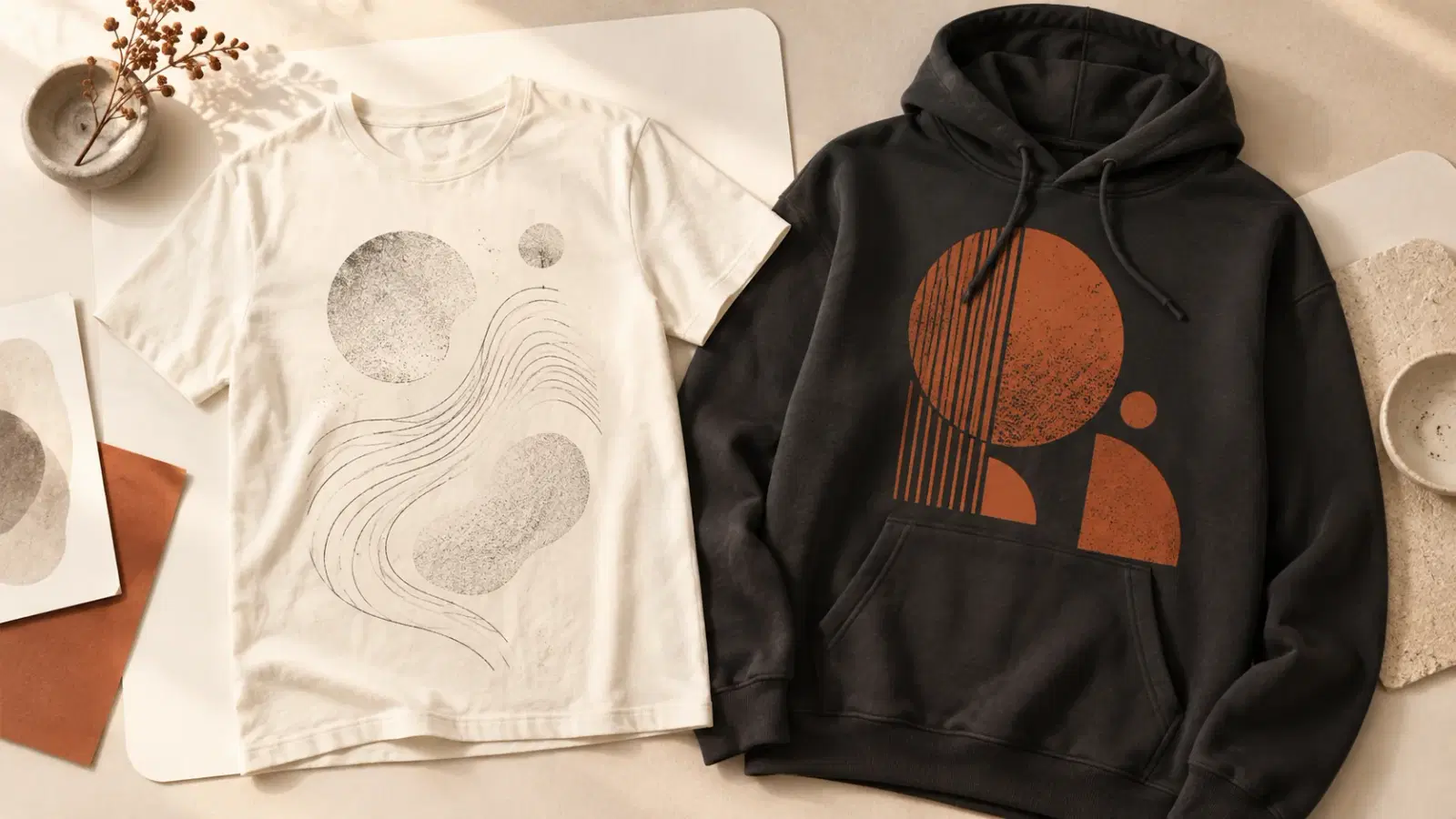
If your design is a four-color graphic going on a black hoodie, DTF is the right call and DTG will disappoint you. If it's a soft, detailed illustration on a cream cotton tee, DTG wins outright. We compared both in detail in DTG vs DTF printing.
How to Make Merch Sell Before You Own Inventory
You don't need stock to find out whether a design works. You need a mockup good enough to judge and pricing that survives contact with fees.
Mockups that do the selling
A flat lay shows the product. A lifestyle shot shows the person your buyer wants to be. Both have jobs: flat lays belong on the listing where buyers compare specifics, lifestyle shots belong in the feed where attention gets won.
Shooting both used to mean a model, a photographer, and a day. Vaybel's AI Mockup Generator produces them on real blanks in under 60 seconds, which means you can test four designs before committing to one. We broke down when each format wins in lifestyle mockups vs flat lays.
The margin math, done honestly
Here's a labeled hypothetical so you can swap your own numbers in.
Take the Comfort Colors 1717 at a $15.60 base cost and price it at $38:2
| Line | Amount |
|---|---|
| Revenue, at your chosen price | $38.00 |
| Blank and DTG print2 | −$15.60 |
| Platform referral fee, 6% to 8%9 | −$2.28 to −$3.04 |
| Gross before shipping | $19.36 to $20.12 |
Swap in the Lane Seven hoodie at $34.63 and price it at $72, and the structure holds: roughly $32 to $33 before shipping.2 The hoodie carries more absolute margin and more risk, because a $72 price point needs the garment to justify itself in hand.
Two cautions. Verify the referral fee for your own channel and category in your seller dashboard rather than trusting a blog figure, including ours; published percentages drift and vary by category.9 And decide explicitly who pays shipping, because on a $38 order a $5 shipping cost is a quarter of your margin.
Print-on-demand versus bulk comes down to this: bulk lowers unit cost but converts cash into boxes. Until a design has sold through once at a price you're happy with, print-on-demand is the cheaper way to be wrong.
Ready to test a design before you commit to it? Generate your first mockups on real blanks with a free 7-day trial.
Where to Sell Your Merch
Three channels matter when you sell merch online, and they reward different things.
- Your own store gives you the margin, the customer list, and the brand control. It gives you zero discovery. Everyone who lands there came from somewhere else.
- TikTok Shop is where discovery lives right now, especially for apparel with a video hook. The tradeoff is that content, not catalog, drives sales.
- Etsy brings existing search demand. Buyers there are actively looking, which rewards listing quality over content volume.
Most creators should run two: one owned, one for discovery.
The operational cost of multi-channel is real, though. Each platform wants different titles, different tag structures, different image ratios. Doing that by hand for every product is the step where most people quietly stop. Vaybel's AI Listing Generator publishes optimized listings to TikTok Shop, Etsy, and Shopify from one pass, which is the difference between selling in three places and intending to.
How to make merch for YouTube specifically
YouTube is its own case, because the platform gives you a shelf under your videos instead of making viewers leave to find the store. That proximity is the whole advantage: the person watching is already in the mood that made them want the thing.
Three things change when the channel is YouTube.
- Eligibility is gated. The merch shelf runs through the YouTube Partner Program, and the requirements change often enough that you should read the current terms rather than a blog's summary of them. Until you qualify, a link in the description and a pinned comment do most of the work.
- The video is the product page. Creator merch sells when the piece appears in the content, worn, in frame, before anyone is asked to buy. A dedicated "my merch is out" video converts worse than wearing the hoodie in six normal uploads.
- Design for the thumbnail. A design that reads at thumbnail scale also reads across a room. If the graphic needs a close-up to make sense, it won't work in either place.
Launching the drop so it doesn't land silently
A drop that goes live with no runway sells to whoever happens to be online that hour. Give it three beats instead.
Tease the thing before it exists: show the design in progress, ask which colorway, let people argue about it. That turns the launch into a conclusion rather than an announcement.
Then set a real constraint. A limited window or a limited run gives people a reason to decide today, and it protects you from guessing demand wrong. Print-on-demand lets you honor "limited" honestly, since you never commit to inventory.
Finally, promote it where the audience signal came from. If the phrase was born in your comments, the launch belongs in your comments. Building this into a repeatable rhythm is the difference between one drop and a merch business.
Trademark and fan-art basics
Short version, and not legal advice: you can't sell merch using someone else's trademark or copyrighted character without a license, and "it's fan art" is not a defense if you're charging money. Your own original designs are yours automatically on creation; registration strengthens enforcement but isn't required to sell. If you're building on an existing property, get permission or change the design.
Make the Garment Part of the Decision
Making merch isn't hard. Making merch people choose to wear a second time is, and it comes down to the decisions nobody talks about.
Five things to carry out of this:
- Design from repetition. The phrase your audience already quotes outperforms your logo every time.
- Demote the logo. Shrink it, relocate it, or extract one element from it.
- Read the gsm, not the label. The Comfort Colors 6014 is sold as heavyweight and weighs the same 206.8 gsm as the standard-weight 1717.2
- Accept the tee ceiling. No common print-on-demand tee hits the 240 gsm band buyers now prefer, so reach for a hoodie or a garment-dyed tee when heavyweight feel is the goal.
- Match print to artwork. DTG for detail on cotton, DTF for bold color on dark or synthetic, all-over-print for pattern.
The design gets you the click. The garment gets you the second purchase. Every guide in this category stops at the first one, which is exactly the opening for anyone willing to learn how to make merch that holds up in a laundry cycle.
Pick one signal your audience already repeats. Build one design around it. Choose the blank by its weight instead of its adjective. That's a drop worth launching.
Start your free 7-day trial → Generate designs, mockups, and multi-channel listings from one workflow, with 200 credits to test the whole pipeline.
Footnotes
Footnotes
-
Custom Ink 2026 Swag Trends Survey, surveying more than 1,000 buyers, January 2026. Reported via GlobeNewswire. Note: this survey polls corporate swag buyers rather than creator-merch customers. The garment-quality findings are about what people will wear and transfer reasonably; treat the audience difference as a real caveat. ↩ ↩2 ↩3 ↩4
-
Weights and Printful base pricing from Vaybel's blanks specification pages, retrieved October 4, 2026. Pricing excludes shipping and tax, and reflects a single front DTG placement where applicable. Size upcharges apply above XL. ↩ ↩2 ↩3 ↩4 ↩5 ↩6 ↩7 ↩8 ↩9 ↩10
-
Goldman Sachs, "The creator economy could approach half-a-trillion dollars by 2027". ↩
-
Joint ASI/PPAI carbon impact and brand recall study, February 2026. Reported via PR Newswire. ↩
-
The 0.5% to 2% drop-conversion band is a planning heuristic widely repeated across creator-merch guides, including Custom Ink's. None of them cite a primary source, and we have not found one. It is used here only to size a first order, and should not be read as a measured benchmark. ↩
-
Merchery, Summer 2026 Merch Trends. ↩
-
"Episode 21: What is GSM? Choosing the Right Fabric Weight," Apparel Sourcing Playbook. ↩
-
DTG ink is formulated to absorb into natural fibers and performs best on cotton and high-cotton blends; DTF transfers apply to a wider range including polyester and nylon. ↩
-
Published platform fee percentages for apparel vary by category and change over time. Vaybel does not restate a fixed figure here deliberately; check your own Seller Center or dashboard. ↩ ↩2