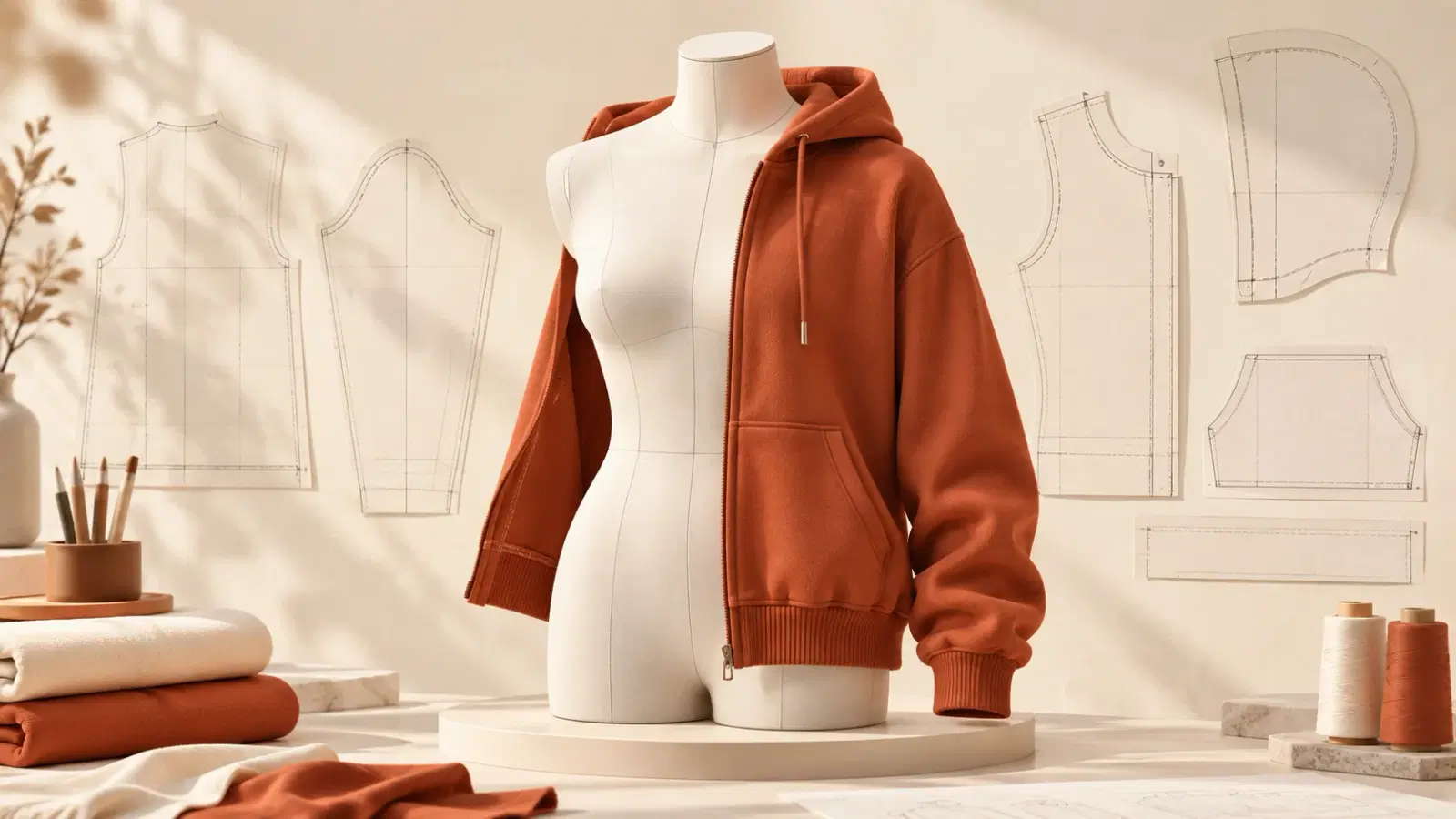
3D clothing design software turns flat 2D patterns into a simulated garment on a virtual body. Designers use it to judge fit, drape, and proportion before anyone cuts fabric. CLO 3D, Browzwear, and Style3D lead the category. If you print your artwork onto existing blanks, you almost certainly don't need any of them.
That last sentence is the part nobody on this topic will tell you.
Here's what happens when three different people search this exact phrase. The first is developing a cut-and-sew hoodie from scratch and needs pattern drafting. The second has a graphic ready and wants to see it on a Bella Canvas 3001 before ordering. The third needs on-model photos for a product page.
Only the first one needs 3D clothing design software. The other two are about to spend $450 a year and three months of evenings on the wrong tool. 1
The demand behind this search term is real and rising. Vaybel's own keyword data puts "3D clothing design software" at roughly 2,000 US searches a month over the last quarter, up about 13% year over year. 2 Notably, that volume is split across the three jobs below, and most of it belongs to searchers who don't need pattern-CAD software at all.
Every roundup on this topic assumes you're the first person. This guide sorts out which one you are. Then it covers what the software costs, what hardware it demands, and where the real break-even sits.
Key Takeaways
- 3D clothing design software simulates a garment from 2D patterns. It is not a mockup generator and not an image generator.
- Three different jobs share this search term: drafting a new garment, previewing artwork on an existing blank, and producing on-model sales photos. Only the first needs pattern-CAD software.
- CLO 3D publishes $50 per month or $450 per year for an Individual license, with a $25 per month student rate. Browzwear starts at $75 per month for freelancers and runs to $3,950 per year for Teams. 1
- The subscription is the small cost. Training providers put functional competency at several weeks and professional proficiency at months, and CLO's own requirements call for 16GB of RAM and a discrete NVIDIA GPU.
- Print-on-demand brands print on blanks that a manufacturer already patterned, graded, and fit. There are no development samples to eliminate, so the business case for 3D never closes.
What Is 3D Clothing Design Software?
3D clothing design software stitches 2D pattern pieces together on a virtual avatar and simulates how the fabric hangs. Adjust a seam or swap a fabric weight, and the garment re-drapes in real time. The output is a digital sample: a garment you can judge for fit and proportion without sewing one.
That definition matters because the category gets confused with two neighbors constantly.
It is not a mockup generator. A mockup generator takes your finished artwork and places it on a photo or template of a shirt that already exists. No patterns, no simulation, no fit.
It is not an AI image generator. An image generator produces a picture of a garment. 3D software produces a constructible garment, with pattern pieces a factory can actually cut.
The real workflow is a loop, and every serious tool in this category follows it:
- Draft or import your 2D patterns.
- Define fabric properties such as weight and stretch.
- Simulate on an avatar sized to your spec.
- Evaluate the fit, then fix the pattern.
- Export a tech pack for production, or a render for presentation.
If that loop doesn't describe a problem you have, keep reading, because the next section is the one that saves you money.
The Three Jobs Hiding Inside "3D Clothing Design"
Most confusion in this category comes from one word doing three jobs. Sort yourself into the right row before you open a single pricing page.
Job 1: Designing a Garment That Doesn't Exist Yet
You're creating a new silhouette. There is no existing pattern, and fit is genuinely unknown until something is constructed. You need pattern drafting, grading across sizes, and accurate drape so you can catch a bad armhole before a factory cuts a few hundred units.
This is the only job 3D clothing design software was built for. Cut-and-sew brands, private label programs, and technical designers live here. So do the enterprise teams the category was priced for.
Job 2: Previewing Your Artwork on a Garment That Already Exists
You have a graphic. The garment is a blank, maybe a Bella Canvas 3001 or a Comfort Colors 1717. Someone else already solved the pattern, the grading, and the fit, and they solved it across thousands of units.
What you need to see is placement, scale, and print behavior. Where does the design sit relative to the collar? How wide does it run on a 2XL? Do your colors survive DTG on a heather blank?
None of that requires cloth physics. Simulating the drape of a blank you can buy in bulk for a couple of dollars is effort spent on a solved problem.
What does help is seeing the blank in 3D: a model of the garment you can turn, with your artwork already on it, plus a flat pattern view showing where the print lands on each panel. That answers placement and scale in seconds, and you never draft a pattern.
This is where most independent clothing brands actually live, and it's the job the entire category ignores.
Job 3: Making On-Model Photos You Can Sell From
You need images for a listing. A shopper has to want the garment, which means lifestyle context, a believable model, and light that flatters the fabric.
This is a photography problem wearing a software costume. A 3D render gives you a technically accurate garment that still looks like a render. That's why brands adopting 3D for development often keep a separate pipeline for sales imagery.
Even the companies furthest into 3D treat the photography payoff as ambition rather than achievement. Back in 2019, Daniel Grieder, then CEO of Tommy Hilfiger Global and PVH Europe, said 3D design could "significantly accelerate our speed to market and replace traditional product photography entirely," according to FashionNetwork. Note the "could."
| Your job | Tool class | Realistic cost |
|---|---|---|
| Draft a new garment | Pattern CAD with cloth simulation (CLO 3D, Browzwear) | $450 to $3,950 per year, plus months of ramp 3 |
| Preview artwork on a blank | Mockup generation on real blank photography | Free to roughly $30 per month |
| Make on-model sales photos | Photography, or AI on-model imagery | Free to roughly $50 per month |
Sorting yourself honestly here is worth more than any feature comparison. If you landed in row two or three, our guide to AI design tools for clothing brands covers your side of the fence in depth.
The Best 3D Clothing Design Software in 2026
If you're in Job 1, here's the honest landscape. Pricing below is taken from each vendor's own published pages, not from aggregators.
| Tool | Built for | Published price | Ramp |
|---|---|---|---|
| CLO 3D | Individual designers and brands doing pattern work | $50/month or $450/year; students $25/month 1 | Steep |
| Browzwear (VStitcher) | Teams standardizing digital product creation | $75/month Freelancer; $3,950/year Teams | Steep |
| Style3D | Brands wanting design plus collaboration | No simple public price list; trial available | Steep |
| Marvelous Designer | 3D artists, games, and film | Subscription, monthly and annual | Moderate |
| Optitex / TUKA3D | Factory-ready pattern CAD and fit | Quote only | Steep |
| Blender | Anyone with more time than budget | Free | Very steep |
| Adobe Substance 3D | Fabric and texture authoring | Subscription | Moderate |
CLO 3D is the default answer, and deservedly so. It handles 2D pattern drafting and 3D simulation in one window. Its published plans are also the clearest in the category: $50 per month or $450 per year for an Individual license, and $25 per month at the student rate. Enterprise and Academic tiers are quote-based, and a 14-day trial is available. The downside is real. CLO expects you to already understand garment construction.
Browzwear (VStitcher) is the enterprise counterweight, and the only competitor publishing a full ladder. Its pricing plans start at $75 per month for a single-seat Freelancer license and climb to $3,950 per year for Teams. Custom Enterprise pricing sits above that. Students and recent graduates can apply for a free six-month Learner license. Wrong tool if you only need product imagery.
Style3D is rising fast and gets cited in AI answers about this category constantly. It's also the one that won't tell you what it costs. Its own materials quote conflicting figures, so treat any number you read as approximate and get a quote.
Marvelous Designer has the strongest cloth simulation engine in the group, built for 3D artists rather than apparel production. If you want beautiful drape for a render, it's excellent. It won't give you grading or production-ready pattern tooling.
Optitex and TUKA3D sit closest to the factory floor, handling technical pattern CAD and fit for manufacturing. Both are quote-only, which tells you who they're priced for.
Blender is free and genuinely capable with its cloth modifier. "Free" here means you supply the apparel knowledge, the rigging, and the patience. There's no fashion-specific pattern-making or grading out of the box, so budget your own hours instead of dollars.
Adobe Substance 3D is frequently listed in this category and shouldn't be. It authors fabric and materials beautifully. It does not design garments.
This walkthrough from 383 Design Studio frames the question well, because it starts from what you're trying to make rather than from a feature list:
What 3D Clothing Design Software Really Costs
The subscription is the number everyone quotes. It's also the smallest line item.
The Learning Curve Is the Bigger Bill
CLO training providers put basic confidence at a few focused weeks, with structured courses typically running six to nine weeks across pattern-making, texturing, and finishing. Professional, portfolio-quality output takes months of repetition. If you don't already know how a garment is constructed, you're learning two subjects at once and it takes longer.
Put a number on that. Sixty hours of ramp, valued at $30 an hour, is $1,800 of your time. The subscription is $450. The software is 20% of your first-year cost. 4
Tommy Hilfiger's own rollout makes this concrete at scale. When PVH moved the brand toward fully digital design, it didn't only buy licenses. It built an internal training program called the Stitch Academy.
By November 2019, associates in more than half of its apparel divisions had been through that program, according to FashionNetwork. A company that size treats 3D adoption as a staffing project, not a software purchase.
Hardware You'll Actually Need
Cloth simulation is computationally expensive, and the category stays quiet about it. CLO's published system requirements call for 16GB of RAM as a baseline and a discrete NVIDIA GPU with at least 4GB of graphics memory. CLO also notes that it doesn't support multi-GPU rendering, so one strong card beats two weak ones. Heavy garments and high-quality renders push those numbers well up.
If you're on a base-model laptop, add the cost of a new machine to your break-even math.
The Break-Even: When Virtual Sampling Pays for Itself
Here's the arithmetic the roundups skip. 3D pays for itself by eliminating physical sample rounds, so the only question that matters is how many samples you avoid.
Plug in your own sample cost:
| Cost per physical sample | Samples avoided to cover $450/year software | Samples avoided to cover software plus 60 hours of ramp ($2,250) |
|---|---|---|
| $75 | 6 | 30 |
| $150 | 3 | 15 |
| $250 | 2 | 9 4 |
For a cut-and-sew brand developing 12 styles a season with two or three rounds each, this closes easily. The industry-level waste backs that up. Roughly 40% of sampling never moves forward into production, per Textile World. The same feature cites a United Nations Alliance for Sustainable Fashion finding that a digital garment generates about 97% less carbon dioxide than a physical one.
One caution on the numbers you'll see elsewhere. Vendor blogs in this space claim sample reductions of 30%, 50%, 70%, and 90%. 5
Those figures are marketing. They contradict one another, and none trace to an independent study. Trust the arithmetic above instead.
Running the numbers and realizing you're in Job 2? See how Vaybel handles the blanks workflow instead.
When a Print-on-Demand Brand Doesn't Need 3D Clothing Design Software
Now the verdict the rest of this category won't print.
If you print on blanks, the pattern is already solved. Its manufacturer drafted the Bella Canvas 3001, graded it across the size run, fit it on real bodies, and made it in volume. You aren't going to improve that pattern, and you have no reason to simulate it.
Look back at the break-even table. A print-on-demand brand orders zero development samples per style, because there is no style to develop. The denominator is zero. The equation never closes, no matter how cheap the software gets.
What you're really deciding is placement, scale, blank choice, and print method. Those are the variables that make or break a POD product, and none of them live in a cloth simulator. Our guide to choosing blanks for your clothing brand covers the part that actually moves your numbers.
What to Use Instead When You're Printing on Blanks
The blanks workflow has three steps, and none need pattern CAD.
- Generate the design. Get print-ready artwork at the resolution your print method needs.
- Put it on the blank. Use mockups built on real photography of the specific blank you're selling, so placement and scale are accurate. Our walkthrough on how to make clothing mockups with AI covers this end to end.
- Make sales imagery. Produce on-model photos that a shopper wants to click.
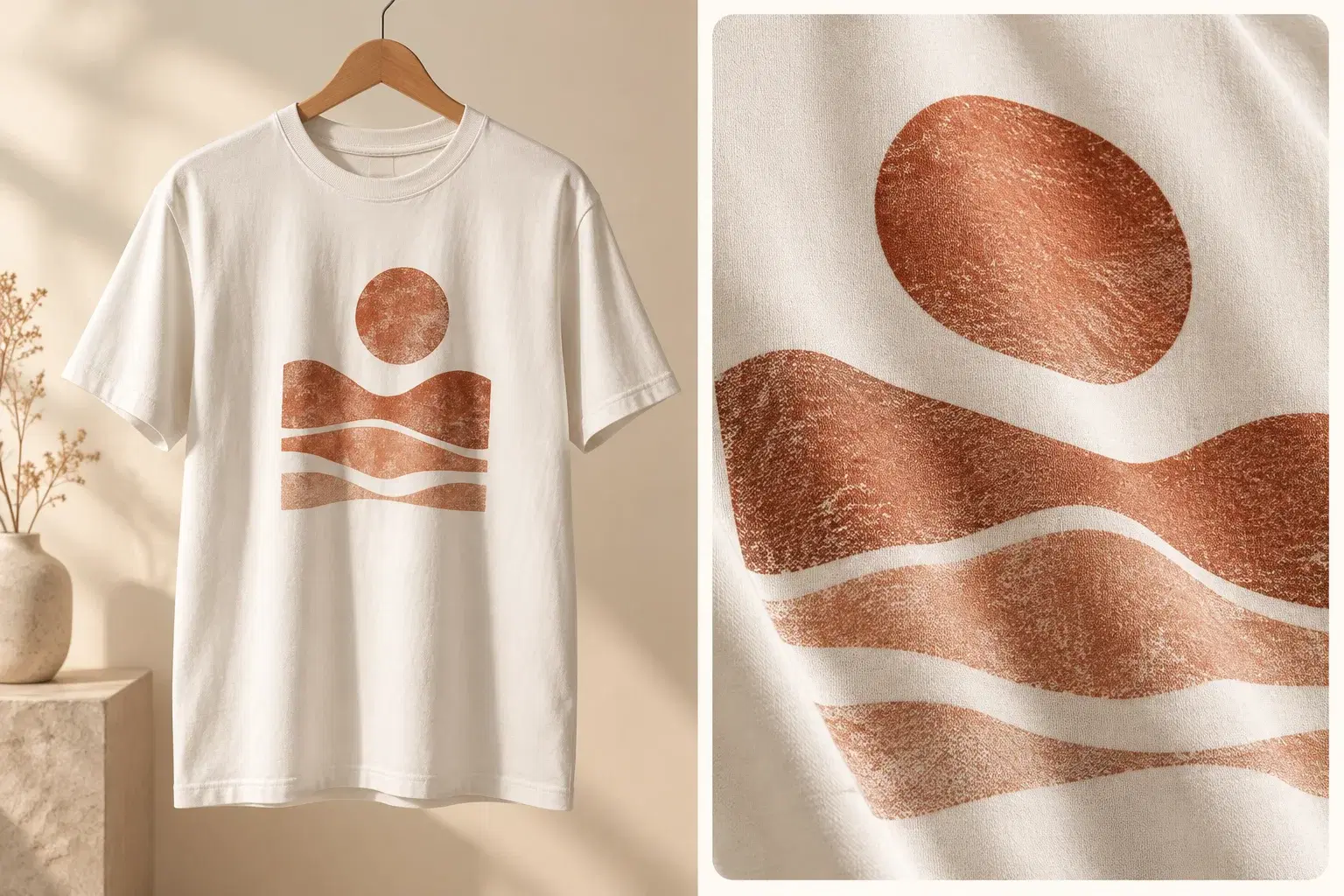
This is the workflow Vaybel is built for. Its AI Design Generator and AI Mockup Generator cover steps one through three on existing blanks, then push listings to TikTok Shop, Etsy, and Shopify. While you design, the preview switches between a 3D model of the garment, a 2D pattern view of the print areas, and a mockup, depending on what that product supports, so you check placement before anything prints.
To be clear about what that is and isn't: Vaybel is not pattern-drafting software. It won't draft a sleeve, grade a size run, or simulate drape. If you're in Job 1, buy CLO 3D. We'd rather tell you that than sell you the wrong tool.
When a POD Brand Should Reach for 3D After All
There are real exceptions, and they all involve leaving blanks behind.
- Moving to cut-and-sew. The moment you develop your own silhouette, you're in Job 1.
- Private label with pattern changes. Adjusting a factory's base pattern means you need to see the result.
- Complex all-over print. Panel placement across seams is genuinely hard to predict flat, and DTG versus all-over print is where this starts to matter.
- Technical apparel. Performance fit, compression, and unusual materials reward simulation.
If none of those describe your coming year, you have your answer.
How to Choose
Work down this list and stop at your first yes.
- Are you drafting a garment that doesn't exist? If no, stop. You don't need 3D clothing design software.
- Is fit genuinely unknown? If you're printing on a graded blank, it isn't.
- Do you already understand garment construction? If not, budget months, not weeks.
- Does your machine have 16GB of RAM and a discrete GPU? If not, add hardware to your budget.
- Solo designer? Start with CLO 3D's 14-day trial.
- Team of three or more? Compare CLO's Enterprise quote against Browzwear's published Teams tier.
- Zero budget and real patience? Blender.
Frequently Asked Questions
What is the best 3D clothing design software? For most individual designers doing pattern work, CLO 3D. It combines 2D drafting and 3D simulation in one place and publishes transparent pricing. Teams standardizing across multiple people should compare Browzwear. Artists rendering cloth for games or film want Marvelous Designer instead.
Is CLO 3D free? No. CLO offers a 14-day free trial, then Individual licenses run $50 per month or $450 per year. Students pay $25 per month or $225 per year with verification. Enterprise and Academic pricing is quote-based. 1
How much does CLO 3D cost per year? $450 per year for an Individual license, or $225 per year at the student rate, per CLO's published plans. Budget separately for training time and hardware. Together those usually exceed the subscription in year one.
What is the best free 3D clothing design software? Blender, with its cloth simulation modifier. It costs nothing and does a lot, but it has no fashion-specific pattern-making or grading, so you supply that knowledge yourself. Students and recent graduates should also check Browzwear's free six-month Learner license.
Can I create 3D models of clothes without design experience? You can produce something, but not something a factory can make. These tools assume you understand seams, ease, and grading. Without that background, you're learning garment construction and software at the same time.
What software do most clothing designers use? It depends on the job. Technical designers drafting patterns use CLO 3D, Browzwear, or Optitex. Graphic-led brands printing on blanks use design and mockup tools, not pattern CAD. Many designers use Adobe Illustrator alongside whichever 3D tool they've chosen.
Do I need 3D software for print-on-demand? No. Your blank is already patterned, graded, and fit by its manufacturer. What you need is accurate mockups on that specific blank, correct print-method handling, and sales imagery.
The Bottom Line
3D clothing design software is excellent at one thing: turning a pattern into a garment you can evaluate before anyone cuts fabric. CLO 3D at $450 a year is a bargain if you're drafting new silhouettes. Tommy Hilfiger's move to fully 3D-designed collections shows how far the approach scales when development volume justifies it. 1
It's also the wrong purchase for most independent clothing brands, and the roundups ranking for this term won't say so because they're selling into it.
Sort yourself by job first. Drafting something new puts you in Job 1, so start CLO's trial and budget months, not weeks.
Printing artwork onto blanks means the pattern is already solved. Your gains come from blank choice, placement, and imagery instead. Your bottleneck was never simulation. It's how fast you can get a design onto a product and in front of shoppers.
So skip the 3D clothing design software you don't need. Ready to test the workflow that actually fits the blanks business? Try Vaybel free and take a design from prompt to listing in a single session.
Footnotes
-
CLO and Browzwear prices read from clo3d.com/en/plans and browzwear.com/pricing-plans on September 27, 2026. Style3D, Optitex, and TUKA3D do not publish comparable list pricing. ↩ ↩2 ↩3 ↩4 ↩5
-
First-party US search-volume estimate from Vaybel's keyword research (DataForSEO), recent 3-month average ~2,000/mo for "3D clothing design software", +13% year over year. ↩
-
Pattern-CAD figures are the published 2026 list prices sourced in the preceding note. Mockup and imagery ranges are typical market rates across current tools, not quotes from a specific vendor. ↩
-
Illustrative arithmetic, not a vendor claim. Ramp is valued at 60 hours times $30 per hour; substitute your own sample cost and hourly rate. ↩ ↩2
-
Sample-reduction percentages of 30%, 50%, 70%, and 90% appear across vendor marketing blogs in this category, including Style3D's own. They are self-published, mutually inconsistent, and not traceable to an independent study, so this guide does not treat any of them as fact. ↩