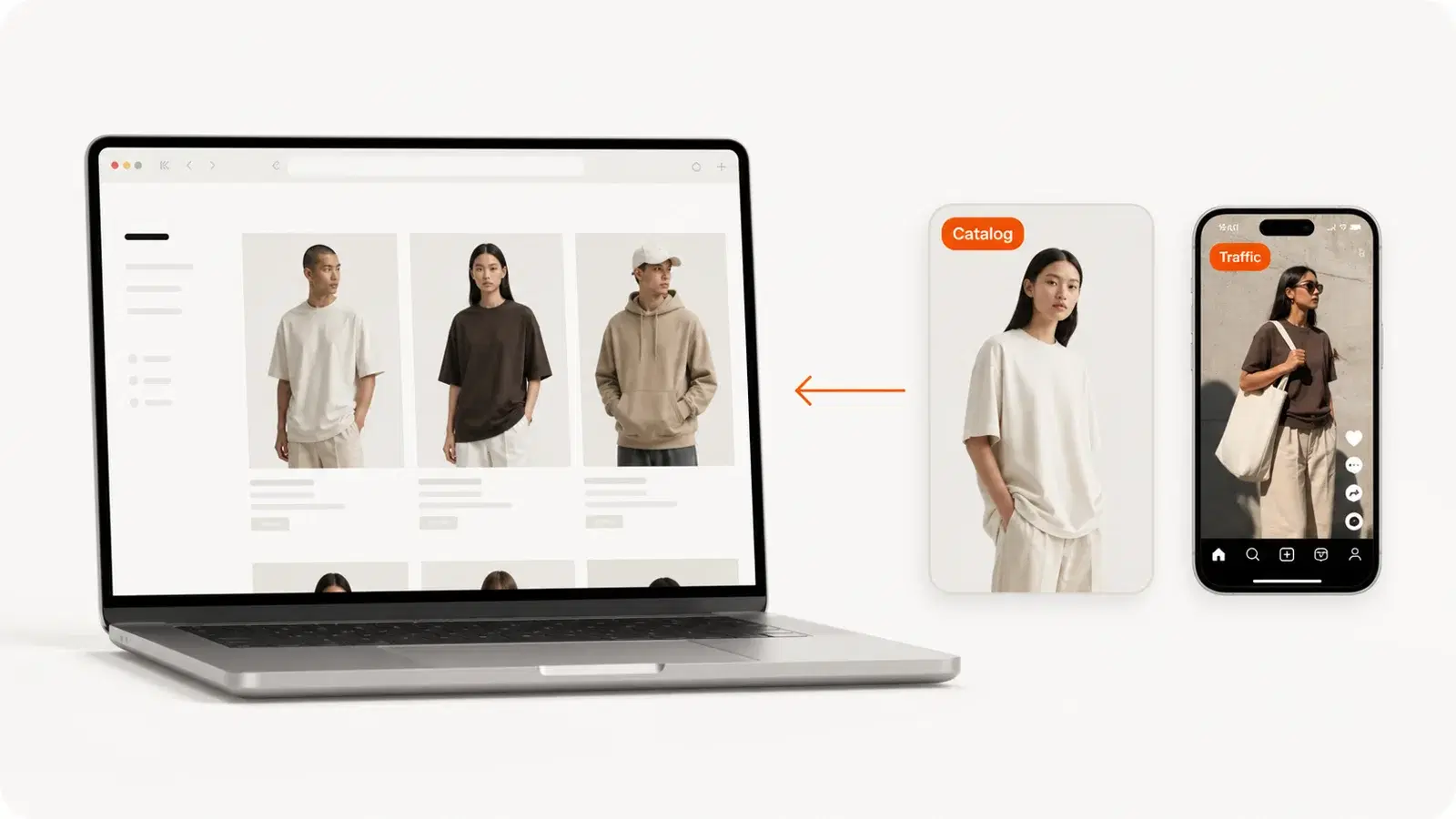
To start a clothing brand on Shopify in 2026, you pick a plan, choose a theme, connect a print-on-demand supplier, upload your products, and open the store. That part takes an afternoon. The part that decides whether the brand works is everything the setup guides skip: producing a catalog worth browsing, and manufacturing the traffic that Shopify itself will never send you.
That second sentence is the whole article, so let's be blunt about it. Shopify is a storefront. It is a very good storefront, and apparel is the single largest category on the platform, at roughly 28% of all Shopify stores.1 But a storefront is a room. It does not come with clothes in it, photographs to sell them with, or a single person walking through the door.
Almost every guide ranking for this query optimizes the room. They will tell you which theme converts, how to structure your navigation, where to put your size chart. That advice is fine. It is also answering the easy question, which is why so many founders follow it perfectly and still end up staring at an analytics dashboard reading zero.
You already suspect this, or you wouldn't be reading past Shopify's own documentation. So here's what this guide covers instead: what launching actually costs once you include the line item nobody prints, where the buyers come from when your platform has no built-in discovery, the returns math that makes apparel structurally different from every other Shopify category, and an honest read on which parts of the 2026 AI hype cycle are worth your attention.
Want to see what filling a catalog looks like before you read the cost breakdown? Explore the AI design and mockup tools →
Key Takeaways
- Shopify has no built-in discovery. Unlike Etsy or a marketplace, there is no internal search engine sending buyers to your store, so every visit has to be manufactured from social, SEO, ads, or email.2
- Product imagery, not the platform subscription, is the largest real cost of launching an apparel brand. A fashion brand shooting a 50-SKU catalog traditionally spends tens of thousands of dollars a year on photography, versus a few hundred with AI generation.3
- Clothing carries the highest return rate in online retail, and size and fit drive the majority of it. Better product information and size guidance measurably reduce returns.45
- The 2026 answer is not Shopify or TikTok Shop. It's TikTok Shop and Etsy at the top of the funnel for discovery, with Shopify as the owned base where you keep the customer relationship.6
- Skip the agentic-checkout hype. OpenAI pulled back on in-chat Instant Checkout in early 2026, and the durable investment is clean, complete product data that pays off in search and on-site conversion regardless.7
In this guide:
- Why apparel founders pick Shopify
- What it really costs
- The line item nobody budgets for
- Shopify sends you zero buyers
- Shopify vs TikTok Shop vs Etsy
- The fit and returns math
- Print on demand vs inventory
- What Shopify's built-in AI already does
- Your launch sequence
- FAQ
Why Apparel Founders Pick Shopify (and What It Actually Gives You)
Shopify gives you three things that matter for a clothing brand, and it's worth being precise about them because the rest of your strategy follows from what's on this list and what isn't.
You own the storefront. Your brand, your layout, your merchandising decisions. Nothing gets buried by a marketplace algorithm or sits next to a cheaper knockoff in a search result.
You own the customer. Email addresses, order history, purchase behavior. On a marketplace you get the sale and the platform keeps the relationship, which quietly caps what your brand can ever be worth.
You own the checkout. Bundles, subscriptions, loyalty, higher-AOV merchandising, all of it under your control rather than a platform's template.
What Shopify does not give you is demand. It's an intent-driven channel: someone landing on your product page has already decided to look at your brand. Getting them to that decision is your job, and it's a job that starts well before the store exists.
Apparel being the biggest category on the platform cuts both ways, too.1 The demand is obviously there. So is the competition, and a lot of it belongs to brands who solved the catalog and traffic problems before they ever picked a theme.
What It Really Costs to Start a Clothing Brand on Shopify
Here's the honest budget. Most guides quote you the plan price and stop, which understates the real number by an order of magnitude for a clothing brand.
| Line item | Realistic 2026 cost |
|---|---|
| Shopify plan | Starter $5/mo, Basic $39/mo, Grow $105/mo, Advanced $399/mo8 |
| Theme | $0 (Dawn) to $200–400 one-time for a premium theme9 |
| Theme customization | $0 if you do it yourself, $500–3,000 with a freelancer9 |
| Apps | $50–200/mo is typical for an active store9 |
| Domain | ~$10–20/year |
| Product imagery | The biggest number on this list. See the next section.3 |
A few notes worth having before you commit. Shopify's Basic plan sits at $39 per month and carries card processing of 2.9% plus 30 cents, along with a 2% fee if you use a third-party payment gateway instead of Shopify Payments.8 The Starter plan at $5 per month is real but limited: it's built for selling through social and shareable links rather than running a full storefront.8
On themes, resist the urge to spend early. A free theme is genuinely enough to validate a concept, and the sensible upgrade trigger is revenue rather than launch day.9 Theme choice matters far less than what you put inside it, which brings us to the part of the budget that actually decides your outcome.
The Line Item Nobody Budgets For: Filling the Store
A clothing store with four products and a stock photo does not convert. It reads as unfinished, and shoppers leave. Filling it properly means designs, on-model imagery in every colorway, size and fit content, and product copy for every single SKU.
That is not data entry. For an apparel brand it's the entire business, and traditionally it's been brutally expensive.
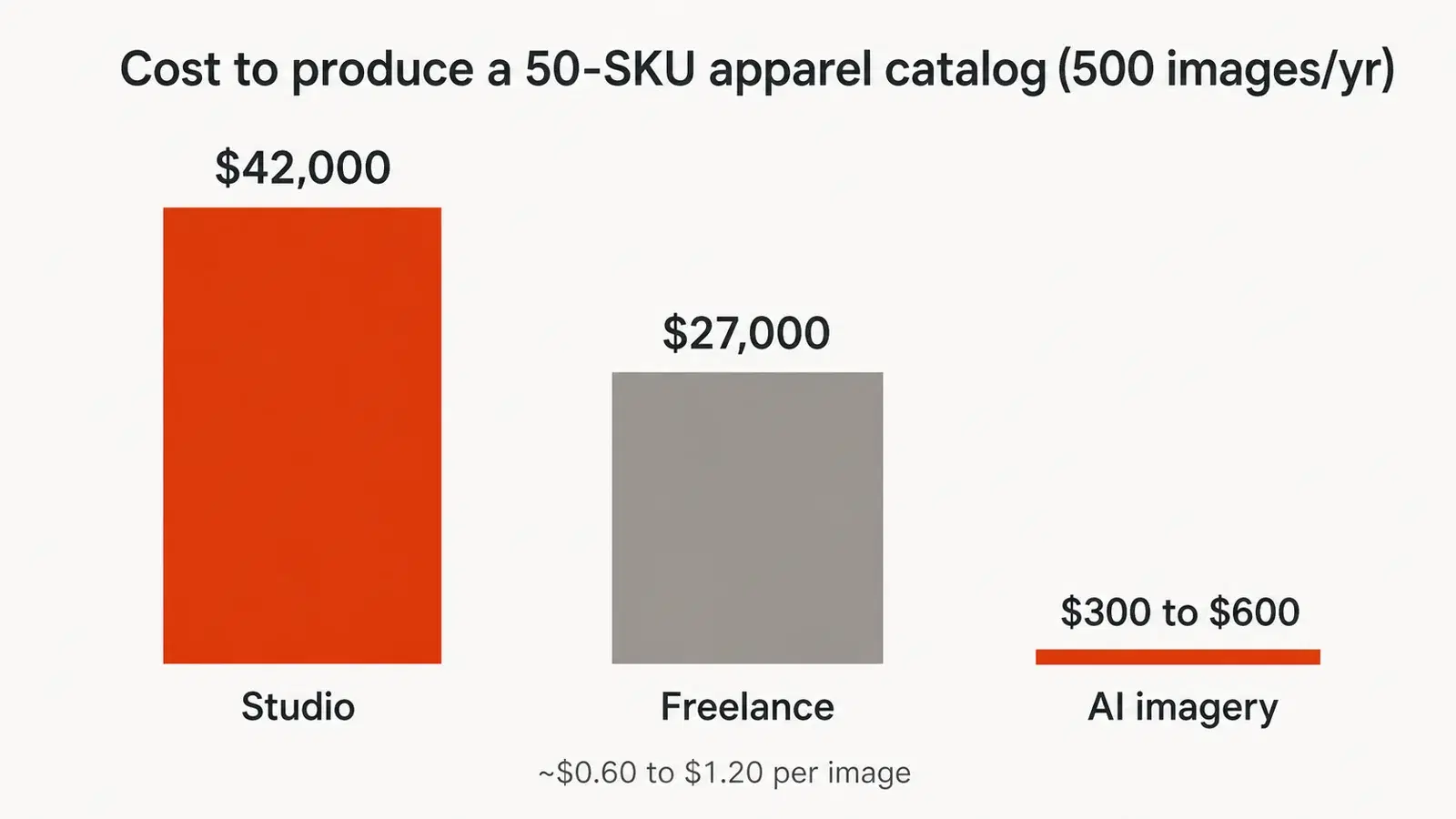
Look at what fashion photography actually costs. On-model images run $150 to $500 or more each.3 A real, documented shoot breakdown of ten outfits producing roughly 60 final images totals $2,750 once you add up photographer and equipment, model, hair and makeup, studio rental, and post-production.3 Scale that to a working catalog and a 50-SKU brand needing around 500 images a year lands near $42,000 through a studio, or about $27,000 with freelancers.3
Now hold that against what a bootstrapped founder actually has. This is the real reason so many new Shopify apparel stores launch with four products: not laziness, but a photography bill that makes a full catalog impossible.
AI generation changes the arithmetic completely. The same 50-SKU catalog produced with AI imagery runs roughly $300 to $600 a year, somewhere near $0.60 to $1.20 per image.3 That's the difference between launching with four products and launching with forty.
This is the layer Vaybel handles. The AI Design Generator turns a concept into a print-ready design, the AI Mockup Generator produces on-model imagery across colorways without a sample or a studio, and the AI Listing Generator writes the product copy and size content that goes with it. You get a catalog that looks like a real brand's catalog, at a cost that doesn't require raising money first.
Ready to see what a full catalog costs you instead? Start the 7-day Starter trial; card required →
For the step-by-step on producing apparel imagery without a photoshoot, our guide to making clothing mockups with AI walks through the whole pipeline.
Shopify Sends You Zero Buyers. Plan for That Before You Launch.
This is the single most important structural fact about the platform, and most guides mention it nowhere.
Etsy has an internal search engine. Amazon has an internal search engine. TikTok Shop has an algorithm actively pushing products at people who weren't shopping. Shopify has none of that. There is no discovery layer inside Shopify sending shoppers to your store, so every visitor arrives from somewhere you built yourself: social, SEO, paid ads, email, or word of mouth.2
The consequences show up in the timelines. Organic SEO generally takes six to twelve months to produce meaningful traffic, and the honest average for a bootstrapped store to reach consistent sales runs somewhere in the three-to-six-month range.2 The frequently repeated "first sale in about two weeks" figure applies to stores that arrive with an audience or an ad budget already in hand.2
Spend an hour in the Shopify community forums and you'll find the same post written hundreds of times: store looks great, traffic is low or converting at nothing, no idea why. It's rarely the theme. It's almost always that the store was built first and the demand was supposed to show up afterward.
So where does traffic come from? The most reliable answer in 2026 is short-form video and creator affiliates, and there's a well-documented example of exactly how lopsided the returns can be.
Portland Leather Goods ran a seven-day affiliate blitz in late March with roughly 500 creators, generating close to 13 million views across 3,800 videos, and hit $1 million in total sales 20 days after the blitz started, including a $100,000 day on the platform.10 The mechanics were unglamorous: gifted product to approved affiliates, cash rewards for creators who posted consistently, and contests for top performers, all nurtured through group chats and direct conversation.10
The part worth internalizing is why it worked. As MacCoy Merkley, Chief Marketing Officer at Portland Leather Goods, put it: "On TikTok, people can get on there, and they don't necessarily need a script. They don't necessarily need a high production value."10
That is a very different production model from a polished DTC campaign, and it's available to a brand with no ad budget. It also explains why the catalog problem and the traffic problem are really the same problem. You cannot fuel a creator program, a content calendar, or a paid test without a deep supply of product assets to work from.
Our complete TikTok Shop guide for clothing brands covers the channel mechanics in full, and product videos for clothing brands covers producing the assets themselves.
If you want the click-by-click store setup this guide deliberately skips, this third-party walkthrough covers the mechanics end to end.
Shopify vs TikTok Shop vs Etsy: Where Should You Actually Sell?
The framing that clears this up fastest: TikTok Shop is discovery-driven and Shopify is intent-driven. One interrupts people who weren't shopping. The other converts people who already chose to look at you.
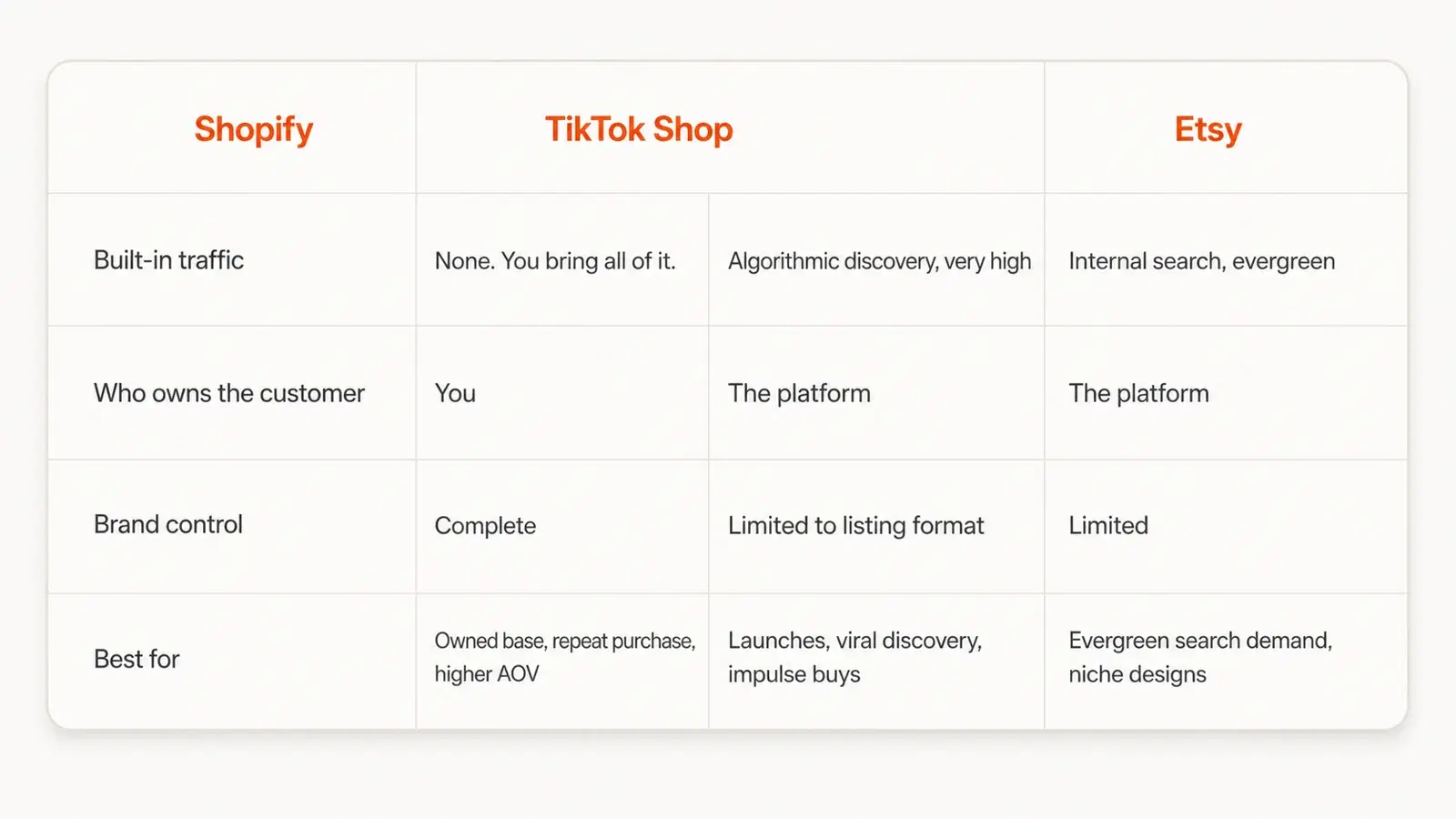
| Shopify | TikTok Shop | Etsy | |
|---|---|---|---|
| Built-in traffic | None. You bring all of it.2 | Algorithmic discovery, very high | Internal search, evergreen |
| Who owns the customer | You | The platform | The platform |
| Brand control | Complete | Limited to listing format | Limited |
| Best for | Owned base, repeat purchase, higher AOV | Launches, viral discovery, impulse buys | Evergreen search demand, niche designs |
| Time to first sale | Slowest without an audience2 | Fastest with creator content | Moderate |
| Main cost | Traffic acquisition | Margin and platform dependency | Fees and competition |
The consensus answer among people actually operating in 2026 is to run more than one, and it's correct. TikTok Shop sits at the top of the funnel for discovery and launches, Shopify sits at the base as your owned home, and Etsy captures evergreen search demand for design-led products.
Here's the footnote nobody adds, though. Multi-channel means rebuilding the same catalog per channel: different listing formats, different attribute schemas, different image ratios, inventory that has to stay in sync. That's real recurring work, and it scales with your catalog size rather than staying fixed. Syncing a Shopify catalog to TikTok Shop typically takes ten to thirty minutes depending on catalog size, with price, image, and description edits propagating from there.11
It's also worth sizing the channel honestly before you commit to it. TikTok Shop reached $50.3 billion in GMV in the first half of 2026, up 92% year over year, with short-form video driving roughly 40% of that.6 For a clothing brand, that's not a side channel.
Vaybel publishes to Etsy and TikTok Shop today, and generates the designs, mockups, product videos, and listing copy that feed a Shopify storefront alongside them. One workflow producing the assets, rather than the same catalog rebuilt by hand per channel. Direct Shopify publishing is in development, and you can join the Shopify waitlist if you want it when it ships.
The Apparel Math Every Shopify Guide Skips: Fit, Returns, and Margin
Apparel is structurally different from every other category on Shopify, and this section is where most guides get vague.
Clothing carries the highest return rate in online retail, generally 20% to 30%, and higher in luxury fashion.3 US apparel retailers report averages in the 30% to 35% range, well above the roughly 19% general ecommerce figure.4 Within apparel, women's fashion and fast fashion both sit close to 28%.4
The cause is remarkably concentrated. Size and fit issues drive the majority of fashion returns, with industry estimates ranging from about half to two-thirds depending on the dataset.4 Not quality. Not shipping. Fit.
Now put that against your margins. Print-on-demand net margins typically land in the 20% to 40% range.12 A 30% return rate against a 25% net margin is not a nuisance, it's the difference between a business and an expensive hobby.
The encouraging part is that this is one of the more fixable problems in ecommerce, and the fix is product content. Improved size and color guidance has been measured to reduce apparel returns by 5% to 10%, and higher-quality product information generally by 2% to 5%.5 Concretely, that means real measurements rather than vague S/M/L, consistent sizing language across your catalog, and on-model imagery that shows the garment on more than one body type.
To be clear about what tooling can and can't do here: Vaybel helps with the imagery and the size and fit content, which is the documented lever. It doesn't touch your returns process, your shipping, or your customer service. Those stay yours.
For context on Shopify fashion conversion generally, apparel stores tend to average around 1.5% to 2.2%, with strongly recognized brands reaching 3.5% or better.13 If you're materially under that with real traffic, product content is the first place to look.
Print on Demand vs Inventory (and the "POD Can't Be Premium" Objection)
Four models, briefly.
- Print on demand. No inventory risk, no upfront capital, per-unit cost is higher. The default starting point for most new brands, and the POD market reached roughly $13.1 billion in 2026 with strong continued growth.12
- Dropshipping. Solves stock risk but not trust or brand differentiation. Weakest option for building an actual clothing brand.
- In-house inventory. Best margins and full quality control, requires capital and demand you've already proven.
- 3PL. Usually the right second step once volume justifies it, not the first.
You'll encounter a credible objection worth engaging honestly: that print on demand is fine for testing but weak for premium positioning. That's true for commodity blanks with generic prints, and it's a fair critique of a lot of POD stores.
It's not true across the board, though. Private-label finishing changes the equation: woven labels, custom linings, appliqués, and embroidery all exist through POD suppliers now, and they produce retail-grade garments. And for brands whose value is design and community rather than fabrication, the manufacturing model was never the differentiator in the first place.
If you're weighing garment quality specifically, our guide to choosing blanks for your clothing brand goes deeper than this section can.
What Shopify's Built-In AI Already Does for You in 2026
Worth knowing before you go shopping for tools, because Shopify now covers a real slice of the work.
Shopify Magic generates product descriptions and marketing copy, and lets you set brand voice parameters that persist across everything it writes. It also handles one-click background removal and replacement on product photos.14
Sidekick works as an in-admin assistant: creating discounts, updating products, editing store content, customizing themes. As of the Winter Editions release it added proactive alerts that flag anomalies and opportunities without being asked, and it can pull context from third-party apps like Judge.me, Klaviyo, Loop, and Smile.14
Here's where it stops, and it's an important distinction. Shopify's AI edits and describes what you already have. It will clean up a photo you took and write copy for a product that exists.
What it will not do is create designs or generate on-model apparel imagery from nothing. That's a different layer, and it's the one that decides whether you have a catalog at all.
Agentic Commerce: What to Ignore, What to Actually Do
You've probably read that AI assistants are about to become a major shopping channel. The record so far suggests patience.
OpenAI launched Instant Checkout inside ChatGPT and then pulled back on it in early 2026, shifting toward routing shoppers into merchant-controlled experiences instead. An OpenAI spokesperson framed the change this way: "We're evolving how we approach commerce in ChatGPT to better meet merchants and users where they are."7 Shopify has since moved toward what it calls agentic storefronts, which automatically make eligible products available to AI platforms through Shopify's existing data infrastructure rather than requiring merchants to build anything custom.7
The practical takeaway is useful, though. Discovery is drifting toward AI assistants, but checkout is not, so don't reorganize your launch around it.
What you should do instead is keep your product data clean, complete, and accurate. Full attributes, real measurements, correct inventory, proper descriptions. That work pays off in search, in on-site conversion, and in returns, no matter what happens to agentic checkout. It's the rare hedge that costs you nothing if the trend stalls.
Your Launch Sequence
Reordered around what actually determines the outcome.
- Pick a niche specific enough to describe in one sentence. "Clothing" is not a niche.
- Validate demand before you build anything. A landing page with a waitlist or pre-orders tells you more than any amount of theme customization.
- Build the catalog. Designs, on-model imagery per colorway, product copy. This is the long pole, and it's why it sits at step three rather than step nine.
- Set up the store. Plan, theme, navigation, payments, shipping. An afternoon's work, and a free theme is fine.
- Write real size and fit content. Actual measurements, consistent language, multiple body types in your imagery.5
- Turn on a traffic channel before launch day. Creator affiliates, short-form content, or a marketplace presence. Something with built-in discovery feeding your owned store.
- Measure and iterate. Watch conversion against category benchmarks and let what sells inform the next drop.13
Notice what isn't first: picking a theme. That's the step most guides open with, and it's close to the least consequential decision on this list.
Frequently Asked Questions
How much does it cost to start a clothing brand on Shopify? Budget roughly $39 per month for the Basic plan, zero to $400 once for a theme, and $50 to $200 per month for apps.89 The larger and more variable cost is product imagery, where a traditional 50-SKU catalog can run tens of thousands of dollars a year versus a few hundred with AI generation.3
Is Shopify or TikTok Shop better for a clothing brand? They do different jobs. TikTok Shop provides algorithmic discovery you can't get anywhere else, while Shopify gives you the owned storefront, the customer relationship, and control of checkout. Most brands doing well in 2026 run both, with TikTok Shop feeding the top of the funnel.6
How long until a new Shopify clothing store makes its first sale? If you launch with no audience and no ad budget, plan for three to six months before consistent sales, with organic search taking six to twelve months to contribute meaningfully.2 Stores that launch with a creator program or existing audience move considerably faster.
Do I need professional product photos to sell clothing on Shopify? You need good product imagery, which is no longer the same as a professional photoshoot. AI-generated on-model imagery costs a fraction of studio photography and is what makes a full catalog viable for a bootstrapped brand.3
What's the best Shopify plan for a new clothing brand? Basic at $39 per month is the right starting point for a real storefront.8 The $5 Starter plan only makes sense if you're selling purely through social links rather than running a store.8
Can I sell print on demand clothing on Shopify? Yes, and it's the most common model for new brands. Suppliers like Printful, Printify, Gelato, and Apliiq all integrate directly, with Apliiq notable for private-label finishing like woven labels and embroidery. The gap they all share is that they start from a finished design, which you still have to create.
Why is my Shopify clothing store getting traffic but no sales? Compare your conversion rate against the apparel average of roughly 1.5% to 2.2% first.13 If you're well below it, the usual culprits are thin product imagery, missing size and fit information, and a catalog too sparse to feel like a real brand.
How many products should I launch with? Enough that the store doesn't look empty, which in practice means dozens rather than a handful. This is precisely why catalog production cost matters more than any other launch decision.3
Build the Catalog and the Demand, Then the Store
Shopify is the right home base for a clothing brand. It's also the easiest part of the job, and treating it as the main event is the most common way founders end up with a beautiful store and no business.
The two hard parts are supply and demand, in the literal sense. Product supply means a catalog deep enough to look like a real brand, with on-model imagery in every colorway and size information good enough to keep returns off your margins. Demand supply means a discovery channel feeding your owned store, because Shopify will not send you a single visitor on its own.2
Both are more solvable in 2026 than they've ever been. Catalog production that used to cost tens of thousands of dollars a year now costs hundreds.3 And creator-led discovery has repeatedly proven it can outrun a paid budget for brands willing to work the affiliate side properly.10
The brands that win on Shopify this year won't be the ones with the best theme. They'll be the ones who solved both supply problems before launch day, so the store opened with something worth browsing and someone to browse it.
Start free and design your first products →
Building the discovery side next? Read the complete TikTok Shop guide for clothing brands.
Sources
Footnotes
-
Apparel as the largest Shopify category: apparel accounts for approximately 28.2% of all Shopify stores. Ecorn Agency, "Shopify Apparel Stores: A 2026 Launch & Scale Guide," https://www.ecorn.agency/blog/shopify-apparel-stores, citing seo.ai store-count data; see also StoreLeads, "Apparel stores on Shopify," https://storeleads.app/reports/shopify/category/Apparel ↩ ↩2
-
Shopify's lack of built-in discovery and realistic first-sale timelines: no internal search engine sending buyers to a store, organic SEO generally requiring 6–12 months, and a bootstrapped average of 3–6 months to consistent sales, with the widely cited ~14-day figure applying to stores that launch with an audience or ad budget. Tevello, "How Long Does It Take to Get Sales on Shopify?," https://tevello.com/blogs/shopify-guides/how-long-does-it-take-to-get-sales-on-shopify and EasyApps, "Shopify Zero to First Sale (2026)," https://easyappsecom.com/guides/shopify-zero-to-first-sale ↩ ↩2 ↩3 ↩4 ↩5 ↩6 ↩7 ↩8
-
Apparel photography cost benchmarks: on-model images $150–500+ each; a documented 10-outfit shoot producing ~60 final images totaling $2,750 (photographer/equipment $1,000, model $500, hair/makeup $250, studio $600, post-production $300, misc $100); a 50-SKU brand needing ~500 images/year at ~$42,000 via studio or ~$27,000 via freelance, versus
$300–600/year ($0.60–1.20 per image) with AI generation. Also the source for clothing carrying the highest return rates in online retail at 20–30%. Nightjar, "The Real Cost of Product Photography in 2026: A Breakdown," published February 27, 2026, https://nightjar.so/blog/the-real-cost-of-product-photography-a-breakdown ↩ ↩2 ↩3 ↩4 ↩5 ↩6 ↩7 ↩8 ↩9 ↩10 ↩11 -
Apparel return-rate benchmarks and the fit/sizing share: US apparel averaging 30–35% against a general ecommerce rate near 19%; women's fashion 27.8% and fast fashion 28.9%; size and fit cited as the leading cause of fashion returns, with published estimates ranging from 53% to 67% depending on dataset. Richpanel, "Ecommerce Return Rates in 2026," https://www.richpanel.com/learn/ecommerce-return-rates; ShipNetwork, "Ecommerce Return Rates by Industry: 2026 Benchmarks," https://www.shipnetwork.com/post/return-rates-by-industry; Bold Metrics, "Fit and Sizing: The Core of Apparel Ecommerce Success in 2026," https://blog.boldmetrics.com/fit-and-sizing-the-core-of-apparel-ecommerce-success-in-2026 ↩ ↩2 ↩3 ↩4
-
Returns reduction from improved product content: better size and color guidance reducing apparel returns by 5–10%, and higher-quality product information by 2–5%. Richpanel, "Ecommerce Return Rates in 2026," https://www.richpanel.com/learn/ecommerce-return-rates ↩ ↩2 ↩3
-
TikTok Shop scale in 2026: $50.3 billion GMV in the first half of 2026, up 92% year over year, with roughly 40% of GMV attributed to short-form video. Data from Momentum Works and Tabcut, reported by Tubefilter, "Led by U. S. sales, TikTok Shop is on track to hit $100 billion of GMV in 2026," https://www.tubefilter.com/2026/08/06/tiktok-shop-gross-merchandise-value-gmv-50-billion/ ↩ ↩2 ↩3
-
OpenAI's retreat from in-chat Instant Checkout and Shopify's agentic storefronts, including the quoted OpenAI spokesperson statement and the description of agentic storefronts automatically making eligible products available to AI platforms through Shopify's existing data infrastructure. Modern Retail, "Shopify says purchases are coming 'inside ChatGPT' through agentic storefronts as OpenAI retreats on Instant Checkout," published March 12, 2026, https://www.modernretail.co/technology/shopify-says-purchases-are-coming-inside-chatgpt-through-agentic-storefronts-as-openai-retreats-on-instant-checkout/ and OpenAI, "Buy it in ChatGPT," https://openai.com/index/buy-it-in-chatgpt/ ↩ ↩2 ↩3
-
Shopify plan pricing and fees for 2026: Starter $5/mo, Basic $39/mo, Grow $105/mo, Advanced $399/mo, Plus from $2,300/mo; Basic online card rate 2.9% + 30¢ with a 2% third-party gateway fee. DemandSage, "Shopify Pricing (2026): Plans, Fees & Cost Breakdown," https://www.demandsage.com/shopify-pricing/ and Truvio, "Shopify Pricing & Plans 2026," https://truvio.com/truvio-blog/shopify-pricing-plans-2026-official-costs-changes ↩ ↩2 ↩3 ↩4 ↩5 ↩6
-
Theme, customization, and app costs: premium themes $200–400 one-time, freelance customization $500–3,000, apps typically $50–200/month. Rovela, "How Much Does a Clothing Store Website Cost in 2026?," https://rovela.ai/blog/clothing-store-website-cost and PageFly, "15 Best Shopify Themes for Clothing Stores That Convert (2026)," https://pagefly.io/blogs/shopify/shopify-themes-for-clothing-stores ↩ ↩2 ↩3 ↩4 ↩5
-
Portland Leather Goods affiliate blitz: a seven-day campaign in late March with roughly 500 creators generating nearly 13 million views across 3,800 videos, reaching $1 million in total sales 20 days after the blitz began including a $100,000 day, using gifted product, cash rewards for consistent posters, and GMV contests. Includes the quoted remarks of MacCoy Merkley, Chief Marketing Officer, Portland Leather Goods. Modern Retail, "How Portland Leather Goods did $1M in sales in 20 days on TikTok Shop thanks to an affiliate blitz," published April 16, 2026, https://www.modernretail.co/marketing/how-portland-leather-goods-did-1m-in-sales-in-20-days-on-tiktok-shop-thanks-to-an-affiliate-blitz/ ↩ ↩2 ↩3 ↩4
-
Shopify to TikTok Shop catalog sync timing of roughly 10 to 30 minutes depending on catalog size, with price, image, and description changes propagating automatically thereafter. Zipchat, "TikTok Shop for Shopify Merchants: Integration Guide 2026," https://www.zipchat.ai/blog/tiktok-shop-for-shopify-merchants ↩
-
Print-on-demand market size and margin benchmarks: the POD market reaching approximately $13.1 billion in 2026 with continued growth, and typical net margins of 20–40%. Printify, "How to Start a Print-on-Demand Business in 2026," https://www.einnews.com/pr_news/912485543/printify-releases-new-guide-on-how-to-start-a-print-on-demand-business-in-2026 and Merchize, "Is Print on Demand Still Profitable in 2026?," https://merchize.com/is-print-on-demand-profitable/ ↩ ↩2
-
Shopify fashion and apparel conversion benchmarks: category average roughly 1.5–2.2%, with strongly recognized brands reaching 3.5–5.5%. PageFly, "15 Best Shopify Themes for Clothing Stores That Convert (2026)," https://pagefly.io/blogs/shopify/shopify-themes-for-clothing-stores and EasyApps, "Fashion Ecommerce on Shopify: Complete Strategy Guide (2026)," https://easyappsecom.com/guides/shopify-fashion-ecommerce-guide ↩ ↩2 ↩3
-
Shopify Magic and Sidekick capabilities in 2026: product description and marketing copy generation with persistent brand-voice parameters, one-click background removal and replacement, in-admin task execution, proactive anomaly and opportunity alerts introduced in the Winter Editions release, and third-party app context from Judge.me, Klaviyo, Loop, and Smile. TrueProfit, "15+ Shopify AI Features Every Merchant Should Know," https://trueprofit.io/blog/shopify-ai-features-2026 and Shopify Community, "Winter Editions 2026 is now out: highlights for merchants," https://community.shopify.com/t/winter-editions-2026-is-now-out-highlights-for-merchants/579120 ↩ ↩2